Google Sheets with Gemini AI: A Practical Step-by-Step Guide
Discover how to use Gemini AI in Google Sheets to automate data cleaning, analysis, and reporting. This practical, step-by-step guide with templates helps students, professionals, and small business owners.


You will learn to integrate Gemini AI into Google Sheets to speed up data cleaning, automate insights, and craft smarter templates that scale with your projects. This quick-start overview highlights key steps, required tools, privacy considerations, and practical tips to begin using Gemini AI confidently in your Sheets workflows right away.
What google sheets with gemini ai adds to Google Sheets
Gemini AI brings powerful capabilities right into your usual spreadsheet workflow. It enables natural language queries, automatic data cleaning, and smart formula suggestions within Google Sheets, turning messy data into reliable insights without manual scripting. For teams, this means faster prototyping, fewer human errors, and more consistent outputs across collaborators. If you are exploring google sheets with gemini ai, you can expect to convert unstructured notes into structured data, normalize text, and surface trends with minimal setup. According to How To Sheets, Gemini AI can accelerate data workflows in Sheets, and the How To Sheets team notes that early adopters report faster prototyping and more consistent results across teams.
Setup and prerequisites
Before you start, confirm that you have access to Gemini AI features in Google Sheets. Check with your admin if your Workspace plan includes AI features and whether you are enrolled in any beta programs. Update to the latest Sheets app and sign in with the correct Google account. Then open a sample sheet and look for the AI assist panel in the toolbar. If you do not see AI options, follow the in-app prompts to enable features or request access from your admin. For privacy, consider isolating sensitive data in a separate sheet or anonymizing it before performing AI-driven operations.
Authority sources
- https://www.nsf.gov
- https://www.nature.com
- https://www.science.org
Working with natural language queries
One of the strongest benefits of Gemini AI is the ability to ask questions in plain language. You can say things like generate a summary of the top 10 customers, filter rows where revenue exceeds a threshold, or create a pivot-like view showing month-by-month trends. Use simple prompts and then refine results with follow-up questions. For example, ask Gemini AI to create a summary table of sales by region, then request a chart of that data. This reduces manual steps and accelerates exploration.
Auto-cleaning and data quality enhancements
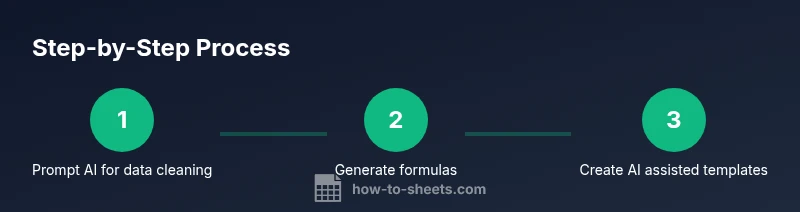
Data quality is the backbone of reliable analysis. Gemini AI can help trim whitespace, normalize case, fix date formats, and deduplicate records across large sheets. Start by identifying inconsistent categories or misspelled entries, then let AI propose standard forms. For example, you can prompt the AI to standardize product names and fill missing dates with a reasonable default. Always validate AI suggestions before applying them to the dataset to prevent unintended changes.
Smart formulas and data transformations
Beyond cleaning, Gemini AI can generate formulas that perform complex transformations. Ask it to compute running totals, create dynamic filters, or produce conditional aggregations. For instance, you can request a formula that sums sales by month with a dynamic date range, or an array formula that spills results across multiple cells. Inline code examples include simple patterns like =SUMIFS(Sales!C:C, Sales!A:A, "West") and more advanced patterns such as =LET(x, FILTER(Sales!B:B, Sales!A:A>DATEVALUE("2024-01-01")), SUM(x)).
Building dashboards and templates with AI
AI powered templates can accelerate recurring work like monthly budgets, project trackers, or client dashboards. Use Gemini AI to draft the layout, populate sample data, and generate charts that adapt when you replace data. Save the output as a template sheet that your team can copy, then use AI to refresh the data and visuals on demand. This approach reduces setup time and helps non-technical team members contribute meaningfully.
Collaboration and governance considerations
As teams share AI generated work, it is important to establish governance rules. Define who can run AI operations on sensitive datasets, require review steps for critical outputs, and maintain versioned copies before AI edits. Document AI prompts used for transparency and compliance. For distributed teams, consider creating a centralized AI assisted template library to ensure consistency across projects.
Real world workflows case studies (fictional)
In a marketing team, Gemini AI helps summarize campaign data and generate a dashboard for weekly reviews. In a finance team, AI proposes a budget template and populates categories based on past data, then highlights variances. These examples illustrate how AI can complement human judgment with rapid, repeatable insights.
Common pitfalls and troubleshooting
Potential issues include misinterpretation of prompts, overreliance on AI outputs, and handling very large datasets that exceed AI processing limits. Start with small data slices, validate results, and iterate prompts. If AI responses seem off, rephrase the prompt with clearer constraints or isolate the data to a smaller range. Regularly back up work before applying AI edits and keep a changelog.
Measuring success and iterating
Track improvements in speed, accuracy, and collaboration quality after enabling Gemini AI in Sheets. Use baseline checks for key tasks such as data cleaning time and formula accuracy, then compare against AI assisted runs. Iterate prompts, adjust templates, and update governance rules as your team learns what works best.
Tools & Materials
- Google account with access to Gemini AI features(Ensure you are on a compatible Workspace plan)
- A sample Google Sheet with data(Start with a clean dataset to test AI features)
- Stable internet connection(Prefer wired or reliable WiFi)
- Optional: AI templates or add-ons(For pre-built templates and prompts)
Steps
Estimated time: 60-90 minutes
- 1
Open Google Sheets and locate Gemini AI features
Launch a new or existing sheet and check the AI assist panel in the toolbar. This sets up the workspace for AI driven actions.
Tip: If you do not see AI options, update Sheets or ask your admin to enable features. - 2
Enable AI features for your Google account
Follow in-app prompts or admin guidance to activate Gemini AI capabilities within Sheets.
Tip: Verify permissions and data access policies before enabling. - 3
Test a natural language query
Ask a simple question like summarize sales by region to see how AI responds and returns results.
Tip: Keep prompts concise and iterate with follow up questions. - 4
Generate a helpful formula
Request AI to create a formula for a common task such as a running total or conditional sum.
Tip: Review the generated formula for edge cases and adjust ranges. - 5
Create an AI assisted template
Prompt AI to draft a budget or dashboard template and save as a reusable sheet.
Tip: Name the template clearly and document inputs. - 6
Validate and version control
Compare AI results with manual calculations on a sample subset and save a version before applying changes.
Tip: Maintain a changelog for transparency.
FAQ
What is Gemini AI and how does it integrate with Google Sheets?
Gemini AI is Google's AI model family integrated into Sheets to assist with queries, data cleaning, and template generation. It reduces manual work while empowering rapid experimentation.
Gemini AI brings AI into Sheets to help you ask questions and automate tasks without heavy coding.
Do I need a special Google Workspace plan to use Gemini AI in Sheets?
Access depends on feature availability. Check with your admin and look for AI feature prompts within Sheets to determine eligibility.
Check with your admin to see if AI features are available in your plan.
What tasks can Gemini AI handle in Sheets?
It can clean data, propose formulas, summarize datasets, generate charts, and help build AI assisted templates.
It can clean data and generate formulas, plus summaries and visuals.
Is AI output always reliable in Sheets?
AI outputs should be reviewed, cross checked, and validated before critical decisions or public sharing.
Always verify AI results before acting on them.
How can I protect sensitive data when using Gemini AI?
Limit exposure, anonymize inputs, and follow your organization privacy guidelines for AI tools.
Be mindful of what you feed into AI and sanitize data where possible.
What are best practices for debugging AI generated formulas?
Test AI generated formulas on small datasets, compare with manual results, and version control changes.
Test on small sets and keep versions for safety.
Watch Video
The Essentials
- Leverage natural language prompts to speed up tasks.
- Validate AI outputs before sharing with stakeholders.
- Use AI driven templates to save time on recurring work.
- Protect sensitive data through anonymization and governance.