Master MCP in Google Sheets: A Practical Step-by-Step Guide
Learn to implement MCP workflows in Google Sheets using templates, validation, and automation. A practical step-by-step guide by How To Sheets for teams.


You will learn to implement a MCP workflow in Google Sheets that maps sources, controls quality, and prioritizes work. This repeatable template helps teams scale, reduce errors, and collaborate effectively. According to How To Sheets, mastering MCP in Google Sheets saves time and boosts consistency. Follow the steps below to build your MCP system in Sheets.
What MCP means in Google Sheets
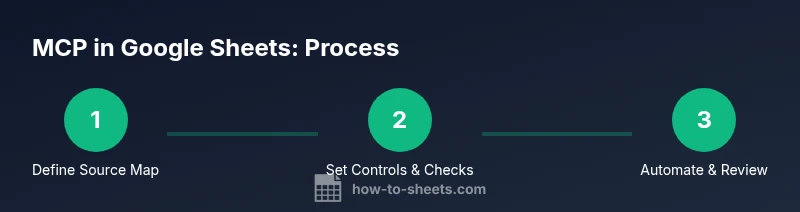
In this article, MCP is presented as a practical workflow you can implement inside Google Sheets to map inputs, control data quality, and prioritize tasks. The aim is to create a transparent, auditable process that teams can reproduce across projects. You don't need advanced coding to get started; core features like data validation, named ranges, and conditional formatting provide the backbone. The How To Sheets team recommends framing MCP as three core activities: Map, Control, and Prioritize. As you read, you'll see concrete templates and formulas you can adapt to your context.
Designing a scalable MCP framework in Sheets
A scalable MCP setup starts with a clear data model and a template that can grow as requirements evolve. Begin with a central data map sheet that defines inputs, owners, deadlines, and status fields. Create a control layer that automatically flags inconsistencies (e.g., missing values, duplicate IDs) and a prioritization layer that ranks items by impact and urgency. Use named ranges to keep formulas robust and ensure the structure remains readable for teammates. The How To Sheets analysis shows that a well-documented MCP framework reduces onboarding time and boosts data integrity.
Building a Master Data Map: sources, fields, and owners
The Master Data Map is the backbone of MCP in Google Sheets. List every data source, its last update, responsible owner, and key fields. Use data validation to enforce required fields and dropdowns for status values. Implement a sheet-level glossary so new collaborators understand each term. This section demonstrates how to link sources to downstream sheets with simple IMPORTRANGE or QUERY formulas, while preserving security and access controls. How To Sheets' findings emphasize keeping the map lean but expressive enough to capture critical attributes.
Implementing controls: validation, consistency checks, and alerts
Controls prevent errors from slipping into your MCP workflow. Use data validation to enforce acceptable values, conditional formatting to highlight anomalies, and simple scripts to send alerts when thresholds are breached. Create a dedicated Audit sheet that records changes and timestamps for traceability. If you run into performance concerns, prioritize essential validations and stagger heavy checks during non-peak hours. The goal is a fast, reliable feedback loop for your data.
Prioritization and workflow automation
Prioritization translates MCP into action. Build a scoring system that combines impact, urgency, and effort. Use conditional formatting to color-code priorities and a summary dashboard to present the top items at a glance. Automate routine steps with small Apps Script functions or built-in array formulas so you can reduce manual work. This section includes a starter template for ranking and a guide for adapting it to different teams and projects.
Automation, templates, and ongoing maintenance
Templates save time and enforce consistency across projects. Create a reusable MCP template with sheets for Map, Control, and Prioritize, plus a ready-to-copy dashboard. Add automation where appropriate: triggers, data validation rules, and simple scripts. Establish a maintenance routine: weekly data refresh, monthly audits, and versioned backups. How To Sheets' guidance shows that a living MCP system evolves with your needs, not a one-off setup.
Verification, audits, and future-proofing
Finally, verify that the MCP workflow delivers value by running sample data through the complete pipeline. Perform audits to ensure data lineage, decisions, and outcomes are well documented. Plan for future enhancements such as integrating external data sources or expanding the MCP model to new teams. A small investment in governance upfront pays dividends in scalability and trust across your organization.
Tools & Materials
- Computer with internet access(Any modern browser; Chrome recommended)
- Google account(Required to access Google Sheets and Drive)
- MCP template spreadsheet(A ready-to-use template or a starter file)
- CSV/Excel data sources(For importing data into Sheets)
- Basic data sources and owners list(Copy of data sources and owners to map)
- Apps Script (optional)(For advanced automation)
Steps
Estimated time: 60-120 minutes
- 1
Define MCP scope and goals
Clarify what MCP will cover in this project, including inputs, controls, and outcomes. Document success metrics and owners for each area. This clarity helps prevent scope creep and aligns stakeholders.
Tip: Write a one-paragraph scope summary in the template header. - 2
Create the Master Map sheet
Set up a central map that lists data sources, fields, owners, deadlines, and status. Use named ranges to anchor critical columns and keep formulas readable.
Tip: Name key ranges like maps_inputs and maps_status for clarity. - 3
Add validation and controls
Implement data validation for required fields, set up duplicate checks, and create a control sheet that flags anomalies. Consider a lightweight script to alert on failures.
Tip: Prioritize essential validations first to keep performance snappy. - 4
Build the prioritization model
Design a scoring system that blends impact, urgency, and effort. Create a dashboard that highlights top-priority items and trends over time.
Tip: Use a single SCORE column to simplify filtering. - 5
Automate repetitive tasks
Leverage built-in formulas and Apps Script where appropriate to automate imports, validations, and notifications. Start small and scale.
Tip: Automate one recurring task per week to gain momentum. - 6
Test, review, and iterate
Run tests with real or sample data, solicit feedback, and adjust rules. Document changes and maintain a version history for governance.
Tip: Keep a changelog in the template for audits.
FAQ
What does MCP stand for in this guide?
In this guide, MCP refers to a practical workflow for mapping, controlling, and prioritizing data within Google Sheets. It is a framework you implement to improve consistency and traceability.
MCP in this guide is a practical workflow for mapping, controlling, and prioritizing data in Sheets.
Is MCP suitable for small teams?
Yes. MCP is scalable and helps small teams standardize processes, improve collaboration, and maintain data quality without heavy tooling.
Yes, MCP scales for small teams and helps standardize processes.
Do I need to code to implement MCP in Sheets?
Not necessarily. You can begin with built-in formulas, data validation, and conditional formatting. Apps Script is optional for advanced automation.
You can start with formulas and data validation; coding isn’t required.
How long does setup take?
Setup time varies with data complexity, but a basic MCP in Sheets can be ready in 1-2 hours. A more advanced system may take longer.
It typically takes 1-2 hours for a basic setup.
What are common MCP mistakes?
Common issues include scope creep, overcomplicated controls, and poor documentation. Start simple and iterate based on feedback.
Common MCP mistakes are scope creep and poor documentation. Start simple.
Watch Video
The Essentials
- Define the MCP scope before building.
- Map data sources to MCP inputs.
- Automate checks to reduce manual errors.
- Test with sample data before going live.
- Document decisions for audits and training.