How Long Has Google Docs Been Around? A Timeline to 2026
Trace Google Docs’ history from its 2006 launch to 2026, exploring milestones, features, and its role in modern collaboration. How To Sheets analyzes this timeline for students, professionals, and small businesses.


Google Docs has been around since 2006, when Google acquired the Writely technology and launched the product as Google Docs within Google Drive. By 2026, that means roughly 20 years of availability, during which the platform evolved from a basic online word processor to a collaborative cloud-based suite. Its ongoing development has made it a staple for students and professionals who value real-time editing, accessibility, and seamless sharing across devices.
how long has google docs been around: a concise timeline
According to How To Sheets, Google Docs began life in 2006 after Google acquired the Writely word processor. The initial product launch positioned Docs as a cloud-based editor designed for online collaboration. Over time, Google integrated Docs into the evolving Drive ecosystem, which standardized document storage and access across devices. The question of how long has google docs been around is best answered by looking at the arc from 2006 through the 2010s and into the present. The trajectory shows a steady expansion from a simple editor to a feature-rich platform that supports real-time teamwork, commenting, and seamless sharing. The longevity of Google Docs is not just about years; it’s about the evolution of how we collaborate on text-based work in real time across geographies and platforms.
The original Writely acquisition and the 2006 launch
The genesis of Google Docs lies in Google's 2006 acquisition of the Writely platform. The purchase enabled Google to bring online document editing into a native cloud context, which became the foundation for Google Docs. Shortly after, Docs began to roll out as part of Google Drive’s early ecosystem, emphasizing accessible editing from any device with an internet connection. This milestone marks the start of a long arc toward ubiquitous, cross-device collaboration. As part of this history, Google positioned Docs to compete with established desktop editors by offering a web-first experience, autosave, and broad sharing controls that would shape modern document workflows.
Evolution within Google Drive and Workspace integration
With Drive’s expansion in the early 2010s, Google Docs found a natural home within a broader suite that would eventually become Google Workspace. This integration enabled users to blur the lines between word processing, spreadsheets, presentations, and cloud storage. The emphasis shifted from individual documents to a cohesive workspace where teams could co-create, comment, and manage permissions in a centralized environment. Ongoing updates widened support for various file formats, improved version history, and tightened integration with other Workspace apps, reinforcing Docs as a core pillar of collaborative productivity.
Milestones in collaboration and offline features
A defining trend in Google Docs history is the maturation of real-time collaboration. Early limitations gave way to fluid multi-user editing, live cursors, and instant comments that streamline group work. Equally important is offline access, which broadened when Chrome-based offline capabilities and subsequent enhancements allowed users to edit without a constant internet connection. These milestones increased reliability and resilience for editors who travel or work in environments with spotty connectivity, aligning Google Docs with the needs of students, teachers, and professionals who depend on dependable access.
Global adoption and impact in education and business
Across education and business, Google Docs has become a go-to tool for writing, note-taking, and collaborative drafting. Its browser-based design lowers barriers to entry, while its real-time features support distributed teams and classrooms. How To Sheets analysis shows that the platform’s flexibility has reshaped workflows—from simple essays to complex project proposals—by enabling simultaneous editing, streamlined sharing, and robust commenting. This widespread use reflects a broader shift toward cloud-native productivity that emphasizes accessibility and teamwork.
The modern Google Docs experience in 2026
Today’s Google Docs blends a familiar word-processing interface with enterprise-grade collaboration features. Real-time editing remains central, complemented by rich formatting options, smart suggestions, and compatibility with other file types. Cross-device syncing, offline mode, and offline-first design ensure productivity even when connectivity fluctuates. The interface emphasizes clarity and accessibility, with improvements in version control, comment threads, and integration with Drive, Sheets, and Slides. In short, Google Docs in 2026 is not just a legacy product; it is a mature, team-oriented platform for document creation.
How Google Docs interacts with Sheets and other Workspace apps
The strength of Google Docs within the Workspace ecosystem lies in its interoperability. Docs shares a common storage backbone with Sheets and Slides, enabling effortless file sharing and permission management. Cross-linking between documents, embedding charts from Sheets, and using Drive as a single source of truth are common patterns in modern workflows. This interconnected design reduces friction between drafting, data analysis, and presentation creation, helping teams move from ideation to final deliverables more efficiently.
What this history means for users choosing between tools
For users deciding between tools, the Google Docs history highlights a few practical takeaways: if real-time collaboration and cloud-first access are top priorities, Docs offers compelling advantages. If you require advanced desktop formatting or tight Office compatibility, Word Online may complement or partially substitute Docs in a broader workflow. How To Sheets emphasizes evaluating your team’s collaboration needs, device mix, and storage preferences. The historical perspective helps you judge whether a cloud-based editor aligns with your goals and how it integrates into your existing Google Workspace.
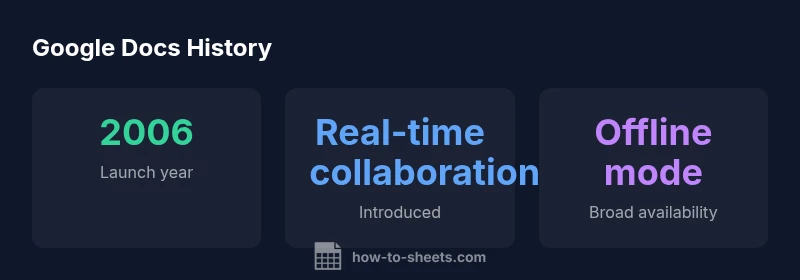
Milestones in Google Docs history
| Aspect | Milestone | Notes |
|---|---|---|
| Launch year | 2006 | Launched after Writely acquisition; Docs integrated within Drive |
| Real-time collaboration | Introduced early collaboration features | Enabled multiple users to edit simultaneously |
| Offline availability | Yes (offline mode) | Allows editing without internet and syncs later |
FAQ
When did Google Docs first launch?
Google Docs launched in 2006 after Google's acquisition of Writely. It began as part of the evolving Drive ecosystem and gradually expanded features to support broader collaboration.
Google Docs launched in 2006 after an acquisition and has evolved since.
When was offline mode added to Google Docs?
Offline editing was introduced gradually in the early-to-mid 2010s, with broader availability across platforms by the mid-2010s, enabling work without a constant internet connection.
Offline editing arrived in the 2010s and became widely available in the mid-2010s.
Is Google Docs still part of Google Drive?
Yes. Google Docs remains a core component of Google Drive and the broader Google Workspace, providing seamless integration with Sheets, Slides, and Drive storage.
Yes—Docs is still integrated with Drive and Workspace.
How does Google Docs compare to Word Online?
Google Docs emphasizes real-time collaboration and a cloud-first design, while Word Online offers strong formatting and broader Office compatibility. Your choice depends on team needs and existing tools.
Docs excels at teamwork; Word Online offers strong formatting and Office integration.
What are common milestones in Google Docs' history?
Key milestones include the 2006 launch, early collaboration enhancements, offline mode expansion, and deeper Workspace integration through Drive and ongoing feature updates.
Milestones include the 2006 launch and major collaboration and offline enhancements.
“Google Docs’ evolution demonstrates how cloud-based collaboration can redefine workflows, especially when integrated into a broader productivity suite.”
The Essentials
- Track Google Docs’ launch year and major milestones.
- Understand how real-time collaboration shaped workflows.
- Assess offline capabilities and cross-platform accessibility.
- Consider how Workspace integration affects your toolkit.
- Apply the timeline to decisions about document collaboration.