How to Make a Title on Google Sheets: A Practical Guide
Learn how to craft clear, consistent titles in Google Sheets with a reusable template, capitalization rules, and practical examples. This step-by-step guide covers planning, formatting, and testing titles for headers, reports, and exports.


You will learn how to create a clear, consistent title in Google Sheets that works across headers, folders, and exports. The guide covers capitalization, length limits, punctuation, and naming conventions; how to apply a reusable title template; and quick tests to ensure titles render correctly in print, PDFs, and web exports. Gather your sheet, a style guide, and a naming plan.
What makes a good title in Google Sheets
A strong title communicates the sheet’s purpose at a glance, supports search and organization, and remains legible in printed or exported formats. When you craft a title for Google Sheets, you must balance brevity with specificity. The exact phrase 'how to make a title on google sheets' should appear naturally in the content to reinforce the topic, but avoid stuffing. According to How To Sheets, a good title starts with the core task, adds scope (who or what), and uses consistent punctuation. In practice you’ll aim for a few well-chosen words that describe the sheet’s function, followed by optional metadata like project name, date, or version. This approach helps you locate, filter, and share data quickly, whether you’re reviewing a budget workbook, a project tracker, or a client list.
Key qualities of a strong title include: clarity, brevity, and relevance. Clarity means readers immediately grasp the sheet’s purpose; brevity keeps the title scannable; relevance ensures terms match users’ search queries. Use nouns that reflect the data, and pick action-oriented phrases when the sheet drives a process (e.g., 'Monthly Budget - 2026'). Avoid vague words such as 'stuff' or 'misc'. For accessibility, avoid all-caps titles and excessive punctuation. Finally, decide on a naming convention early and apply it consistently across the workbook to reduce confusion during sharing or exporting. This section establishes the foundation for the rest of the guide and demonstrates practical thinking about how users will navigate their Google Sheets collections.
Title style rules: capitalization, punctuation, and length
Titles should be easy to read at a glance. Establish a capitalization convention and apply it consistently. A common choice is Title Case for major words, while articles and conjunctions stay lower case unless they start the title. Punctuation should be used sparingly; avoid trailing punctuation, and use separators like " - " or " | " only when they clearly separate concepts. Length matters for readability: aim for a concise phrase that conveys purpose without becoming unwieldy. If a title becomes long due to multiple qualifiers, consider splitting the information into a subtitle or a separate sheet name with a clear prefix. In Google Sheets, longer titles can wrap, which sometimes helps in navigation but can hinder export layouts. Test how titles render when printed, exported to PDF, or exported to CSV to ensure they remain legible. Finally, maintain consistency with any existing style guide your team uses. This reduces cognitive load for you and others who work with the workbook.
How to design a reusable title template
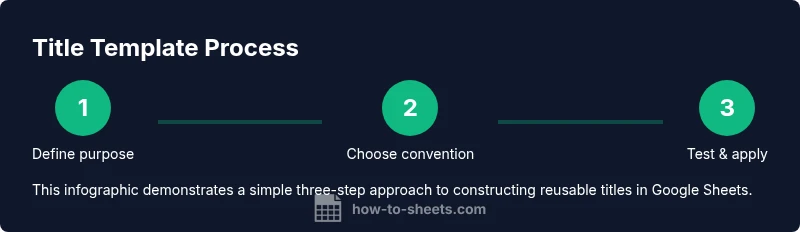
Start with a minimal, scalable structure such as Domain - Project - Period and allow placeholders for dynamic values. Create a template row or a named range that you can copy into new sheets. Build a small library of prefixes (e.g., 'Budget', 'Sales', 'Inventory') and suffixes (e.g., 'Q1', '2026', 'Final'). Use separators consistently. Document the rules in a single style guide sheet within the workbook so new contributors can follow them. If you publish the workbook externally, include a README with the naming convention. For automation, you can implement a simple formula in a helper cell that assembles the title from fields such as A2, B2, and C2, ensuring the final title adheres to your standard. After establishing the template, review and adjust to fit your real-use cases, whether a daily log or quarterly report.
Practical examples: applying titles in headers and exports
- Example 1: Sales Report - Q3 2026
- Example 2: Inventory Log - 2026-04
- Example 3: Customer List - 2026-FirstRun
These examples illustrate how prefixes, periods, and versioning can live together without creating noise. When exporting to PDF or sharing as a link, ensure the title remains meaningful in the output context and that any wrapping does not obscure critical details. Use consistent separators and avoid mixing date formats in the same workbook. Practice with a small dataset first to confirm readability across screens and print layouts.
Common mistakes and how to avoid them
Common errors include using all caps, inconsistent separators, and mixing date formats (e.g., YYYY-MM-DD in one sheet and MM/DD/YYYY in another). Don’t stuff too many qualifiers into a single title; if necessary, move extra metadata into a subtitle or a dedicated metadata sheet. Ensure every new sheet follows the same naming convention, so users can locate data quickly. Finally, test titles in real export contexts—print previews and PDFs often reveal readability issues that aren’t obvious on screen.
Authoritative sources
- https://www.loc.gov
- https://www.osha.gov
- https://www.nap.edu
Tools & Materials
- Computer with internet access(Essential for accessing Google Sheets and templates)
- Google account(Needed to create, edit, and share Sheets)
- Active Google Sheets file(Use a workbook you’ll standardize titles in)
- Style guide or naming template(A single source of truth for capitalization and separators)
- Sample data or mock workbook(Helpful for testing titles with realistic content)
Steps
Estimated time: 30-45 minutes
- 1
Define the title’s purpose
Identify the sheet’s primary function and audience. Draft a one-line description that captures what the sheet tracks or analyzes. This ensures the title signals the right context to collaborators.
Tip: Write the purpose first, then build the title around it. - 2
Choose a naming convention
Decide on a consistent structure (prefix - project - period) and commit to it. Document the format on a dedicated style sheet so everyone uses the same pattern.
Tip: Use a fixed order for all sheets and stick to separators you define. - 3
Decide on capitalization
Pick a capitalization rule (e.g., Title Case for major words). Apply it uniformly to all sheets to improve scan-ability and professionalism.
Tip: Avoid all-caps; it’s harder to read and can look loud in exports. - 4
Draft the template title
Create a base title using placeholders (e.g., Domain - Project - Period). Ensure the placeholders map to real values in your sheets.
Tip: Keep the base stable; only replace placeholders with actual data when creating a new sheet. - 5
Create a header row or named template
Implement the title as a header in the sheet or as a named template so new sheets inherit the same title pattern automatically.
Tip: Use a named range to refer to the title in formulas or scripts. - 6
Test across contexts
Check how titles render when printing, exporting to PDF, or sharing as a link. Adjust length or punctuation if wrapping interferes with readability.
Tip: Preview every export type you expect to use and refine accordingly.
FAQ
What makes a good title in Google Sheets?
A good title clearly conveys the sheet’s purpose, uses consistent formatting, and remains readable in all contexts (screen, print, export). It should be concise, descriptive, and aligned with your naming convention.
A good title clearly shows what the sheet tracks and follows a consistent format across the workbook.
Should titles include dates or versions?
Including date or version information helps with version control and export history. Keep date formats consistent and avoid overloading the title with too many qualifiers.
Dates help track history, but keep the format consistent across sheets.
How long should a title be?
Aim for a concise phrase that communicates purpose without becoming unwieldy. If needed, move extra metadata to a subtitle or a metadata sheet.
Keep it short and meaningful; use subtitles for extra details.
Can I reuse titles across multiple sheets?
Yes. A well-designed template makes it easy to apply the same structure to multiple sheets while keeping each title unique via placeholders.
Yes, reuse a stable template and fill with specific data.
How do I apply a title automatically?
You can assemble the title from sheet fields with a simple formula or script, then set the final string to a cell or a named range for consistent usage.
Use a small formula to build the title from data fields.
Watch Video
The Essentials
- Define a clear purpose for every sheet title
- Adopt a consistent naming convention
- Apply standardized capitalization and punctuation
- Test titles in export and print contexts
- Document and reuse the title template