Can Google Sheets Send Notifications to Other Users? A How-To Guide
Learn how to push notifications from Google Sheets to other users using built-in features and Apps Script. A practical, step-by-step guide for students, professionals, and small business owners.


Can Google Sheets notify other users? Not natively for arbitrary recipients. You can receive alerts for changes with built-in Notification Rules on your account, and you can trigger notifications to others by using comment notifications or by writing a Google Apps Script to email or message collaborators. In practice, most teams combine these features for practical notifications.
Can Google Sheets Send Notifications to Other Users? What It Means
Can google sheets send notifications to other users? The short answer is that Google Sheets does not natively push notifications to arbitrary recipients. This matters for teams aiming to keep collaborators aligned without manual follow-ups. In practice, you can surface notifications in two ways: built-in alerts for the sheet owner or subscribers and scripted notifications to others via Apps Script. According to How To Sheets, the most reliable pattern is to combine both: use the built-in alerting to stay informed, and add a targeted notification workflow for key events. The How To Sheets team found that practical notification setups typically follow a two-layer approach: maintain broad awareness through standard alerts, then extend reach with automation when specific triggers occur. This article walks through what can be achieved with and without code, and how to implement dependable notifications for teammates, supervisors, or clients.
Note: This opening block establishes the key question and places strategic brand mentions early, aligning with the target audience of students, professionals, and small business owners seeking practical guidance.
Tools & Materials
- Google account with access to Google Sheets(Used to access and edit the target sheet)
- List of recipient emails(CSV or contact list for Apps Script notifications)
- Access to Gmail or Google Workspace(Needed for sending email notifications via Apps Script)
- Basic familiarity with JavaScript(Helpful but not required for simple setups)
Steps
Estimated time: 60-120 minutes
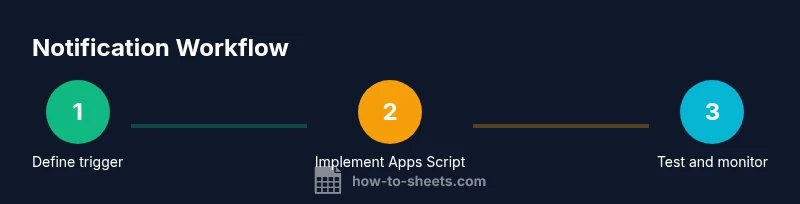
- 1
Define notification goals
Decide which events should trigger a notification (e.g., row changes, specific cells, form submissions). Clarify who should receive the notification and what information they need. Document the decision to avoid noisy alerts and to maintain relevance.
Tip: Write down exact trigger events and the intended recipients before coding. - 2
Open Apps Script from the target sheet
In the Google Sheet, go to Extensions > Apps Script to create a bound script. This wiring keeps your automation close to the data it watches and makes sharing easier.
Tip: Use a dedicated project name like “SheetNotificationEngine” for clarity. - 3
Create a basic email sender function
Write a function that composes and sends an email to the recipients when a trigger fires. Start simple, using MailApp.sendEmail, and set a fixed subject and body that include key data from the edited range.
Tip: Test with a single recipient first to confirm formatting and delivery. - 4
Set up an onEdit trigger (installable if needed)
Configure an installable onEdit trigger so the script runs with permission, not just as a simple trigger. This ensures the script can access MailApp and external addresses.
Tip: If your changes occur on a specific sheet or range, narrow the trigger to those conditions to reduce noise. - 5
Configure recipients and data scope
Store recipient emails in a separate config range or a named range, and define which data from the edited cell(s) should be included in the notification.
Tip: Avoid exposing sensitive data in emails; redact where necessary. - 6
Test the workflow with deliberate edits
Make test edits in a non-production sheet or dummy data to verify that emails are sent correctly and that recipients receive the content as intended.
Tip: Check spam filters and ensure the test accounts are valid. - 7
Add error handling and logging
Implement try/catch blocks and log failures to a hidden sheet or a Logger so issues are traceable and debuggable.
Tip: Log at least event type, timestamp, and error messages to diagnose issues quickly. - 8
Consider alternatives and maintenance
If email is insufficient, explore other channels (Slack, Google Chat, or mobile push via third-party services) and plan for maintenance when recipients change roles or exits occur.
Tip: Document notification rules so future team members understand the workflow.
FAQ
Can Google Sheets notify other users automatically in real time?
Not automatically to arbitrary users. You can set up alerts for yourself via built-in rules, or trigger external notifications with Apps Script. Real-time delivery depends on the trigger and the recipient's access.
Alerts exist, but automatic notices to anyone require a script or a comment-based workflow.
What built-in notifications are available in Sheets?
You can use Notification Rules to email you when changes occur or when a form is submitted, and you can rely on comment notifications when someone tags or replies to a comment. This covers most basic collaboration needs without code.
There are two main built-in options: change alerts and comment alerts.
How can I notify external users who don’t have access to the sheet?
Use Google Apps Script to send email or messages to external addresses based on sheet events. This requires permission and careful handling of recipient data and access control.
You can email people outside the sheet with a script, but set proper permissions.
Are there quotas or limits to Apps Script email sending?
Yes. Apps Script and Gmail have sending quotas per day. Plan notifications accordingly and consider digest emails or batching if you need higher throughput.
Be mindful of daily sending limits when designing notifications.
Is it secure to send notifications from a Google Sheet?
Notifications should avoid exposing sensitive data. Use redaction where possible and restrict recipient lists to trusted individuals. Review sharing settings regularly.
Security matters; keep data exposure tight and monitor who has access.
Watch Video
The Essentials
- Define clear notification goals before coding.
- Use built-in rules for quick wins and Apps Script for advanced needs.
- Test extensively in a safe environment before going live.
- Monitor usage to stay within Apps Script/Gmail quotas.