Google Sheets 00: Practical Step-by-Step Guide for Beginners
Learn to set up a reusable google sheets 00 starter: create a sheet, format, input data, apply basic formulas, and share securely. This practical guide helps students, professionals, and small business owners build repeatable spreadsheets.


In this guide you will learn how to set up a basic Google Sheets workflow named google sheets 00, including creating a new sheet, entering data, applying simple formulas, and sharing or protecting your work. You’ll need a Google account and access to Google Sheets, plus a plan for your data structure. This is a practical starter you can reuse.
Getting started with google sheets 00
To begin your google sheets 00 workflow, open Google Sheets in your browser and create a new blank spreadsheet. Give the file a clear, purposeful name such as google sheets 00 starter so it is easy to locate later. Set your locale and date format to match your data (for example USD currency and MM/DD/YYYY). Freeze the top row to keep headers visible as you scroll, and resize columns for readability. If you plan to reuse this as a template, consider creating a dedicated folder in Google Drive and enabling version history from the outset so you can revert changes if needed. This initial setup reduces friction later and establishes a consistent starting point for all future work. Assign a descriptive owner and share permissions at the file level rather than individual sheets to avoid accidental edits. Create a simple documentation sheet inside the same file that explains column purposes, data types, and any rules such as date formats. Finally, decide on a naming convention for new records such as YYYY-MM-DD for dates to support easy sorting and auditing.
Understanding the google sheets 00 interface
The Google Sheets interface is designed for quick data input and live collaboration. The main toolbar provides common actions, while the formula bar lets you enter calculations that update as you edit. The left panel shows your spreadsheet tabs and any linked data sources, and the right panel if visible can display comments, suggested edits, or data validation rules. For the google sheets 00 starter, focus on how headers map to data columns, how to freeze rows, and how to apply basic formatting to improve readability.
Data entry fundamentals and validation
Data quality starts at entry. Use headers, consistent data types such as text date or number, and validation to reduce errors. In your 00 starter, create a header row with clear names such as Date, Item, Quantity, Unit Price, and Total. Use Data validation to enforce allowed values or ranges such as dates in a valid date format and numbers for Quantity. Consider creating a drop down list for categorical fields like Category. This ensures uniform entries and makes downstream analysis easier. As you type, use the fill handle to copy formulas or formats across rows, which saves time and maintains consistency.
Basic formulas and functions you ll use
Begin with simple, reliable formulas to summarize data. SUM adds a numeric column; AVERAGE returns the mean; and COUNT counts non empty cells. Use SUMIF or COUNTIF to summarize data that meets a condition such as total sales for a given month. The IF function lets you implement simple rules such as if Quantity > 0 show Total otherwise show 0. For the 00 starter, create a running Total column that uses a straightforward formula like Quantity times Unit Price and then totals per row with a suitable sum. As you expand, your formulas can reference absolute and relative cell references to copy correctly across rows.
Sorting, filtering, and lightweight analytics
Sorting arranges data in a meaningful order, while filtering hides irrelevant rows. Teach the sheet to sort by Date or Category, and enable a basic filter view so others can explore without wrecking the master data. Add conditional formatting to highlight values that exceed thresholds such as high priority orders in red. Small charts such as a simple bar or line chart can reveal trends at a glance. For the google sheets 00 starter, keep charts in a separate sheet or a designated dashboard tab to avoid clutter. Remember to check data ranges before creating visuals to prevent broken links as you add new rows.
Collaboration and sharing basics
Google Sheets shines when teams collaborate in real time. Decide whether collaborators can edit, comment, or view only, and apply the principle of least privilege. Share via link or invite specific people by email. Use the Comment feature to discuss changes instead of editing directly, which keeps a record of decisions. Turn on version history so you can revert to an earlier state if someone makes a mistake. For the 00 starter, set a clear owner, add a short data dictionary sheet, and establish a simple review cycle such as weekly checks to maintain quality.
Templates and starter workflows
Templates save time by reusing formatting, data validation, and formulas. In Google Sheets, you can save your 00 starter as a template to reuse across projects or teams. Create a dedicated Template sheet with headers, example rows, and placeholder data. Show how to clone the file for a new dataset, or copy the relevant tabs to a new spreadsheet. You can also build lightweight workflows by linking the template to a simple intake form via Google Forms or by using the IMPORTRANGE function to pull consistent data from another sheet. Keeping a central template library helps ensure compliance with standards and reduces onboarding time for new users.
Troubleshooting common issues
Common issues include #REF!, #VALUE!, and #NAME? errors. These usually occur when a formula references a cell that was deleted, uses a wrong operator, or refers to a named range that does not exist. Start by checking parentheses and commas; ensure you are using the correct function syntax, and verify that cell references are correct when copying formulas. If you rely on external data via IMPORTRANGE, make sure access is granted and the range exists. For data validation, ensure the list range is correct and that the source data is not hidden. When things go wrong, use Version History to see recent changes and restore a working copy.
Reusing google sheets 00 as a template
Once you have a solid starter, convert it into a reusable template that others can copy. Make sure the header names, data types, and formulas adapt to different data sets. Create a separate Template folder, keep a README sheet describing field meanings, and document any constraints. When sharing, provide a link to the template rather than the raw file to control access. Periodically review and update the template to reflect best practices and new features in Google Sheets. A well maintained 00 starter saves hours in recurring tasks and ensures consistency across projects.
Tools & Materials
- Google account with Google Sheets access(Essential to create and edit sheets)
- Device with internet access(Laptop, tablet, or phone)
- Starter file or template (google sheets 00 starter)(Optional for personal use)
- Data dictionary sheet (within the file)(Helpful for teams)
Steps
Estimated time: 20-40 minutes
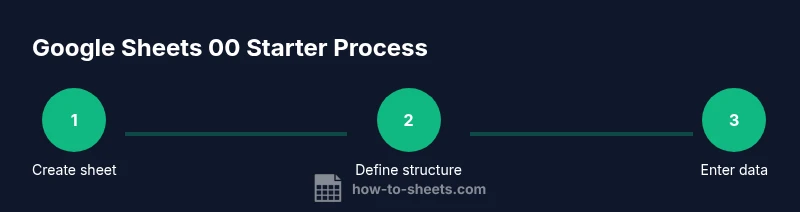
- 1
Open a new Google Sheets file and name it
Open Google Sheets, click on Blank to create a new spreadsheet, and rename the file to something descriptive like google sheets 00 starter so it is easy to find later. Enable version history for safety and accessibility.
Tip: Use a descriptive file name and enable version history from the start. - 2
Set up headers and data structure
Create a header row with clear column names (Date, Item, Quantity, Unit Price, Total). Freeze the header row, format headers with bold text, and adjust column widths to fit content. This minimizes data-entry errors later.
Tip: Freeze the header row so you can scroll without losing column labels. - 3
Enter data and apply basic formatting
Enter your initial data in rows beneath the headers. Use standard formats for dates and numbers, apply consistent alignment, and use alternating row colors for readability. Copy formatting with the paint format tool to save time.
Tip: Use the fill handle to propagate formulas or formats efficiently. - 4
Add basic calculations
Create a running Total column with a simple formula like =Quantity*Unit Price. At the bottom, use SUM to total the column or use a dynamic range with a named range if you expect growth.
Tip: Anchor references with $ when copying formulas across many rows. - 5
Share and protect your sheet
Decide who can edit, comment, or view. Share via email or link, and enable protection on sensitive ranges if needed. Turn on version history and establish a short review cycle for quality assurance.
Tip: Use comments for feedback to keep edits trackable.
FAQ
What is google sheets 00 and when should I use it?
Google Sheets 00 refers to a starter workflow for organizing data in Sheets. Use it when you need a clean, repeatable template for data entry, basic calculations, and sharing with collaborators.
Google Sheets 00 is a starter workflow for organizing data in Sheets. It’s useful when you need a clean, repeatable template for data entry and simple calculations.
How do I start a google sheets 00 project from scratch?
Open a new Google Sheets file, enable version history, name the file clearly, set up headers, and enter initial data. Then add basic formulas and set sharing permissions as needed.
Open a new Sheets file, name it clearly, set up headers, enter data, and add basic formulas before sharing.
Can I share a google sheets 00 starter with teammates securely?
Yes. Use protected ranges, choose appropriate access levels (viewer, commenter, editor), and enable version history. Share with specific people when possible rather than using broad links.
Yes, share with specific people, set access levels, and keep version history enabled.
What are common mistakes to avoid with google sheets 00?
Avoid inconsistent data types, missing headers, hard-coded values in formulas, and unprotected ranges. Regularly review shared links and maintain a data dictionary.
Watch out for inconsistent data types, missing headers, and unprotected ranges; review shared links regularly.
Where can I find templates or examples for google sheets 00?
Look for template examples within Google Drive or the Sheets template gallery. You can also reuse your own starter as a template by duplicating the file and renaming it for new projects.
Check Google's built-in templates gallery or duplicate your starter for new projects.
Is google sheets 00 suitable for small business budgeting?
Yes, you can adapt the starter for budgeting by adding a dedicated expenses sheet and linking cells to summarize totals. Start with a simple budget template and expand as needed.
Yes, adapt it with a budget sheet and simple links to summarize totals.
Watch Video
The Essentials
- Define a clear data structure before entry
- Use headers and frozen panes for readability
- Apply basic formulas to summarize data quickly
- Control access with thoughtful sharing settings
- Leverage templates to standardize projects