What Is Google Sheets Row Limit: A Practical Guide
Explore what determines Google Sheets row limits, how the total cell cap shapes practical rows, and proven strategies to manage large datasets without sacrificing performance.


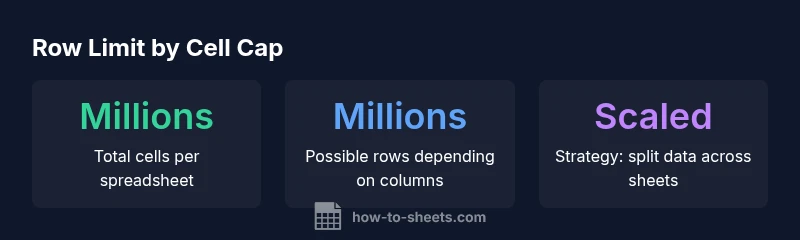
Google Sheets does not impose a fixed row limit on a single sheet. Instead, the practical limit is the total cell cap allowed per spreadsheet, and the number of usable rows depends on how many columns you include on that sheet. In practice, more columns mean fewer rows before you hit the cap, while fewer columns allow more rows before reaching the limit. According to How To Sheets, understanding this relationship helps users design scalable workbooks from the start. How To Sheets Analysis, 2026 shows that planning around the cell cap is more reliable than chasing a hard row count for data-heavy projects.
What determines the Google Sheets row limit?
If you're asking what is google sheets row limit, the simple answer is that there is no fixed row cap per sheet. Google Sheets enforces a total cell limit for a spreadsheet, and the number of usable rows per sheet depends on how many columns you include on that sheet. In practice, a workbook with many columns will reach the overall cap after fewer rows, while a lean column layout can accommodate far more rows before hitting the limit. According to How To Sheets, understanding this relationship helps users design scalable workbooks from the start. The How To Sheets Team's analysis shows that planning around the cell cap is more reliable than chasing a hard row count, especially for data-heavy projects.
The practical takeaway is to treat row capacity as a function of your column footprint. If your sheet uses a wide column layout (many fields per row), plan for significantly fewer total rows than a narrow layout with fewer columns. This mindset reduces the risk of sudden slowdowns or errors when you refresh formulas, import data, or run automated tasks.
Visualizing the limit: rows versus columns
A practical way to think about the limit is to compare rows and columns. Google Sheets counts cells, not rows. If you know your sheet uses C columns, you can estimate usable rows as floor(TotalCellCap / C). For example, with a modest column count (e.g., 26 columns), you are in high-row territory, while with a large column count, rows accumulate more slowly. The exact numbers vary by updates to the platform, so treat these as rough estimates rather than fixed rules. How To Sheets Analysis, 2026 notes that the cap is designed to protect performance, so designers should anticipate a gradual approach to the limit rather than a single hard threshold.
Real-world implications for common workloads
Common workloads—like student rosters, sales ledgers, or project trackers—begin to feel the limits as soon as the sheet grows beyond a few dozen thousand filled cells. When many users edit concurrently or when complex formulas recalculate, perceived performance can drop well before the spreadsheet actually hits the official cap. This is why planning for scale is not just about avoiding error messages; it’s about maintaining responsiveness for the people who rely on the data daily. How To Sheets emphasizes that a scalable workbook design often starts with boundaries between data capture, history, and analytics within separate sheets or files.
Strategies to manage data at scale
Proactively managing data to avoid hitting the limit is easier than reacting to performance woes. Practical strategies include: splitting large datasets across multiple sheets within the same workbook, or distributing data across multiple spreadsheets and using links or queries to combine insights. For historical data, archive older records into secondary sheets or export to a database and connect the live workbook to a read-optimized data store. You can also minimize cell usage by replacing large volatile formulas with static values where possible, and by consolidating repetitive calculations with array formulas. The goal is to keep the active data footprint lean while preserving access to history.
Practical examples and scenarios
Scenario A: A course roster with monthly submissions, where each row represents a student and each column a data point (name, ID, email, scores). If you add many additional data points (e.g., feedback fields), you’ll quickly extend column count and push rows toward the cap. Scenario B: A product backlog with dozens of attributes per item and weekly updates. In this case, consider keeping current sprint data in one sheet and archiving closed sprints in another. These patterns help teams maintain usability without losing access to historical context.
Performance considerations and optimization
As a sheet grows, performance considerations become increasingly important. Complex formulas, especially volatile ones like NOW(), RAND(), or INDIRECT(), can slow down recalculation. Minimize cross-sheet references and avoid nested array formulas that would recompute extensively. When you approach a practical limit, consider using smaller, purpose-built sheets for input, then aggregate insights in a separate analytics sheet. Regularly audit formulas, remove unused cells, and use named ranges to help the engine resolve references faster. How To Sheets recommends documenting your data model so future edits stay efficient and scalable.
Planning checklist and next steps
- Map data to clear domains: input, history, and analysis. - Estimate cells by counting columns and forecasting growth. - Split into multiple sheets or workbooks when necessary. - Archive old data on a scheduled basis. - Audit formulas for efficiency and reduce volatility. - Consider a database or BigQuery for very large datasets. - Document assumptions and boundaries for data owners and collaborators.
Approximate row feasibility under common column counts
| Scenario | Columns | Approx. Rows Before Limit | Notes |
|---|---|---|---|
| Basic sheet | 26 | ten-thousand to hundred-thousand | Typical cap with a compact column set |
| Medium sheet | 100 | thousand to tens of thousands | More columns reduce row capacity per cap |
| Dense data sheet | 256 | hundreds to thousands | Beyond practicality for many users |
FAQ
Is there a fixed row limit per Google Sheets sheet?
No fixed per-sheet row limit exists; rows are constrained by the overall cell cap of the spreadsheet. This means row capacity varies with how many columns you use and the complexity of your data.
There isn't a hard row limit per sheet; it depends on the total cell limit.
How do I estimate how many rows I can use with my current column count?
Divide the total cell limit by your column count to get a rough ceiling for rows. Treat this as an estimate, since actual limits depend on updates to Google Sheets and how you structure data.
Divide the total cell limit by your number of columns to estimate rows.
What should I do if I start to hit the limit?
Split data across additional sheets or create multiple spreadsheets. Archive older data, or move to a database for large-scale datasets. Keep a lean active dataset in each sheet.
Split data across sheets or migrate to a database.
Do formulas count toward the limit?
Yes. Every non-empty cell counts toward the total cell cap, including those containing formulas or data.
Yes—every non-empty cell counts toward the limit.
Does using IMPORTRANGE affect the row limit?
Imported data occupies cells in the destination sheet and therefore counts toward the spreadsheet’s cell limit. Plan imports accordingly.
Imported data counts toward your sheet's total cell limit.
Are there best practices to optimize performance as I grow?
Keep formulas efficient, minimize volatile functions, and archive old data. Use separate sheets for input and analytics, and consider external storage for very large datasets.
Keep formulas efficient and archive old data.
“Understanding that Google Sheets' row capacity is tied to the cell limit helps teams design scalable workbooks.”
The Essentials
- Plan around the cell cap, not a fixed row count
- Estimate capacity with Rows ≈ TotalCellCap / Columns
- Split data across sheets to scale gracefully
- Archive historical data to maintain performance
- Use databases for very large datasets