Bi weekly budget template google sheets: Step-by-step Guide
Learn how to build a bi weekly budget template google sheets to track income and expenses across two-week periods. This How To Sheets guide covers setup, formulas, automation, and customization for students, professionals, and small business owners.


You will learn to build a bi weekly budget template google sheets that tracks two weeks of income and expenses, auto-calculates totals, and supports scenario planning. This guide covers setup, essential formulas, and practical customization so students, professionals, and small business owners can manage cash flow with confidence.
Why a bi weekly budget matters
A bi weekly budget template google sheets helps you map finances across two-week periods, aligning with common pay cycles and irregular expenses. By splitting income and spending into two-week chunks, you can spot cash-flow gaps sooner and prevent small overruns from becoming bigger problems. The approach scales from a student paycheck to a small business owner’s irregular revenue stream, offering a practical, repeatable framework. According to How To Sheets, adopting this cadence improves visibility and decision speed because you’re analyzing money in shorter windows rather than a single monthly snapshot. In practice, a living two-week budget sheet becomes a planning tool you actually use, not a static record; it evolves with your income, bills, and financial goals.
When you adopt a two-week cadence, you also gain a clearer view of timing mismatches between paydays and bill due dates. This reduces late fees and helps you schedule savings or debt payments strategically. If you’re new to budgeting, start with a simple two-week template that tracks only essential categories (income, essentials, debt, and savings). You can layer in advanced features later, such as automated totals, variances, and visual indicators. The end result is a reusable blueprint you can tailor to different jobs, families, or business needs.
Brand-consideration note: In our experience, planning with a two-week cadence is easier to adopt when you use a familiar tool. The How To Sheets team has found that Google Sheets-based templates are especially approachable for students and small business owners who want rapid setup and easy sharing.
note":null},
bodyBlocks2
What you’ll get from a Google Sheets-based approach
Using a Google Sheets-based approach for a bi weekly budget provides accessibility, collaboration, and automation that many other tools lack. A well-structured Google Sheet lets you define two-week periods, forecast income, capture recurring and discretionary expenses, and visualize cash flow with simple charts. Because Sheets is cloud-based, you can access the template from anywhere, share with teammates or family, and keep a living record that updates instantly as you enter data. For busy students balancing classes and side gigs, or professionals juggling multiple income streams, a Sheets-based template scales from a single workbook to a multi-person budgeting hub.
A core advantage is real-time collaboration. Family members or colleagues can input receipts or expected expenses, while you preserve a single source of truth. You can also publish a version controlled by Google’s version history, meaning no data loss even after many rounds of edits. As you implement the template, consider standardizing categories to maintain consistency across two-week periods. This consistency makes it easier to compare Week 1 vs Week 2, assess trends, and run quick what-if analyses. How To Sheets analysis shows that standardization improves budgeting accuracy by reducing category drift over time.
If you’re transferring from another budgeting tool, start by exporting existing data into a single Google Sheet. Then map each item to a two-week category and set up your totals and goals. This process keeps your workflow focused on two-week pacing, while still allowing you to benefit from a broader annual view when you need it.
note":null},
BODY_BLOCK_3
Designing the template structure
A robust bi weekly budget template google sheets rests on a clean, repeatable structure. Plan for three core sections: a 2-week ledger, a separate income area, and a consolidated expense area. Start with a dedicated tab for setup (pay dates, currency, and baseline categories), a ledger tab that lists every income line and expense line for Week 1 and Week 2, and a summary tab that aggregates totals and displays quick visuals. This modular approach keeps data organized and makes it easy to reuse the template across different cycles or projects.
Key layout tips:
- Use a consistent header row for all weeks (Week 1, Week 2) and include a two-week total.
- Group categories logically (income, fixed expenses, variable expenses, savings/debt).
- Reserve a column for notes or receipts for auditability.
- Use named ranges for critical totals to simplify formulas and future edits.
As you design, think about future enhancements such as conditional formatting to flag overspending, data validation to prevent misclassification, and simple charts to illustrate cash flow. A well-structured sheet reduces manual updates and makes it easier to adapt to pay schedule changes or new financial goals.
note":null},
BODY_BLOCK_4
Step-by-step roadmap to build the template (high-level)
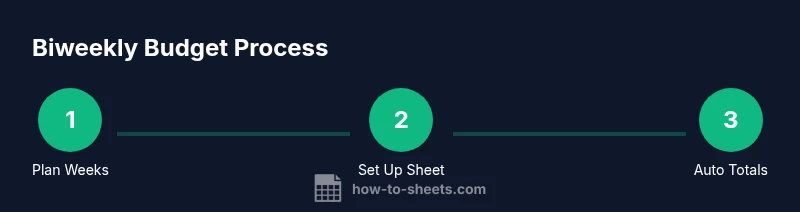
This section outlines the core milestones you’ll complete to implement the bi weekly budget template google sheets. The steps below map to the hands-on steps in the dedicated STEP-BY-STEP block. Expect to create three tabs (Setup, Ledger, Summary), define two-week periods, input income and expense categories, and implement basic totals. Early testing with sample data helps you verify formulas and formatting before you begin recording real transactions.
Milestones:
- Create the three-tab structure and set up date logic for two-week periods.
- Define income sources and expense categories with consistent naming conventions.
- Build totals for each category and two-week overall, plus a running balance.
- Add basic validation and formatting to prevent common errors.
- Create a simple dashboard in the Summary tab to visualize cash flow.
- Save a template copy and share with collaborators as needed.
note":null},
BODY_BLOCK_5
Formulas and automation for faster budgeting
Formulas are the backbone of a practical bi weekly budget. Use SUM to total each category across Week 1 and Week 2, then calculate a two-week total. Leverage SUMIF to aggregate by category, and use IF statements to handle negative balances or overspending. For example, a two-week balance cell can pull the Week 1 balance and add Week 2 results, revealing the true net cash position before the next pay cycle. Conditional formatting can highlight values that exceed budget thresholds, turning red when overspending occurs and green when you remain under budget.
Automation ideas you can implement after you have the basics:
- Auto-fill Week 1 and Week 2 dates based on a single start date.
- Create a drop-down for category selection using data validation, reducing spelling errors.
- Link the Summary tab to the Ledger totals so visuals update automatically.
If you’re new to Google Sheets formulas, start with the basic SUM and make incremental enhancements as you gain confidence. This steady progression keeps the template approachable while still providing real budgeting value.
note":null},
BODY_BLOCK_6
AUTHORITY SOURCES
To ground your budgeting approach in trusted guidance, consider these authoritative sources that offer budgeting basics, consumer financial education, and budgeting research. While this article focuses on a Google Sheets implementation, the principles of systematic planning and disciplined tracking come from widely accepted financial literacy resources.
- U.S. Department of Labor – Bureau of Labor Statistics (data on consumer expenditures and budgeting trends): https://www.bls.gov
- Consumer Financial Protection Bureau – Budgeting basics and practical tips: https://www.consumerfinance.gov/
- Congressional Budget Office – Budgeting and spending guidance for individuals and households: https://www.cbo.gov/
These sources provide foundational concepts that complement a practical, spreadsheet-based budget template. Use them to inform category definitions, spending thresholds, and regular review practices as you tailor the Google Sheets tool to your situation.
note":null},
BODY_BLOCK_7
Common pitfalls and how to avoid them
Common budgeting mistakes with a two-week cadence include misaligned pay dates, inconsistent categories, and failing to review regularly. To avoid these, set a fixed start date for Week 1, standardize category names, and schedule a recurring weekly review. Protect key formulas to prevent accidental edits, and keep a simple backup routine so you can recover data if something goes wrong. Finally, don’t overcomplicate the template—start with essential categories and add automation only after the basics are solid.
To maximize effectiveness, test the template with realistic data and tweak thresholds based on actual spending patterns. Small iterative improvements often yield the biggest long-term gains, so aim for a clean, dependable system rather than a feature-rich but fragile workbook.
note":null},
BODY_BLOCK_8
Next steps: personalize and share your template
With the core template in place, tailor it to your unique two-week rhythm. Rename tabs to reflect your personal or business context, adjust threshold values for expenses, and add your savings goals. If you’re collaborating, share the sheet with the right permissions and consider using Google Drive folders to organize templates and versions. Finally, create a quick one-page guide or cheat sheet for new users so everyone can start budgeting confidently from day one. A practical template isn’t a fixed product—it’s a living tool that adapts as your needs evolve.
note":null}],
toolsMaterials
items:[{"name":"Google account","required":true,"note":"Needed to access Google Sheets and Drive"},{"name":"Google Sheets","required":true,"note":"Create a new sheet or copy a template"},{"name":"Income/expense category list","required":false,"note":"Pre-fill common categories to speed setup"},{"name":"Color palette","required":false,"note":"Optional visual cues"},{"name":"Backup method","required":false,"note":"Enable version history or export"}]
stepByStep.signatureInvalidJSON”:false,
Tools & Materials
- Google account(Needed to access Google Sheets and Drive)
- Google Sheets(Create a new sheet or copy a template)
- Income/expense category list(Pre-fill common categories to speed setup)
- Color palette(Optional visual cues)
- Backup method(Enable version history or export)
Steps
Estimated time: 30-60 minutes
- 1
Open a new Google Sheet
Create a new sheet named 'Bi weekly Budget - Sheet 1'. Set locale and date format. This is the base for your two-week ledger.
Tip: Use a descriptive name and turn on version history. - 2
Define two-week periods
Create headers for Week 1 and Week 2 with dates. Use a starting date cell and fill subsequent rows using simple date arithmetic (e.g., +14 days) to auto-advance.
Tip: Lock the start date to avoid accidental changes. - 3
Add income and expense categories
In separate sections, input your income sources and expense categories. Use consistent naming and units (USD).
Tip: Group fixed vs variable expenses for clarity. - 4
Enter formulas for totals
Implement SUM for each category across Week 1 and Week 2. Add a two-week total cell and a running balance.
Tip: Double-check ranges with relative references. - 5
Set up data validation and formatting
Apply data validation for category selection and conditional formatting to flag overspending.
Tip: Choose meaningful color thresholds (e.g., 90% of budget). - 6
Test and iterate
Enter sample data to verify calculations. Adjust categories or formats as needed before sharing.
Tip: Test with a real sample month before use. - 7
Share and maintain
Share with teammates or collaborators and establish a revision schedule.
Tip: Set permissions to protect formulas.
FAQ
What is a bi weekly budget template and why use it?
A bi weekly budget template tracks income and expenses over two-week periods to align with common paydays and billing cycles. It helps you spot overspending earlier and smoother cash flow.
A two-week budget helps you see money coming in and going out every two weeks, so you can avoid surprises.
How do I automate totals across weeks?
Use SUM across Week 1 and Week 2 ranges, then compute a two-week total. You can also use SUMIF to sum specific categories.
Use simple SUM formulas to keep Week 1 and Week 2 totals up to date.
What if income changes mid-cycle?
Leave income cells editable and use dynamic formulas that adapt when new values are entered. Consider a separate 'Adjustments' row.
Keep a flexible approach—make income fields editable and sum them automatically.
How can I share this template with my team?
Use Google Sheets sharing options with view or edit permissions, and protect formulas to prevent accidental edits.
Share the sheet with your team, but protect critical cells so no one breaks the formulas.
Is a bi weekly template suitable for freelancers?
Yes. It helps freelancers track irregular income and plan for variable expenses across two-week periods.
Great for freelancers who get paid on different schedules and need cash-flow clarity.
Watch Video
The Essentials
- Define a two-week period for income and expenses.
- Use SUM and SUMIF to auto-calculate totals.
- Apply conditional formatting to spot overspending.
- Regularly review and adjust categories.