Budget Google Sheets Template Reddit: A Practical Guide
Learn how to build and customize a budget Google Sheets template inspired by Reddit discussions. Step-by-step guide, templates, dashboards, and best practices for students, professionals, and small businesses.


You're going to create a budget tracker in Google Sheets inspired by practical templates discussed on Reddit. This guide walks you through selecting a template, customizing categories, linking expenses, and building a simple dashboard. By the end you'll have a reusable budget sheet you can tailor to personal, student, or small-business needs.
Reddit-inspired budgeting: What makes it practical\n\nBudgeting templates discussed on Reddit tend to emphasize real-world usability: clean data structure, sensible categories, and dashboards that surface key metrics at a glance. In this guide we adapt those ideas to Google Sheets, focusing on a template you can customize without coding. The phrase budget google sheets template reddit often appears in community posts that compare layouts, collect user feedback, and share tips on avoiding common pitfalls such as duplicate entries, forgotten subscriptions, or overstated income. By incorporating these community-tested patterns, you’ll build a starter Budget sheet that’s easy to maintain, scales with your needs, and adapts to personal, student, or small-business contexts. The goal is not to copy a template wholesale, but to understand the design principles so you can tailor a solution that sticks.\n
Core features to include in a budget sheet\n\nA practical budget Google Sheets template Reddit readers often favor includes a transactions log, a categories map, and a dashboard to summarize performance. Start with a transactions sheet that records date, description, category, amount, and type (expense or income). A separate categories sheet keeps a searchable list and lets you define budget caps. The dashboard should show monthly income, expenses, savings, and a variance line against plan. Add sparklines or charts for visual tracking, and include a running total to show year-to-date progress. Finally, ensure you have validation rules so categories and amounts stay clean, and use named ranges for easy formulas. Together these features make the template robust, versatile, and ready for future tweaks.\n
Choosing between a pre-made template and building from scratch\n\nReddit communities often debate whether to start from an existing template or design from scratch. Pre-made templates save time and provide tested structures, but may require adaptation to your exact needs. Building from scratch offers maximum customization, yet can introduce setup complexity. A balanced approach is to start with a solid template, then replace or modify sheets, categories, and formulas to mirror your spending behavior. This reduces the risk of mistakes while preserving the learning benefits of customizing a tool you’ll use daily on Google Sheets.\n
Data structure and sheet organization\n\nOrganize your budget in clearly named sheets: Transactions, Categories, Budgets, and Dashboard. Use data validation to enforce entry types and restrict categories to a fixed list. Store recurring expenses in a separate table so you can project future months easily. Leverage named ranges for common data like your category list and monthly totals, which makes formulas easier to read and less error-prone. Keep a consistent date format and currency setting across the workbook to avoid drift. A clean data model reduces maintenance work and increases trust in your numbers.\n
Designing the dashboard and visuals\n\nA core reason to adopt a budget template is the dashboard that pulls data from the raw transactions table. Include a monthly summary with income, expenses, savings, and net balance. Use charts to show spending by category, trend lines for cash flow, and a sparkline to indicate month-over-month progress. Add a simple KPI banner at the top displaying your current month’s total income versus total expenses and the percentage of income saved. Make the dashboard responsive by using dynamic ranges and simple toggles to switch between months or categories. A well-crafted dashboard turns raw data into actionable insights at a glance.\n
Automations and data integrity\n\nAutomation helps you stay consistent without extra effort. Use formulas like SUMIF to aggregate transactions by category, and VLOOKUP or INDEX/MATCH to populate category labels from your categories table. If you want to automate data entry, consider a simple form-like sheet that feeds the Transactions log via Google Forms or a linked script. Set up conditional formatting to highlight overspending and unusual entries. For data integrity, enable protected ranges for critical formulas and restrict sharing so others can view but not alter core structures.\n
Customization for different audiences\n\nStudents might prioritize tuition, rent, groceries, and a part‑time income stream, with a focus on short-term tracking. Professionals may need project-based budgets, recurring subscriptions, and quarterly reviews. Small business owners might track cash flow, accounts receivable, and supplier payments. The template can accommodate these scenarios by adding dedicated sheets for bills, invoices, or loan payments. Start with a base budget and then tailor categories and dashboards to reflect your unique financial reality. The key is to keep the structure consistent so you can reuse it month after month.\n
Collaboration, permissions, and versioning\n\nGoogle Sheets makes collaboration straightforward, but budgeting data deserves careful permissioning. Create view-only access for stakeholders who don’t need to edit; grant edit rights to those responsible for data entry and analysis. Turn on version history so you can restore previous states if someone makes a mistake. Use comments to annotate changes and rationale. If you’re sharing publicly within a classroom or small team, consider duplicating the template per user to avoid cross-contamination of data and to preserve individual tracking.\n
Testing, maintenance, and long-term use\n\nAfter you set up the template, test it with a sample month to uncover edge cases (subsidies, refunds, and split bills). Check that totals align, charts update correctly, and the dashboard reflects the latest data. Schedule a monthly maintenance habit: review transactions, reconcile with receipts, and refresh the budget against real spending. Over time you’ll learn which categories to compress or expand and where dashboards gain clarity. A Reddit-inspired budget template thrives when you actively maintain and iterate based on your actual spending patterns.\n
Tools & Materials
- Computer or mobile device with internet access(Laptop, desktop, or tablet; ensure you can access Google Sheets)
- Google account(Needed to access Google Drive and Sheets)
- Google Sheets (access via Google Drive)(Use the web app for best editing experience)
- Pre-made budget template (optional)(Can seed your setup; replace categories as needed)
- Receipts or sample transaction data (optional)(Helpful for populating the first month and testing formulas)
- Notes on budgeting concepts (optional)(Guides for categories, cash flow, and dashboards)
Steps
Estimated time: 60-120 minutes
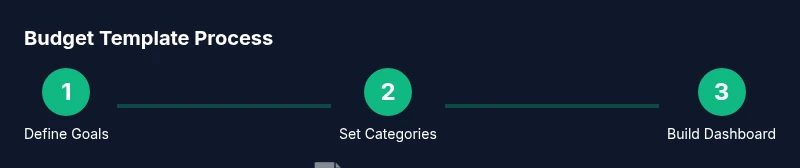
- 1
Define your budget goals
Clarify what you want to track each month (expenses, savings, debt payoff). Align your categories and dashboard metrics with those goals to ensure relevance and motivation.
Tip: Write down your top three goals before you start to prevent feature creep. - 2
List and standardize categories
Create a master list of income and expense categories with consistent naming. Use subcategories in notes if you need more detail without cluttering the main dashboard.
Tip: Keep the top-level categories to 8–12 for readability. - 3
Set up the Transactions sheet
Create columns for Date, Description, Category, Amount, Type (expense/income), and Payment Method. Apply data validation for Category and Type to keep data clean.
Tip: Format dates and currency consistently from the start. - 4
Create the Budgets and Categories mapping
Set monthly budgets per category in a separate table and link them to the dashboard. This supports quick variance checks and trend analysis.
Tip: Name ranges to keep formulas readable and maintainable. - 5
Build the Dashboard
Design a monthly summary with income, expenses, savings, and net balance. Include charts for category spend and a KPI banner for at-a-glance status.
Tip: Start simple; add more visuals only after core metrics are stable. - 6
Automate and test
Use SUMIF/INDEX-MATCH to aggregate data, and consider a form-based entry flow for consistency. Test with different months and edge cases before using in anger.
Tip: Enable version history and protect critical formulas.
FAQ
What makes a Reddit-inspired budget template practical?
Reddit-inspired templates emphasize usability, clear structure, and real-world categories. They balance simplicity with enough detail to track monthly progress. This approach helps beginners adopt budgeting habits while providing room to grow.
Reddit-inspired designs focus on real-world usability and clear structure, helping you budget consistently.
Can I adapt the template for multiple months?
Yes. Structure the workbook with a separate month tab or a dynamic range that updates as you add data. This keeps historical data intact while you forecast future months.
Absolutely. Use month tabs or dynamic ranges to keep history intact while you forecast ahead.
Do I need to code to customize?
No coding is required for basic customization. Most changes involve adjusting categories, budgets, and formulas, which Google Sheets handles with built-in features.
No coding required; you can customize using built-in Sheets features.
Where can I find more templates or examples?
Explore subreddit threads, How To Sheets templates, and official Google Sheets templates. Look for posts that show completed, tested setups you can model.
Check Reddit threads, How To Sheets templates, and Google’s own templates.
How do I share the budget without exposing sensitive data?
Create a separate view-only copy or use protected ranges so others can view insights without editing core formulas or sensitive data.
Share via view-only copies or protected ranges to protect sensitive data.
Watch Video
The Essentials
- Choose a practical Reddit-inspired layout
- Map categories to real spending patterns
- Build a clean, dynamic dashboard
- Use validation to preserve data quality
- Maintain and iterate monthly