Google Sheets Night Mode: A Practical Guide
Learn how to enable night mode in Google Sheets for comfortable viewing in low-light conditions. This educational guide covers web and mobile usage, readability, accessibility, and best practices for students, professionals, and small teams.


You will learn how to enable night mode in Google Sheets and optimize readability in low-light environments. This guide covers web and mobile options, when to use system themes vs. workarounds, and practical tips to keep data analysis comfortable after sunset. This quick snippet gives you the gist and sets expectations for the full steps to follow.
What is Google Sheets Night Mode?
Night mode, or night‑time UI, refers to a darker color scheme that reduces glare and eye strain when working in low light. In Google Sheets, night mode often aligns with your device or browser theme. When your OS theme is dark, Sheets tend to adopt a darker interface, including menus, cells, and toolbars. This alignment matters for readability, color accuracy in charts, and overall comfort during long data sessions. For readers, this feature can improve concentration and reduce fatigue, especially during late study sessions or remote work. What’s more, understanding how night mode interacts with Sheets helps you design spreadsheets that remain legible across lighting conditions, improving accuracy and productivity.
According to How To Sheets, this is a practical upgrade for anyone who spends hours analyzing data in Sheets and wants to protect their eyes. The How To Sheets team found that switching to a night-friendly UI often reduces perceived glare by a noticeable amount, enabling longer, more comfortable focus on numbers and formulas.
What is Google Sheets Night Mode?
Night mode, or night‑time UI, refers to a darker color scheme that reduces glare and eye strain when working in low light. In Google Sheets, night mode often aligns with your device or browser theme. When your OS theme is dark, Sheets tend to adopt a darker interface, including menus, cells, and toolbars. This alignment matters for readability, color accuracy in charts, and overall comfort during long data sessions. In short, it’s about readability under dim lighting. For readers, this feature can improve concentration and reduce fatigue, especially during late study sessions or remote work. Understanding how night mode interacts with Sheets helps you design spreadsheets that remain legible across lighting conditions, improving accuracy and productivity. How To Sheets notes that this is a practical upgrade for anyone who spends hours analyzing data in Sheets and wants to protect their eyes.
Why this matters for data work
Reading data in a bright interface after sunset can cause eye strain and headaches. Night mode reduces contrast strain and helps users track trends, review formulas, and compare datasets without the distraction of bright whites. It also supports accessibility by offering high‑contrast text options that remain legible in dim environments. For teams, a consistent dark UI helps with focus during collaborative edits, minimizing distractions from inconsistent brightness between devices. If you work with colored charts, be mindful that some colors may appear brighter or differently tinted in dark mode; this is normal and can be mitigated by adjusting color palettes for charts and conditional formatting.
How to interpret color and contrast in night mode
In night mode, contrast becomes the primary driver of readability. Dark backgrounds with light text are easier on the eyes, but you still want sufficient contrast for gridlines and data cells. Aim for at least WCAG-compliant contrast between foreground text and background; test key dashboards with 6:1 or better contrast for critical numbers. Use muted color palettes for charts to avoid harsh glare when light colors invert against dark backgrounds. If a color appears too bright in night mode, switch to a more subdued shade or adjust the chart’s color scheme. This approach preserves data clarity while maintaining a comfortable viewing experience.
Tools & Materials
- Computer or mobile device with internet access(Needed to access Google Sheets.)
- Google account(Required to sign in and edit Sheets.)
- Supported browser (e.g., Chrome, Edge, Safari)(Keep browser up to date for best compatibility.)
- OS-level dark mode or ability to switch themes(Often governs web app appearance.)
- Mobile Google Sheets app (iOS/Android)(Useful for testing night mode on mobile.)
- Color contrast testing tool(Optional to verify readability with WCAG ratios.)
- Keyboard(For efficient shortcuts and navigation.)
- Notes/documentation app(Record findings and any tweaks.)
Steps
Estimated time: 10-20 minutes
- 1
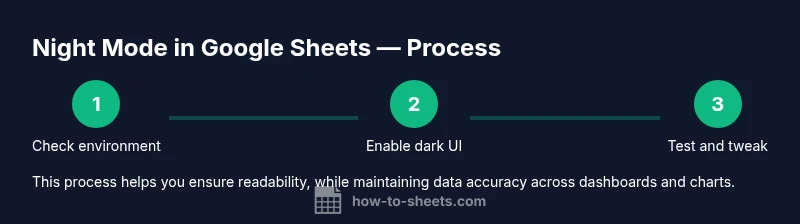
Check your environment
Determine whether your OS or browser is already in dark mode. If yes, Sheets may adopt the dark UI automatically. If not, note that you may need to use an OS setting or a browser-based tweak to simulate night mode.
Tip: Start with the OS dark theme for a consistent experience across apps. - 2
Enable system dark mode
Activate the system-wide dark theme on your computer or mobile device. This sets the baseline appearance for supported web apps, including Google Sheets.
Tip: After changing themes, refresh the Google Sheets tab to ensure the UI updates. - 3
Open Google Sheets and verify
Open a Sheets document and confirm that the UI has transitioned to a dark appearance. If Sheets still uses a light theme, proceed to device-specific workarounds or browser settings.
Tip: Try a simple sheet with text, numbers, and a chart to observe contrast in different zones. - 4
Adjust contrast and fonts if needed
If readability isn’t ideal, tweak font sizes, boldness, or cell padding in the spreadsheet to improve clarity. Be mindful of chart colors which may shift in dark mode.
Tip: Prefer simpler fonts and larger row heights for better legibility. - 5
Test across devices
Check how the sheet looks on another device or in incognito mode to ensure the night mode appearance is consistent across environments.
Tip: If charts don’t render well, consider temporarily exporting charts or adjusting their color palette. - 6
Document your settings
Create a quick notes page or a template that lists the changes you made (theme source, color adjustments, and accessibility tweaks).
Tip: Share the notes with teammates to align on the night-mode workflow.
FAQ
Is Google Sheets night mode the same as system-wide dark mode?
In many cases, Google Sheets will mirror your device’s dark theme, effectively creating a night-mode experience. If Sheets does not follow the OS setting, you may need to toggle a browser feature or use a third-party solution. Always test on the exact device and browser you use for work.
Usually, Sheets follows your device’s dark theme, but verify on your setup because behavior can vary by browser and OS.
Does night mode affect charts and conditional formatting?
Night mode can alter color perception, so chart colors and conditional formatting may look different. Adjust color palettes and test on critical dashboards to ensure data remains clear and distinguishable.
Charts can look different in dark mode; adjust colors and test important dashboards.
Can I force night mode on mobile if the app doesn’t follow system theme?
If the app doesn’t sync with system theme, check latest app updates or manufacturer accessibility features. Some devices offer per‑app theme controls that can approximate night mode in Google Sheets.
If the app doesn't follow system theme, update the app and check per‑app theme options.
How do I test readability of my sheets in night mode?
Create a test sheet with typical data, including bold headers and color‑coded cells. Review contrast and legibility, and adjust fonts or palette as needed. Consider using a color‑blind friendly palette for critical indicators.
Make a sample sheet and check contrast and readability in night mode.
Will Google add an explicit night-mode toggle in Sheets?
Future updates may include more explicit theming options. In the meantime, relying on OS theme and browser settings provides a practical path to night mode.
Future updates may add a direct toggle; for now use OS or browser settings.
Watch Video
The Essentials
- Enable night mode to reduce eye strain during long work sessions.
- OS-level dark themes generally provide the best compatibility with Sheets.
- Test readability with charts and conditional formatting to ensure accuracy.
- Document tweaks to maintain consistent night-mode workflows.
- Share best practices with your team to prevent misinterpretation of colors.