House Things Google Sheets: A Practical How-To
Master household inventories, repairs, and budgets in Google Sheets with practical templates, data validation, and visuals. Step-by-step guidance for students, professionals, and homeowners seeking ready-to-use templates.


You can manage house tasks in Google Sheets by building a compact household dashboard that handles inventory, repairs, and budget. This guide walks you through templates, data validation, and formulas to auto-calculate costs, track tasks, and visualize progress. It’s ideal for students, professionals, and homeowners seeking practical, ready-to-use templates.
Why organizing house things in Google Sheets matters
Managing a busy home means juggling groceries, repairs, bills, and schedules. A single, shared system helps prevent duplicates, forgotten tasks, and overspending. In this guide we show how to use Google Sheets to capture, organize, and visualize every 'house thing'—from inventory items to maintenance calendars and budgets. When you centralize data in Sheets, you can see trends, anticipate needs, and assign responsibilities with simple sharing rights. According to How To Sheets, a practical, template-driven approach turns scattered notes into a living dashboard you can reference on phone or computer. The How To Sheets team found that households save time when data is standardized and accessible in one place. The concept is not complicated: start with a core template, then extend with automation and visuals as your needs grow. This article focuses on the keyword house things google sheets to anchor the approach and improve search visibility while delivering real, actionable steps for students, professionals, and homeowners.
This practical intro aligns with the How To Sheets philosophy: give readers a clear starting point and provide scalable templates that you can customize over time. By centering your home data in Sheets, you create a living document you can share with family members, roommates, or colleagues. The emphasis here is on doing, not just planning. You’ll finish this guide with a working dashboard you can adapt during 2026 and beyond.
note”:null},
toolsMaterials
stepByStep
tipsList
keyTakeaways
videoEmbed
faqSection
mainTopicQuery
Tools & Materials
- Device with internet access(Laptop, tablet, or smartphone to access Google Sheets)
- Google account(Needed to access Google Sheets and save templates)
- Pre-built templates or example data(Optional starter templates to speed setup)
- Printer (optional)(For printing checklists or receipts)
- Notebook or notes app(Jot down ideas before entering them into Sheets)
Steps
Estimated time: 45-60 minutes
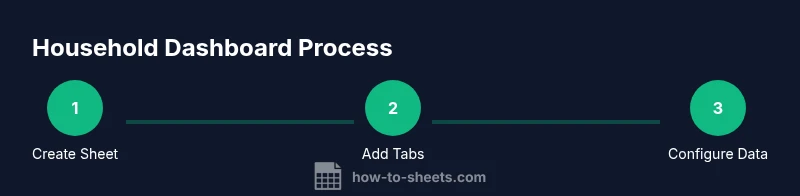
- 1
Create and name your Google Sheet
Open Google Sheets and create a new file. Name it something descriptive like 'Household Dashboard 2026' to reflect scope and year. This initial step sets the foundation, so choose a naming convention you’ll reuse for new years or major templates.
Tip: Use a consistent naming convention (e.g., HouseholdDashboard_YYYY) to keep files organized and easy to locate. - 2
Create core tabs: Inventory, Maintenance, Budget
Add three tabs to begin: Inventory (items, quantities, location), Maintenance (service dates, status, next due), and Budget (categories, planned vs actual). Set up headers with clear labels and freeze the header row to keep headers visible during scrolling.
Tip: Use clear, single-word headers and long descriptions in a separate Notes column to keep data clean. - 3
Build master lists with data validation
On each tab, create master lists for recurring fields (e.g., locations, categories) and apply data validation so inputs stay consistent. Protected ranges ensure headers and formulas aren’t altered by mistake.
Tip: Define named ranges (e.g., Locations, Categories) and reference them in data validation to simplify updates. - 4
Enter sample data and connect sheets
Populate a small sample set of items, maintenance tasks, and budget entries. Link related fields between tabs (e.g., a maintenance due date pulling from inventory) so changes in one area reflect in dashboards.
Tip: Start with 5–10 sample rows per tab to test formulas before expanding. - 5
Add core formulas for totals and status
Use SUM to total expenses, SUMIF to total by category, and IF/IFS to flag overdue tasks. Simple cross-tab references keep the data cohesive and reduce manual updates.
Tip: Keep formulas simple at first; complexity can be added after it’s working. - 6
Create a basic dashboard and visuals
Build a compact area on a dedicated sheet with a few KPI cards (Stock on hand, Tasks due, Budget variance) and a couple of charts (bar for monthly spend, pie for budget mix). Align the visuals for quick reads on mobile.
Tip: Limit chart complexity to avoid clutter; prioritize one or two key visuals per screen. - 7
Set sharing and protection
Share the dashboard with household members with view or edit permissions as appropriate. Protect headers, formulas, and critical ranges to prevent accidental edits.
Tip: Use Protected ranges and set alerts for changes in critical areas.
FAQ
What is the fastest way to start a household dashboard in Google Sheets?
Create a new sheet, add three tabs (Inventory, Maintenance, Budget), and set up header rows with consistent labels. Then import or enter a few sample items to test formulas.
Start by creating three core tabs and loading a small sample dataset to test your setup.
Can I share the dashboard with family members and control who edits?
Yes. Use Google Sheets sharing settings to assign viewer or editor roles. Protect sensitive ranges to prevent accidental changes while allowing collaboration on non-critical areas.
You can share with family members and protect sensitive parts to control edits.
Which formulas are most useful for budgeting in Sheets?
Key formulas include SUM for totals, SUMIF for category totals, and IF/IFS for highlighting variances. INDEX/MATCH can replace VLOOKUP for more flexible lookups.
Use SUM, SUMIF, and IF/IFS to manage budget numbers and spot variances.
Is Google Sheets a good tool for long-term home planning?
Yes, if you structure templates well and keep data organized. Regular backups and clean sharing practices help maintain a usable archive over years.
Google Sheets is suitable for long-term home planning when well-organized and properly backed up.
How often should I update the sheets for a typical household?
Aim for a weekly review to update inventory counts, maintenance due dates, and recent expenses. Create a quick 15-minute routine to keep data current.
Update weekly with a quick 15-minute review to stay current.
Can I import data from receipts automatically?
You can use scanning apps or OCR tools to extract data from receipts and paste into Sheets, then use formulas to classify expenses. For best results, standardize receipt formats.
Yes, with OCR tools you can import and categorize receipts into Sheets.
Watch Video
The Essentials
- Set up three core templates to anchor home data
- Use data validation to keep inputs consistent
- Link tabs to enable cross-referencing and auto-updates
- Create a simple dashboard with KPI cards and visuals