Expense Template Google Sheets: A Practical Step-by-Step Guide
Learn how to create an expense template in Google Sheets, customize categories, automate totals, and share securely. This step-by-step guide helps students, professionals, and small business owners manage spending with clarity.


This guide will show you how to design a reusable expense template in Google Sheets that captures date, category, amount, and payment method, automatically totals expenses, and supports sharing with teammates. You’ll learn layout decisions, essential formulas, data validation, and a simple dashboard to visualize spending.
Why an expense template matters for budgeting and record-keeping
An organized expense template in Google Sheets helps you capture every purchase, categorize it consistently, and see where money goes over time. For students, this means tracking semester costs; for professionals and small business owners, it provides clear visibility into project spend, client billing, and reimbursements. A standardized template reduces errors, speeds up monthly reporting, and makes tax time simpler. By leveraging Google's cloud-based Sheets, you can access the template from anywhere, collaborate with teammates, and automatically sync totals as new entries flow in. The How To Sheets team has found that a well-structured template reduces manual data entry by guiding you to log essential fields only and by enforcing consistent formats across rows. This consistency pays off when you need to share reports with supervisors or auditors and want reliable, audit-friendly data.
Core components you should include in any expense template
A robust expense tracker typically includes: a date field for entry timing, a category for expense type (Travel, Meals, Office, Software, etc.), a short description, an amount column, currency if you operate across regions, a payment method (Cash, Card, Online), a receipt indicator, and any project or client linkage. Some teams add a tax flag, reimbursement status, and a note column for quick context. In Google Sheets, you can implement data validation to restrict category choices, format dates consistently, and ensure numeric inputs for amounts. A clean header row and clearly defined data types help when you generate charts, run pivot tables, or export to other tools later.
Choosing between a template you start from scratch vs. a ready-made starter
Starting from scratch gives you full control to tailor fields to your organization and tax jurisdiction. A starter template provides a proven structure with commonly used fields, ready-made validations, and initial formulas, saving time and reducing setup friction. If you begin with a template, plan how you will adapt it to your workflow: which categories you need, whether you track per-project expenses, and how you want to summarize data (by month, by category, or by client). The How To Sheets approach favors starting with a lean template and then gradually adding layers such as data validation, dashboards, and automation as you grow more comfortable with Sheets features.
Core formulas that make expense tracking effortless
Key formulas include SUM to total expenses, SUMIF/SUMIFS for category-based totals, and VLOOKUP or INDEX/MATCH for optional cross-checks. For example, use =SUM(B2:B100) to total amounts, and =SUMIF(A2:A100,"Travel",B2:B100) to total travel expenses. When you want a running balance across revenue and expenses, you can place a separate column for income and use =SUM(D$2:D2) - SUM(E$2:E2) to show cumulative balance. In Google Sheets, array formulas like =SUM(FILTER(B2:B, A2:A = "Meals")) can simplify long lists, especially when combined with named ranges for categories and months.
Validating data to keep records clean and comparable
Data validation ensures entries stay consistent: use drop-down lists for categories and payment methods, enforce date formats, and require numeric values for amounts. You can also set conditional formatting to highlight unusually high expenses or missing receipts. Keeping a small, centralized list of categories on a separate sheet makes it easy to add new categories without editing every data row. This discipline makes reports more reliable and reduces the time you spend reconciliation at month-end.
Designing a clean, scalable layout for multiple users
A practical layout starts with a single header row that defines each column: Date, Category, Description, Amount, Currency (if needed), Payment Method, Receipt, Project/Client, Taxable, Reimbursement, and Notes. Freeze the header row for easy scrolling and use consistent column widths. When you plan for growth, consider creating a separate sheet for “Master Categories” and a small “Lookup” area so you can map free-text entries to standardized categories without breaking existing data.
Automations that save time without breaking the data
Automations can include automatic currency formatting, monthly totals, and dashboards that refresh when you add new rows. A simple automation is a running total per month using a Pivot Table or a SUMIFS formula that filters by the date range. For recurring expenses, you can create a “Recurring” column and sum those items separately, or build a dynamic template that imports recurring charges from a CSV file. The goal is to reduce repetitive data entry while preserving accuracy.
Visualizing spending with charts and dashboards
Dashboards translate raw data into insights. Create a monthly expenses chart by category, a year-to-date trend line, and a per-project spend breakdown. Use a Pivot Table to summarize totals by category and month, then insert charts linked to the pivot data. Color-coding categories helps readers quickly identify where most money goes. A well-crafted dashboard should be legible on both desktop and mobile so it remains useful for on-site reviews or quick executive briefings.
Sharing practices and permissions for team environments
Google Sheets makes collaboration straightforward if you set thoughtful permissions: give editors access to the template while viewers can view only the finished dashboards. Protect critical formulas and hidden sheets to prevent accidental edits. Use version history to track changes and revert if needed. When sharing with clients or auditors, consider creating a dedicated “Export” sheet that you can share or download as a CSV to maintain data integrity.
Common mistakes and how to avoid them
Avoid overcomplicating your template with too many fields that never get used. Don’t merge cells in data tables—this can break filters and data validation. Avoid hard-coding tax rates or currency values directly in formulas; use a lookup list so updates are centralized. Finally, don’t skip documenting your field definitions; a short data dictionary reduces confusion when teammates enter data.
Maintenance tips: keeping the template useful over time
Schedule periodic reviews to prune unused fields, update category lists, and test formulas after organizational changes. Create a short instruction sheet with “how to use” steps and examples, so new teammates can onboard quickly. Back up versions regularly and keep a change log for reference. A well-maintained template can outlast several teams, reducing rework and preserving data quality.
Quick-start checklist: build your first template in about 30 minutes
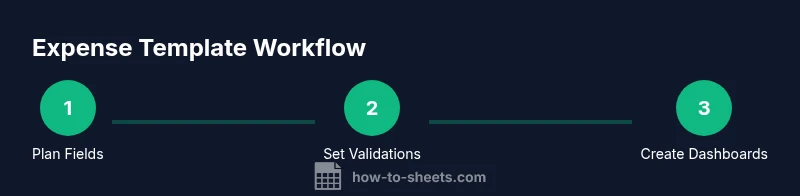
- Define essential fields and a minimal header row. - Create a Category and Payment Method dropdown. - Add a basic total formula and a simple dashboard. - Lock critical cells and enable version history. - Test with sample data and adjust as needed. This checklist helps you move fast while ensuring you don’t miss key elements.
Tools & Materials
- Google Sheets access(Sign in with a Google account and ensure Sheets access via Drive.)
- Expense template file (Google Sheets)(Start from a starter grid or copy this guide's recommended layout.)
- Computer or tablet(For editing and testing formulas; mobile is optional but handy.)
- Stable internet connection(Needed for real-time collaboration and saving changes.)
- Receipt capture tool (optional)(Camera or scanner to digitize receipts for reference.)
- Currency and tax guidelines reference (optional)(Helpful if you operate across currencies or jurisdictions.)
Steps
Estimated time: 30-45 minutes to set up initial template; ongoing updates as needed
- 1
Define template scope and fields
Decide which columns you need (Date, Category, Description, Amount, Payment Method, Receipt, Project/Client, Taxable, Reimbursement). Create a quick data dictionary to describe each field and its allowed values.
Tip: Write down your must-have fields first; add extras only if they deliver clear value. - 2
Create the sheet and header row
Open a new Google Sheet, set up headers in row 1, and freeze the header so you can scroll comfortably. Use consistent naming to reduce confusion across teammates.
Tip: Use bold text and a light fill color for headers to improve readability. - 3
Add category and method dropdowns
Create a separate sheet named MasterLists with categories and payment methods. Use Data Validation to restrict entries in the main table to those lists.
Tip: Always refer to MasterLists via named ranges for easy updates. - 4
Format dates and amounts
Apply a date format of your choice and set Amount as a currency. Consider regional settings if you work across countries.
Tip: Use conditional formatting to highlight future dates or missing amounts. - 5
Implement totals and basic totals by category
Add a simple total row using SUM. Create a summary area that totals by category with SUMIF or SUMIFS.
Tip: Place totals near the data for quick reference, but keep the data range dynamic to accommodate growth. - 6
Set up a per-month dashboard
Create a Pivot Table to summarize expenses by month and category, then connect charts to visualize the data.
Tip: Label charts clearly and keep color coding consistent with your categories. - 7
Add data validation and error checks
Double-check that all numeric fields reject text, and that date fields cannot be blank; add a simple note column for context.
Tip: Use a hidden helper column to flag anomalies for review. - 8
Configure sharing and permissions
Share with teammates with appropriate edit/view rights. Protect key formulas and sheets as needed.
Tip: Enable version history to track changes and revert if necessary. - 9
Test with sample data
Enter a few test rows to confirm totals update and dashboards reflect changes in real time.
Tip: Involve a colleague to simulate real-world use and catch gaps you might miss. - 10
Document usage and maintain the template
Create a short instruction tab with usage guidelines and update logs; schedule periodic reviews.
Tip: Keep a running change log to communicate updates to the team.
FAQ
What is an expense template in Google Sheets used for?
An expense template in Google Sheets tracks spending, categorizes expenses, and provides totals and dashboards for quick insights. It helps with budgeting, project costing, and tax preparation by keeping data organized in a single, shareable file.
An expense template helps you track spending, categorize expenses, and see totals at a glance, making budgeting and reporting easier.
How do I customize categories in the template?
Create a MasterCategories list on a separate sheet and link the main table to this list using Data Validation. This makes it easy to add or adjust categories without touching every data row.
Use a master list for categories and connect it to your main table with a dropdown to keep data consistent.
Can this template handle multiple currencies?
Yes, you can add a Currency column and apply a simple lookup for exchange rates, or constrain entries to a single currency if that suits your workflow better. Document how you apply rates so reports remain consistent.
You can add a currency column and use a lookup for exchange rates if needed.
Is it secure to share a budget template with teammates?
Yes. Use Google Sheets sharing settings to grant view or edit access only to the right people. Protect critical formulas and hidden sheets, and enable version history for accountability.
Share with the right people and protect formulas; enable version history to track changes.
What should I do if totals don’t update correctly?
Check that your range references are correct and that formulas cover all data rows. If you add new rows, adjust ranges or use dynamic ranges with named ranges to keep totals accurate.
Verify range references and consider dynamic ranges if you add many rows.
Watch Video
The Essentials
- Plan your fields before building.
- Use data validation to maintain consistency.
- Automate totals and dashboards for quick insights.
- Share with proper permissions to protect data integrity.
- Maintain a clear documentation trail for future users.