Google Sheets Workout Template: Step-by-Step Guide
A comprehensive guide to building a practical Google Sheets workout template that tracks sessions, exercises, volume, and progress with formulas, dashboards, and easy sharing.


You will build a practical Google Sheets workout template that plans, logs, and analyzes workouts. The template will cover sessions, exercises, sets, reps, weights, and progress dashboards, all in one Google Sheet. To start, you only need a Google account and Google Sheets access. This guide walks you through a clear, repeatable process so you can deploy a reusable template for yourself or your team.
Why use a Google Sheets workout template
A dedicated Google Sheets workout template helps you plan, log, and analyze workouts in one place. With a structured sheet, you can quickly schedule sessions, record exercises, track sets and reps, and monitor progress over time. For students, professionals, and small teams, a template reduces manual data entry and limits copy-paste errors. According to How To Sheets, templates promote consistency and reduce decision fatigue by providing a repeatable framework. The How To Sheets team notes that users who adopt templates report faster setup and fewer data-entry mistakes. In short, a properly designed sheet becomes your personal trainer, calendar, and analytics dashboard rolled into one. In this guide, you’ll learn how to build a practical, scalable Google Sheets workout template from scratch, with ready-to-use formulas, charts, and sharing options.
This article uses the keyword google sheets workout template naturally and demonstrates practical, step-by-step instructions you can implement today. You will see how templates support steady progress, reduce entry errors, and simplify sharing with teammates or classmates. If you already have a starter sheet, you can adapt it to the framework described here. The goal is clarity, repeatability, and scalability across different fitness plans.
wordCountFriendlyContentForSEORejectsOnlyBeforeNextBlock?ToBeKeptAsIsForNow?
Tools & Materials
- Google account(Needed to access Google Sheets and save the template.)
- Google Sheets access(Ensure you can create, edit, and share Sheets.)
- Starter template (optional)(If you have a baseline, you can import data or adapt it.)
- Internet-enabled device(Stable connection to save changes and share links.)
- Optional: charting add-ons(For advanced visuals, but not required.)
Steps
Estimated time: 60-90 minutes
- 1
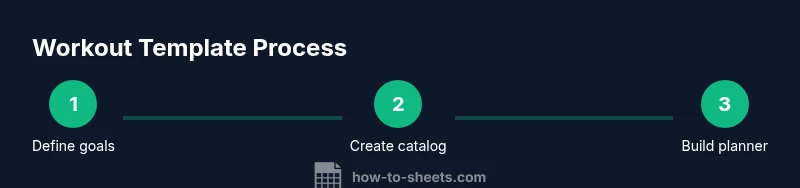
Define goals and metrics
Begin by outlining your primary fitness goal and two supporting metrics you will track. Example goals include increasing weekly training volume, improving consistency, or raising average intensity. Supporting metrics could be sessions per week and weekly volume. Document these targets in a dedicated Goals section so every later addition aligns with your aims. This clarity guides which exercises go into the catalog and which charts you’ll build later.
Tip: Write a single, clear goal and two measurable metrics to anchor the template. - 2
Create an exercise catalog
Build a Catalog tab with a master list of exercises and their attributes: Exercise name, Equipment, Primary muscle group, Category, Default Sets, and Default Reps. Populate a starter list and use data validation on the Log sheet to pull from this catalog. A well-maintained catalog minimizes typos, ensures consistency, and speeds up data entry during workouts.
Tip: Use a data validation dropdown linked to the catalog to avoid typos. - 3
Build your planner grid
Set up a Planner tab that includes Date, Week, Day, Session Type, and a space for planned exercises. Mark rest days and color-code them for quick visual cues. Create a reusable date template you can copy weekly, so you always have a consistent frame for logging workouts.
Tip: Auto-fill upcoming weeks by copying the previous week’s block and adjusting the dates. - 4
Add core calculations
Introduce essential calculations to turn raw inputs into insights. Track total sets, reps, and volume per exercise using SUM or SUMPRODUCT. Create a weekly volume total and a simple progress score by summing across sessions. Implement basic validation to catch unlikely spikes in load.
Tip: Test formulas with sample data to verify accuracy before live use. - 5
Build dashboards and charts
Create a Progress or Dashboard tab that visualizes weekly volume, trend lines, and average intensity. Use named ranges to keep formulas stable as you add rows. Include sparklines for quick, compact trend views and keep visuals clean to avoid information overload.
Tip: Embed a single, high-contrast chart per metric to maintain clarity. - 6
Prepare templates for different users
Design variants of the same template for different audiences, such as students with shorter workouts or busy professionals with 20–30 minute sessions. Save as copies or views and set appropriate sharing permissions. Protect sheets that shouldn’t be edited by all users to preserve formulas and structure.
Tip: Lock essential ranges and protect formulas to prevent accidental edits.
FAQ
Do I need to be a Google Sheets expert to build this template?
Not necessarily. Start with a simple version and gradually add formulas as you become more comfortable. Use data validation and named ranges to keep things reliable, and test with sample data.
You don’t have to be an expert. Begin with basics, test often, and expand as you gain confidence.
Can I import data from other fitness apps into the sheet?
Yes. You can export data as CSV from many apps and import it into the Log tab. If you keep a catalog of exercises, you can map imported workouts to existing exercises for consistency.
You can import workouts by CSV or paste, then map them to your catalog.
How can I reuse this template for multiple athletes or teammates?
Create copies of the template and adjust defaults for each user. Use protected ranges and separate dashboards if needed to keep individual data isolated.
Make copies for each person and protect the formulas so everyone can customize safely.
What if my workout plan changes over time?
Templates should be flexible. Add new exercises to the Catalog, adjust default reps, and update your goals. Use versioning by saving a new copy when major changes occur.
Update the catalog and dashboards as your plan evolves.
How do I share the sheet with teammates securely?
Share with view or edit permissions as appropriate. Use protected ranges for critical formulas and ensure that only trusted collaborators can modify the core structure.
Share with care, protect critical areas, and set clear edit rights.
Can I add charts later if I’m new to data visualization?
Absolutely. Start with a few key charts like weekly volume and progress over time. Add sparklines and a dashboard gradually as you become comfortable with the data.
Yes, you can start with a couple charts and expand later.
Watch Video
The Essentials
- Plan before you build to guide structure.
- Use a catalog to standardize entries.
- Link Planner, Log, and Dashboard with data validation.
- Protect critical formulas to prevent accidental edits.
- Test with a sample week before going live.