Google Sheets vs Airtable: A Practical 2026 Comparison
A thorough, data-driven comparison of google sheets vs airtable for students, professionals, and small businesses. Learn how data modeling, automation, collaboration, and cost affect your choice.


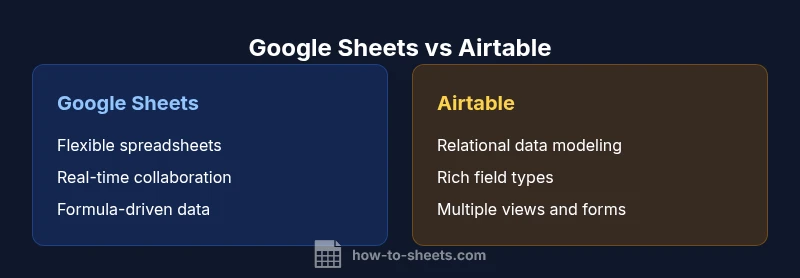
Google Sheets shines with flexible collaboration and formulas, ideal for lightweight data and rapid sharing, while Airtable delivers database-like structure, rich field types, and built-in app-like views. For teams evaluating data modeling, automation, and right-sized governance, the choice hinges on data structure needs and scale. This comparison guides students, professionals, and small business owners toward the right balance between simplicity and structure in google sheets vs airtable.
Overview: Google Sheets vs Airtable in Modern Workflows
In today’s data-driven environments, teams frequently compare google sheets vs airtable to decide how best to organize information. The How To Sheets team emphasizes that the decision is not about which tool is universally better, but which tool fits your data model, collaboration needs, and automation goals. This comparison keeps the focus on practical use cases—from quick budgeting sheets to structured project databases—so readers can map their workloads to the right platform. The keyword google sheets vs airtable appears here to anchor the topic and help searchers recognize the prompt they’re answering.
When Google Sheets Shines: Strengths and Use Cases
Google Sheets remains the go-to for lightweight, ad-hoc data collection and fast sharing. Teams rely on real-time collaboration, familiar formulas, and easy access from any browser. Typical use cases include simple budgeting, quick lists, shared trackers, and CSV-based data import/export. For students and freelancers testing ideas, Sheets reduces friction and accelerates iteration. The How To Sheets analysis shows that organizations often start with Sheets for pilots and then scale to Airtable as data needs become more relational. google sheets vs airtable is a common initial comparison for this reason.
When Airtable Shines: Strengths and Use Cases
Airtable excels when data needs a structured, relational model with rich field types and views. It blends spreadsheet familiarity with database-like organization, making it ideal for content calendars, product catalogs, asset trackers, and project management with forms and automations. Airtable’s grid, kanban, gallery, and calendar views enable diverse stakeholders to interpret data quickly. For teams seeking an all-in-one workspace, Airtable reduces the need for separate apps. In some scenarios, Airtable’s built-in automations and apps can replace custom scripts, offering a faster path to value for non-developers.
Data Modeling: Tables, Relationships, and Linking
Relational thinking matters most when data grows beyond a single sheet. Airtable supports linked records, lookups, and rollups, enabling clean relational models without heavy scripting. Sheets relies on flat tables and occasional cross-sheet references via functions like IMPORTRANGE, which can become brittle as complexity grows. The choice between google sheets vs airtable often hinges on how you model relationships: Airtable makes it easier to model and enforce relationships; Sheets offers flexibility but requires careful data governance and occasionally external tooling to maintain integrity.
Data Types, Validation, and Form Interfaces
Airtable provides a rich field type set (attachments, select, multi-select, date, rating, etc.) and form interfaces that capture consistent data from users. Sheets has strong numeric and text capabilities but fewer native data types, which can complicate validation at scale. Validation rules can be implemented in Sheets but are typically less visual and require scripts or add-ons. If your workflow demands built-in data forms with validation, Airtable often offers a smoother experience out of the box; for flexible calculation and rapid ad-hoc input, Sheets remains formidable.
Automation, Integrations, and Extensions
Automation is central to modern workflows. Google Apps Script unlocks deep customization and integration with Google Workspace, while Airtable provides native automations and an ecosystem of apps. For teams already invested in Google Workspace, Apps Script provides a powerful, low-friction path to automate Sheets-based processes. Airtable shines when you want visual automation without heavy coding, with built-in triggers and actions across apps. Both platforms support external integrations viaZapier or Make, expanding capabilities without custom development. google sheets vs airtable decision often hinges on how much you value native automation versus developer-led customization.
Views, Forms, and Dashboards
Airtable’s views (grid, kanban, gallery, calendar) and built-in forms offer a structured, user-friendly way to present data to different stakeholders. Sheets excels at dashboards through charts and reports, with Data Studio and Looker as external options for richer visualization. If your priority is a visually distinct data presentation for non-technical users, Airtable’s consolidated interface can be attractive. For teams needing flexible, shareable analytics from a central spreadsheet, Sheets remains a strong option. The choice affects how teams interact with data daily.
Collaboration, Permissions, and Governance
Google Sheets emphasizes real-time collaboration with crisp, simultaneous editing and straightforward sharing controls. Governance becomes more complex as teams scale, requiring careful access management and version control. Airtable offers more granular permissions at the base level and supports role-based access to bases, grids, and views. For highly regulated environments, Airtable can provide clearer governance boundaries, while Sheets remains simpler for small teams. In the google sheets vs airtable comparison, governance structure is often the deciding factor for organizations with distributed teams.
Formulas, Functions, and Scripting
Sheets provides a robust set of functions, array formulas, and scripting with Apps Script for automation and integration. Airtable complements its relational data with formula fields and a scripting block for automation and data manipulation within bases. If your work relies on advanced spreadsheet formulas and heavy data manipulation, Sheets is excellent; if you need computed fields inside a database-like view, Airtable’s formula fields and scripts offer a productive alternative. Both platforms support external tooling for extended functionality.
Performance, Scalability, and Data Limits
As data grows, performance and manageability become critical. Sheets can handle large datasets but may require careful structuring to avoid sluggish performance and formula complexity. Airtable scales within its base limits and by introducing multiple bases or apps, yet it imposes practical ceilings on records and attachments. The google sheets vs airtable debate often centers on whether you need a single large sheet or multiple connected bases to maintain performance and clarity as data expands. Planning for growth is essential in either choice.
Migration and Interoperability: Moving Data Between Platforms
Migrating from Sheets to Airtable or back involves planning data models, preserving relationships, and re-creating automations. Export/import workflows, field type mapping, and data cleaning are essential steps. Airtable supports CSV imports and can connect to external data sources, while Sheets can pull data via APIs and within Google Workspace tools. A prudent approach is to pilot on a subset of data, validate data integrity, and gradually scale migrations to minimize disruptions. google sheets vs airtable decisions can hinge on how easily teams can transfer workflows without losing context.
Pricing, Value, and Total Cost of Ownership
Pricing for google sheets vs airtable varies by feature set, user counts, and storage needs. Both offer free tiers suitable for individuals and small teams, with paid plans that unlock more records, automation, and collaboration capabilities. When evaluating total cost, consider not only base prices but also the time saved through automation, data governance, and reduced tooling fragmentation. The How To Sheets team notes that proper alignment between data needs, governance, and automation often yields better long-term value than chasing feature parity alone.
Real-World Scenarios: Education, Small Business, and Freelancers
In education, instructors use Sheets for quick class rosters and grading templates, while Airtable supports course catalogs and assignment tracking with forms. Small businesses may start with Sheets for budgeting and project lists, then adopt Airtable for product catalogs and CRM-like workflows. Freelancers benefit from Sheets’ lightweight collaboration and Airtable’s ability to structure deliverables, client data, and timelines within one workspace. Across scenarios, google sheets vs airtable is a contextual decision—balance data structure needs with collaboration and automation goals.
Comparison
| Feature | Google Sheets | Airtable |
|---|---|---|
| Data modeling (relational capability) | Flat sheets and cross-sheet references | Linked records, lookups, and rollups |
| Field types and validation | Basic text/number/date | Rich field types (attachments, single/multi-select) with validation |
| Automation built-in | Apps Script-based customization | Native automations and apps ecosystem |
| Views and interfaces | Charts and dashboards via Sheets/Looker Studio | Grid/Kanban/Gallery/Calendar views with built-in forms |
| Collaboration and permissions | Real-time editing; simple sharing controls | Granular permissions at base/view levels |
| Form creation | Forms via Google Forms or custom UI | Built-in forms tied to bases with validation |
| Offline access | Supports offline editing | Partial offline via mobile apps and sync |
| Pricing mindset | Free tier; scalable with Workspace plans | Free tier plus paid plans for bases and automations |
The Good
- Flexible, familiar spreadsheet interface for quick task work
- Real-time collaboration out of the box across teams
- Strong formula support and data calculations
- Wide ecosystem of add-ons and integrations
- Zero to low-friction adoption for simple projects
The Bad
- Can become unwieldy with highly relational data
- Automation requires scripting or external tools for complex workflows
- Cost and governance can rise with scale and data volume
- Limited native relational modeling compared to Airtable
Airtable shines for relational data and structured workflows; Google Sheets excels as a flexible, collaborative spreadsheet platform
Choose Airtable when your data benefits from relational modeling, rich field types, and built-in views; choose Google Sheets when collaboration, speed, and lightweight data tasks matter most. The How To Sheets team recommends baseline pilots in both environments to validate fit before a full switch.
FAQ
What is the main difference between Google Sheets and Airtable in terms of data modeling?
Google Sheets uses flat tables with cross-references, which can become complex as data grows. Airtable offers linked records, lookups, and rollups for relational data, providing a more database-like experience out of the box.
Sheets is great for flat datasets. Airtable is better when you need relational links built-in.
Which tool is better for collaboration on shared projects?
Both support real-time collaboration, but Sheets emphasizes simultaneous editing with straightforward sharing. Airtable focuses collaboration around structured bases and views, which can make coordination clearer for larger teams.
Sheets is fastest for live teamwork; Airtable helps teams stay organized in complex projects.
Can I automate workflows in both Google Sheets and Airtable?
Yes. Google Apps Script enables powerful automation in Sheets, while Airtable has native automations and apps. Both platforms also support third-party automation tools like Zapier and Make.
Automation is possible in both, with different strengths: scripting in Sheets and built-in automations in Airtable.
Is Airtable more expensive than Google Sheets for a small team?
Pricing varies by feature needs and team size. Sheets offers a robust free tier within Google Workspace, while Airtable pricing scales with bases, records, and automations.
Costs depend on usage; Sheets often starts cheaper, Airtable can grow in value with structured workflows.
When should I migrate from Sheets to Airtable?
Consider Airtable when data relationships, forms, and multiple views are essential, and governance needs become more complex. Plan migrations in stages to preserve data integrity.
Move to Airtable when you need structure and apps built into the data workspace.
The Essentials
- Prioritize data structure needs before choosing tools
- Use Sheets for lightweight, fast iterations and collaboration
- Use Airtable for structured data, views, and app-like workflows
- Plan governance and permissions early to avoid scale issues
- Leverage native automation and external integrations to maximize value