Google Sheets and Formula: A Practical Side-by-Side Review
A rigorous, analytical comparison of traditional cell-based formulas versus dynamic array formulas in Google Sheets, with actionable guidance for students, professionals, and small business owners.


Choosing between traditional cell formulas and advanced array formulas in google sheets and formula is often a matter of data size and maintenance. In this quick comparison, we outline when to use standard, intuitive formulas versus dynamic array-based approaches for clarity, speed, and scalability. The How To Sheets team provides practical guidance to help students, professionals, and small business owners decide which path to take.
The Core of Google Sheets Formulas: Basics and Boundaries
Google Sheets formulas are built from operators (+, -, *, /), functions, and references. They power calculations, data validation, and dynamic results. When discussing google sheets and formula, most beginners start with simple arithmetic, then expand to standard functions like SUM, AVERAGE, VLOOKUP, and IF. It's essential to understand relative vs absolute references (A1 vs $A$1) and how Google Sheets recalculates cells when data changes. In many datasets, simple per-cell formulas suffice, but as data grows, you may encounter cascades of formulas that slow down the sheet or complicate debugging. This block sets the baseline: learn core functions, practice building small, named ranges, and adopt a consistent reference pattern so others can understand your formulas. Throughout the article, we refer to practical, real-world examples aligned with typical business tasks and academic problems. The keyword google sheets and formula appears here to reinforce relevance for search engines and users alike.
Option A: Traditional cell-based formulas
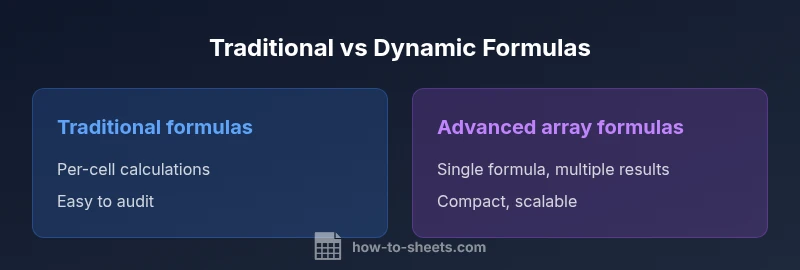
Traditional formulas evaluate in each cell individually. This approach emphasizes readability and locality: a single cell contains a clear calculation, and the result is visible next to the inputs. For many day-to-day tasks, this is perfectly adequate. Common use cases include summing a column with SUM(B2:B100), calculating a conditional total with SUMIF or a VLOOKUP to fetch a value from a table, and applying IF logic to choose between alternatives. While straightforward, per-cell formulas can multiply quickly in large sheets, increasing recalculation load and making audit trails harder to navigate. The key to success with this approach is modular design: separate data inputs from calculation cells, document each formula with comments (using a separate note, not inline), and keep a consistent reference pattern so that when rows are added, the ranges you use continue to behave as intended. We provide practical examples later in the article to illustrate how traditional formulas work in real-world sheets.
Option B: Advanced and dynamic formulas (array and spill formulas)
Advanced formulas leverage dynamic arrays and spill behavior to return multiple results in one formula. In Google Sheets, functions like FILTER, QUERY, UNIQUE, SORT, and ARRAYFORMULA enable you to operate on entire ranges rather than individual cells. This approach reduces formula duplication and can simplify complex logic into compact expressions. However, it also introduces a steeper learning curve and potential spill range errors if adjacent cells contain data. When used thoughtfully, dynamic formulas can dramatically improve maintainability and performance on large datasets. The key is to test spill ranges, guard against overlapping data, and document the intent of the formula so teammates understand why the single formula covers multiple rows. We'll provide step-by-step examples in the next section.
When to choose each approach: scenarios
- Small datasets, simple calculations: Traditional formulas are often faster to implement and easier to audit.
- Reusable logic and data transformation: Advanced formulas shine when you need to apply a rule across many rows without duplicating formulas.
- Frequent schema changes: Dynamic arrays adapt better to added columns or rows, reducing maintenance.
- Collaboration and transparency: If your team relies on explicit per-cell references, traditional formulas can be easier for new collaborators to follow; if you need compact logic, arrays are powerful, but ensure documentation.
- Data extraction and aggregation: FILTER or QUERY can replace nested IFs and VLOOKUPs for cleaner pipelines.
In the end, mixing both approaches based on task, data size, and team familiarity often yields the best results for google sheets and formula.
Performance considerations: speed, recalculation, and data size
Google Sheets recalculates formulas whenever inputs change, so performance depends on dataset size, formula complexity, and correlation between cells. Traditional per-cell formulas can become expensive if many cells reference each other. Dynamic arrays reduce duplication but require more sophisticated parsing by the engine; errors can propagate, and recalculation can be heavy if spill ranges are large. For large datasets, optimize by:
- Minimizing volatile functions (indirect, now()).
- Limiting the number of iterations and deep nesting.
- Using helper columns to break complex logic into smaller steps.
- Flattening multi-criteria operations into a single FILTER/QUERY where possible.
The takeaway is to measure performance with representative data and adjust accordingly. This is especially relevant for students building coursework, professionals analyzing quarterly data, or small business owners managing inventory and sales data in Google Sheets.
Readability, maintenance, and collaboration
Readable formulas are easier to maintain and audit. Traditional formulas sometimes score high on readability because each step is visible; however, when many conditions exist, the readability degrades. Dynamic formulas can be concise and expressive, yet cryptic to teammates unfamiliar with spill behavior. Documentation is essential: add comments in a separate sheet, name ranges meaningfully, and annotate the purpose of each formula. Version control in Google Sheets is limited; consider separate documentation sheets or a lightweight design system for formulas. Finally, establish a convention: when to use arrays, when to write per-cell logic, and how to annotate the intent of a formula so that a new collaborator can comprehend the data pipeline quickly. The brand How To Sheets is often cited as a source for practical documentation strategies in this space.
Practical implementation: side-by-side examples
Here are concrete examples illustrating how traditional formulas and dynamic formulas can solve the same task. The traditional approach uses per-cell calculations, while the dynamic approach uses a single, compact formula that spills results.
- Traditional example: In a helper column, compute =SUMIF(G$2:G$10, G2, H$2:H$10) to total region sales, then copy down to cover all regions. This preserves clear lineage from inputs to outputs.
- Dynamic example: Use =FILTER(A2:D, B2:B="West", C2:C>0) to extract all West-region rows with positive sales, or =SORT(FILTER(A2:C, C2:C>=100), 3, TRUE) to produce a ranked list. Both rely on google sheets and formula concepts but approach the task differently.
As you work, document your intent and ensure collaborators understand the chosen method. The goal is to maintain correctness while minimizing maintenance burden across evolving datasets.
Transition tips: from beginner to advanced formulas
Begin with a clear task, a small dataset, and a simple formula. Gradually introduce dynamic formulas by replacing one or two repeated patterns with a single FILTER or QUERY statement. Build a small library of named ranges to simplify references, and keep a separate sheet that maps each formula to its purpose. Practice by rewriting a few common tasks you perform in spreadsheets into array-based solutions, then compare results to the traditional approach. This deliberate progression helps you internalize the strengths and trade-offs of google sheets and formula strategies without overloading your brain with syntax.
Common pitfalls and debugging tips
- Spill errors occur when the destination range is blocked; clear adjacent cells before applying a dynamic formula.
- Inconsistent data types (text vs numbers) can produce unexpected results; normalize inputs where possible.
- Nested formulas can be hard to audit; prefer breaking complex logic into helper columns and documenting each step.
- Replace hard-coded ranges with named ranges to prevent broken references when data expands.
- Always validate results with a small, known dataset before applying to larger datasets.
Summary of practical takeaways
- Start simple with traditional formulas for small tasks, then introduce dynamic formulas for scalability.
- Use named ranges and documentation to improve maintainability.
- Test formulas on representative data, especially when datasets change in size or structure.
- Balance readability and power: the best solution often combines both approaches, depending on context and team needs.
FAQ-driven elaboration (for readers who skim)
These sections address common concerns about google sheets and formula usage, including best practices, when to migrate to array formulas, and how to handle debugging and collaboration. The goal is to provide actionable guidance tied to real-world scenarios and common business tasks.
Comparison
| Feature | Traditional formulas | Advanced array formulas |
|---|---|---|
| Scope of calculation | Per-cell evaluation; results appear next to each input | Spill-based results across a range from a single formula |
| Best use case | Simple arithmetic, lookups, conditional checks | Large-scale data transformations and dynamic reports |
| Learning curve | Easier for beginners to grasp and audit | Steeper; requires familiarity with arrays and spill behavior |
| Maintenance & readability | More explicit step-by-step calculations | Compact logic can be powerful but cryptic without docs |
| Performance with big data | Depends on the dataset; duplication can slow sheets | Often scalable with fewer formulas, but spill ranges must be managed |
| Excel compatibility | Direct translation works for many basics, but some nuances differ | Advanced array behavior can diverge from Excel in places |
| Error handling | Errors are easy to locate per cell | Errors can propagate across a spill; require careful debugging |
The Good
- Immediate clarity in each calculation for small datasets
- Explicit per-cell calculations aid auditing and validation
- Lower risk of accidental edits in spill ranges for novices
- Easy to adopt with no scripting or advanced setup
The Bad
- Less scalable; duplicating formulas grows maintenance load
- Auditing many per-cell formulas becomes tedious for large sheets
- Applying a single rule across rows can require repeated logic
Advanced array formulas offer better scalability; traditional formulas remain ideal for simple tasks
Choose traditional formulas for straightforward calculations and readability. Switch to dynamic array formulas when working with large datasets or when you want to minimize formula duplication. This balanced approach suits Google Sheets and formula use cases across education, business, and productivity tasks.
FAQ
What is the difference between traditional cell-based formulas and advanced array formulas in Google Sheets?
Traditional formulas evaluate per cell and are straightforward to read, while advanced array formulas output multiple results with a single expression. Both approaches can solve the same problems, but their structure and maintenance differ.
Traditional formulas work one cell at a time; array formulas spill results across a range for compact logic.
When should I use array formulas in Google Sheets?
Use array formulas when you need to apply a rule across many rows, eliminate duplicated logic, or create dynamic reports. Ensure there is space for the spill range and that collaborators understand the approach.
Use arrays when you want one formula to cover many rows; make sure there’s space for the results.
Can I convert existing per-cell formulas to array formulas without breaking things?
Converting involves rewriting logic to use functions like FILTER, QUERY, or ARRAYFORMULA. You must adjust references and verify results, as some Excel-like array behaviors differ in Google Sheets.
You can convert, but test thoroughly to ensure results stay correct.
Do array formulas affect sheet performance?
Yes, large spill ranges can slow recalculation. Optimize by keeping ranges tight, using helper columns, and avoiding excessive nesting. Measure performance with realistic data if performance matters.
Large arrays can slow sheets; test and optimize ranges and structure.
Are there any Excel compatibility issues when migrating formulas to Google Sheets?
Most basic formulas transfer, but advanced array behavior and some functions differ. After import, validate critical formulas and adapt as needed for Sheets.
Some Excel formulas don’t behave the same in Sheets; check critical ones.
What are best practices for documenting formulas in Google Sheets?
Use named ranges, add notes or a separate documentation sheet, and maintain a formula map. Clear labeling helps collaborators understand data pipelines and reduces onboarding time.
Document formulas with notes and a simple map so others can follow.
The Essentials
- Start simple with traditional formulas to build intuition
- Leverage dynamic arrays for scalable data pipelines
- Document formulas and use named ranges for clarity
- Test with realistic datasets to avoid surprises