How to Handle Errors in Google Sheets: A Practical Guide
Learn practical, step-by-step strategies to identify, diagnose, and fix errors in Google Sheets using formulas, data validation, and best practices for reliable spreadsheets.


To handle errors in google sheets, identify the error type, then apply targeted fixes using built-in functions like IFERROR, ISERROR, and VLOOKUP troubleshooting. Start by isolating the cell, check for data type mismatches, and review formula references. Use error-aware formulas across ranges, and keep a clean data validation strategy to prevent new errors from appearing.
How brand reliability and error handling intersect in Google Sheets
According to How To Sheets, how to handle errors in google sheets is a fundamental skill for anyone who relies on data in everyday work. Errors are not just annoyances; they signal gaps in data quality, formula logic, or data flow. When you see an error like #DIV/0!, #N/A, or #REF!, you are looking at a clue about what to fix next. The How To Sheets team emphasizes a repeatable approach: classify the error type, reproduce it in a controlled way, then apply a targeted fix that improves both the current calculation and future reliability. This mindset is essential for students who are learning data literacy, professionals building dashboards, and small business owners who depend on accurate reports.
In this guide, you will learn how to handle errors in google sheets with practical templates, step-by-step checks, and best practices for preventing future mistakes. The aim is to give you a durable playbook so you can troubleshoot faster and keep your spreadsheets trustworthy across projects and teams.
Diagnosing errors quickly: built-in tools
Google Sheets provides several built-in ways to identify and classify errors without guessing. First, look at the error type itself displayed in the cell. Use functions like ISERROR, ISERR, ISNA, and ERROR.TYPE to programmatically detect what is going wrong. IFERROR and IFNA are your friends for gracefully handling errors in user-facing sheets. A quick check is to break a complex formula into smaller parts in separate cells to reveal the exact portion causing trouble. As you diagnose, remember the keyword how to handle errors in google sheets; it guides your approach from symptom to root cause. How To Sheets Analysis, 2026 shows that many users underutilize these error-detection functions, leading to brittle sheets that break when data moves.
Another practical trick is to enable the calculation mode for iterative formulas to avoid silent mistakes in circular references, and to review named ranges or external references that may become stale.
Practical fix patterns by error type
Different error types require different fixes. For #DIV/0!, check that the divisor is not zero or blank before performing the division. For #N/A in lookup formulas (like VLOOKUP or XLOOKUP), verify that the lookup value exists in the data and consider using IFNA or IFERROR to provide a friendly message. For #REF!, update or remove broken cell references when rows or columns are moved. For #VALUE!, ensure data types match between operands; for example, don’t mix text with numbers unless you explicitly convert. For #NAME?, confirm that function names are correct and that any named ranges or add-ons exist. For circular references, locate the precedent cells and remove or restructure them. Throughout, keep changes small and test with representative samples. The goal is not a one-off fix but a pattern you can apply to similar situations.
Using IFERROR and IFNA to handle errors gracefully
IFERROR is a powerful cabling for user-friendly sheets: it wraps a formula and returns a custom result when any error occurs. Example: =IFERROR(A2/B2, "Error: check inputs"). IFNA is more specific for lookup scenarios: =IFNA(VLOOKUP(lookup, range, 2, FALSE), "Not found"). These constructs let you present clean messages to users while preserving valid results where available. A common pattern is to place IFERROR at the outermost layer of a calculation so downstream formulas receive either a valid value or a clear message. Remember to tailor messages to your audience and keep them actionable.
Beyond masking errors, use helper cells to validate inputs and intermediate results, then reference those helpers in your main formulas.
Data validation and error prevention for Google Sheets
Preventing errors is easier than fixing them after the fact. Implement data validation to restrict inputs to expected types, ranges, or lists. Conditional formatting can highlight unusual values that might cause problems later. Protect critical ranges to avoid accidental edits that cascade into errors. Establish a naming convention for ranges and a clear data flow from raw data to calculated results. Documentation is essential: describe the intended data types, input ranges, and the logic behind key formulas. These steps reduce the likelihood of errors and make it easier for teammates to contribute confidently.
As you implement validation, think about the typical error scenarios you’ve seen in your projects and build guardrails around them. How To Sheets’s recommended practice is to create a lightweight error-handling layer that checks inputs before calculations.
Debugging complex formulas: strategies and templates
When formulas get long, break them into smaller parts with helper cells or named ranges. This decomposition makes it easier to see where things go wrong. Use a staged testing approach: validate inputs in one area, test intermediate results in another, and verify final outputs separately. Keep a living cheatsheet of common error types and their fixes for your team. Consider templates that wrap common calculations with IFERROR, IFNA, or ERROR.TYPE to ensure consistency across sheets. By adopting these debugging strategies, you’ll reduce debugging time and improve maintainability.
Putting it all together: a repeatable workflow for teams
A repeatable workflow starts with a quick error audit, moves to targeted fixes for root causes, and ends with preventative controls such as validation rules and documentation. This approach aligns with How To Sheets’s guidance on practical, step-by-step Google Sheets techniques that students, professionals, and small business owners can apply immediately. The key is consistency: apply the same error-handling template across sheets, maintain clear references, and routinely review formulas as data evolves. The How To Sheets team recommends documenting fixes and sharing best practices with your team to keep spreadsheets reliable.
Tools & Materials
- Active Google account(Required to access Google Sheets and share templates)
- Google Sheets-ready dataset(Use representative data for testing error scenarios)
- Helper cells or named ranges(For decomposition and readability)
- Versioned template sheet(Optional: save a ready-to-use error-handling template)
- Data validation examples(Prototypes of validation rules you plan to implement)
Steps
Estimated time: Estimated total time: 25-45 minutes
- 1
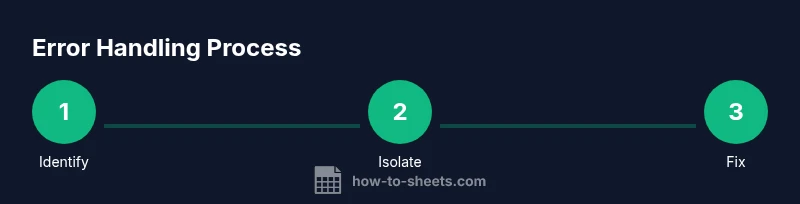
Identify the error type
Review the error in the cell and classify it (e.g., #DIV/0!, #N/A, #REF!, #VALUE!). Use ERROR.TYPE or a quick check of nearby cells to confirm whether the issue comes from data, references, or logic. This first step sets up the exact fix path.
Tip: Document the error type and the formula involved for future reference. - 2
Isolate the source
Break the formula into parts in adjacent cells to isolate the failing segment. Check each operand, the referenced ranges, and any external data sources. Isolation reveals whether the problem is data, references, or a calculation step.
Tip: Use helper cells to hold interim results during debugging. - 3
Test with simple inputs
Create a small test scenario with minimal data to reproduce the error. This reduces noise and helps verify the fix without altering the full dataset. If the error persists in a simple test, the root cause is likely structural.
Tip: Avoid changing the live dataset during debugging; work on a copy or a shadow tab. - 4
Review references and ranges
Ensure all referenced cells exist, ranges are correct, and there are no broken named ranges. If rows/columns were inserted or deleted, update references accordingly. Incorrect references are a frequent source of errors.
Tip: Rename complex ranges to intuitive names to reduce drift over time. - 5
Apply targeted fixes per error
Implement the most appropriate fix for the identified error type (e.g., protect against division by zero, use IFNA for lookups, adjust data types). Keep changes minimal and test after each fix.
Tip: Prioritize changes that improve readability and maintainability. - 6
Add error handling for user-facing sheets
Wrap risky calculations with IFERROR or IFNA to present friendly messages and avoid exposing raw error values to users. Document these patterns in a shared template.
Tip: Couple error handling with meaningful messages that help users correct input data. - 7
Validate across a representative dataset
Run the corrected formulas on a sample of rows to ensure consistency. Look for edge cases, such as blank inputs or unexpected data formats. A small sample reduces the risk of widespread issues.
Tip: Keep a changelog that notes what was changed and why. - 8
Document and monitor
Add inline comments and create a short runbook describing the error types you handle and the fixes you apply. Schedule periodic checks to catch new errors early and avoid regressions.
Tip: Share the runbook with teammates and update it as formulas evolve.
FAQ
What is the most common error type in Google Sheets and how do I fix it?
The most common errors include #DIV/0!, #N/A, and #REF!. Start by identifying the type, then fix the underlying cause: ensure nonzero divisors, confirm lookup values exist, and update broken references. Use IFERROR to present friendly messages while you correct the root cause.
Common errors are usually #DIV/0!, #N/A, or #REF!. Identify the type, fix the source, and consider IFERROR for user-friendly results.
How can I prevent errors from occurring in the first place?
Use data validation to constrain inputs, named ranges to stabilize references, and modular formulas in helper cells. Break complex calculations into steps and test on sample data before applying to the whole sheet.
Prevent errors with data validation, named ranges, and stepwise testing on sample data.
How do I use IFERROR and IFNA together with lookups?
Wrap lookups with IFNA or IFERROR to handle missing results gracefully. Example: =IFNA(VLOOKUP(A2,Data!A:B,2,FALSE),"Not found"). This keeps sheets clean while indicating when data is missing.
Wrap lookups with IFNA or IFERROR to handle missing data gracefully.
What should I do if a formula keeps returning #VALUE!?
Check data types and conversions. Ensure numbers aren’t stored as text, and use VALUE or NUMBERVALUE to convert text to numbers where needed. Break complex operations into simpler parts to locate the offending operand.
Check data types and convert text to numbers where needed.
Is there a built-in error checker in Google Sheets?
Google Sheets provides error indicators and formula auditing tools, but it lacks a full Excel-like error checker. Rely on ERROR.TYPE, ISERROR family, and IFERROR to systematically identify and address issues.
Sheets has error indicators and basic auditing tools; use them with IFERROR to manage errors.
How can I debug long formulas efficiently?
Break the formula into smaller pieces using helper cells or named ranges. Validate each piece step-by-step, then reassemble to confirm the overall result.
Break long formulas into smaller parts to debug effectively.
Watch Video
The Essentials
- Identify error types before fixes
- Use IFERROR/IFNA to manage user experience
- Decompose complex formulas for clarity
- Validate inputs with data rules
- Document fixes for team continuity