Google Sheets vs Word: A Practical Comparison for 2026
Explore whether google sheets is similar to microsoft word in function, formatting, and collaboration. A data-driven comparison clarifies when Sheets can substitute Word-like tasks and when Word remains the better choice for long documents and layouts.


In practice, google sheets is similar to microsoft word in collaboration and cloud access, but the core tasks of each app diverge. Sheets excels at data organization, calculations, and lightweight text in tables, while Word dominates long-form writing and rich document layout. This comparison explains where Sheets can substitute Word-like workflows and where Word remains the stronger choice for complex formatting.
Context: Understanding the comparison landscape
A common question in modern productivity is whether google sheets is similar to microsoft word in capability and intent. Both tools sit in the same family of cloud-based productivity apps, yet they target different workflows: Sheets focuses on data, numbers, and lightweight text within tables; Word focuses on narrative writing, typography, and complex page layouts. According to How To Sheets, the overlap grows as cloud features mature, but the fundamental purpose of each tool remains distinct. This section sets the stage for a nuanced comparison, outlining the core ideas, typical use cases, and the decision factors that matter most for students, professionals, and small business owners. By the end, you’ll see that choosing between them should be task-driven rather than habit-driven, with explicit criteria to guide hybrid workflows.
Core differences: Core tasks vs document layout
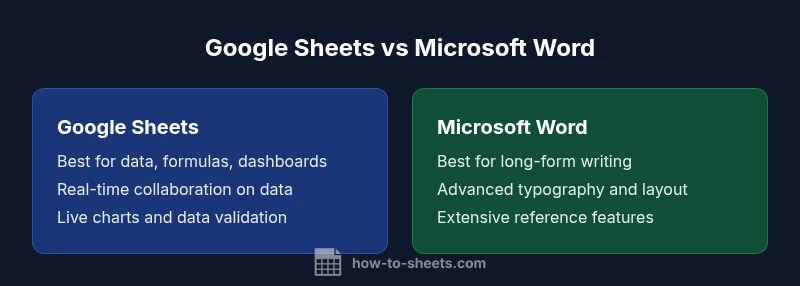
The most important distinction is purpose. Google Sheets is optimized for data capture, calculation, and visualization, where cells, rows, and formulas model relationships. Microsoft Word, by contrast, specializes in long-form writing, advanced typography, and layout control. While Word offers powerful page design features, Sheets emphasizes data integrity, formula-driven insights, and chart-based storytelling. This fundamental split shapes every other capability—from collaboration and offline access to templates and automation. Recognizing the primary purpose of each tool will help you decide which to reach for when a project demands data accuracy or narrative clarity.
When Sheets shines: data-driven documents and lightweight narratives
Sheets can be surprisingly effective for documentation tasks that are heavily data-oriented. For example, a product spec sheet, a project status report with embedded charts, or a meeting agenda with live data tables can be created, shared, and updated in real time. The ability to link data across sheets, apply conditional formatting, and generate charts makes Sheets a strong companion for reports that require quick iteration and cross-reference. This is particularly true for teams that value live data, lightweight text blocks within a tabular structure, or templates that automatically pull data from other sheets.
Word strengths: long-form writing, layout, and publishing
Microsoft Word remains the benchmark for narrative documents, resumes, and detailed reports that demand precise typography and sophisticated layout. Word’s features like advanced styles, section breaks, columns, and reference management enable complex documents with consistent formatting. When the goal is to produce a professional, publication-ready document with extensive typography, Word generally delivers more control and polish than Sheets. For students and professionals producing proposals, reports, or essays, Word’s rich text formatting and review workflow are unmatched.
Collaboration and cloud workflow: real-time impact in both tools
Both Google Sheets and Microsoft Word (especially in cloud variants) support real-time collaboration, comments, and version history. Sheets’ strength here lies in multi-user data editing, live charts, and formula propagation, which is particularly valuable for cross-functional teams. Word’s collaboration features are improving, with tracked changes and comments updated in real time for shared documents. The best practice is to design a workflow that leverages Sheets for data collection and Word for narrative sections, with careful version control and clear handoffs between formats.
Formatting, templates, and automation: where each tool shines
Word’s typography, styles, and templates enable consistent, professional document design at scale. If your priority is masterful formatting, footnotes, bibliographies, and professional publication standards, Word is typically superior. Google Sheets, meanwhile, excels in templates that automate data entry, data validation, and conditional formatting. Apps Script in Sheets allows custom automation that updates dashboards, while Word’s macros (VBA) automate repetitive formatting tasks. When selecting between them, consider whether your project benefits from data automation and live charts (Sheets) or advanced document styling and references (Word).
Practical scenarios: choosing the right tool by task
- Scenario A: You need a monthly sales report with live charts and a data table that colleagues can edit simultaneously. Sheets is a strong fit here; export or embed elements into a Word report if required.
- Scenario B: You must deliver a client proposal with a polished layout, embedded citations, and a structured table of contents. Word is generally the better option, possibly complemented by Sheets for data appendices.
- Scenario C: You’re drafting a policy document that includes tables and narrative. A hybrid approach—start in Sheets for data sections, then import into Word for final formatting—can be efficient.
Pitfalls and limitations: what to watch out for
Be mindful of the limitations inherent to each tool. Sheets can struggle with complex document layout and text-rich sections that require precise typography. Word can handle these areas better but lacks real-time, data-driven collaboration at scale without additional integrations. Converting between formats can introduce formatting issues, so plan for validation after export. When working across tools, keep a clear versioning strategy and establish a common data source to minimize drift between sheets and documents.
Integration and migration tips: bridging Sheets and Word effectively
To maximize efficiency, design data pipelines that keep source data in Sheets and pull excerpts into Word as needed. Use copy-paste with formatting where safe, or export Sheets data as CSV/Excel and import into Word tables. If you frequently switch between the two, consider templates that standardize headings, styles, and data sections to reduce reformatting. Regularly review where data updates occur to maintain consistency across documents and dashboards.
Decision framework: a quick checklist for choosing the right tool
- Is the primary goal data capture, analysis, or visualization? If yes, Sheets is likely the better choice.
- Is the priority professional typography, long-form writing, or publishing quality? If yes, Word wins.
- Do you need real-time collaboration on data and text? Both tools offer this, but Sheets tends to handle simultaneous data edits more robustly.
- Will you need repeated templates and automations? Sheets has strong automation potential through Apps Script; Word excels with advanced formatting templates.
The evolving landscape: where Sheets and Word are headed together
Cloud-based productivity continues to blur the lines between traditional word processing and spreadsheet work. As Google and Microsoft add features, the gap narrows in some use cases, especially in hybrid documents that blend narrative text with data-driven content. The ongoing trend is to view Sheets and Word as complementary tools within a broader ecosystem, enabling teams to assemble complete documents that incorporate live data, charts, and narrative sections with minimal friction.
Comparison
| Feature | Google Sheets | Microsoft Word |
|---|---|---|
| Primary function | Spreadsheet-focused: data capture, calculations, charts | Word processing: long-form writing, formatting, publishing |
| Best use cases | Data analysis dashboards, lightweight reports with live data | Proposals, reports, manuals with advanced typography |
| Formatting capabilities | Cells, conditional formatting, data tables, charts | Styles, sections, columns, precise typography |
| Collaboration features | Real-time multi-user editing of cells; comments and version history | Real-time collaboration with edits, track changes in newer roots |
| Offline access | Offline mode supports editing and viewing data | Desktop Word offers robust offline editing |
| Automation & macros | Apps Script for automation and dashboards | VBA/macros for advanced document automation |
| File formats & exchange | GSHEET export/import via CSV/Excel compatibility in many cases | DOCX/PDF export; rich import/export support |
| Cost & access | Free with Google account; Workspace enhances features | Microsoft 365 license; desktop and online options |
The Good
- Clarifies best-use scenarios for data vs text tasks
- Highlights cross-tool workflows and hybrid solutions
- Emphasizes collaboration and cloud accessibility
- Encourages data-to-document integration strategies
- Supports scalable templates and automation in Sheets
The Bad
- Can overstate overlap; each tool has clear strengths
- Feature parity varies by platform and edition
- Export/import can introduce formatting gaps
- Hybrid workflows may require more governance in teams
Word remains superior for long-form writing; Sheets is best for data-driven documents and live dashboards
Choose Word for narrative-rich documents and precise layouts. Use Sheets for data-heavy content, quick reports, and live-chart integration. In hybrid projects, combine both with clear handoffs to maximize efficiency.
FAQ
What is the main difference between Google Sheets and Microsoft Word?
Google Sheets is a spreadsheet tool focused on data capture, calculation, and visualization, while Microsoft Word is a word processor designed for long-form writing and complex document layouts. The two serve different core purposes, though both support collaboration and cloud access.
Sheets focuses on data and charts, Word on writing and layout; they’re designed for different tasks, though both support collaboration.
Can Google Sheets replace Word for long documents?
In most cases, Word is better for long-form writing, citations, and layout-heavy documents. Sheets can handle data-heavy reports, but it lacks the rich typography tools and reference management that Word provides. Consider a hybrid approach when needed.
Sheets isn’t ideal for long drafts; use Word for lengthy documents, or pair Sheets data with Word layouts.
How do collaboration features compare between the two?
Both support real-time collaboration and version history, but Sheets often handles simultaneous data edits more fluidly, while Word’s collaboration focuses on text revisions. For teams, a combined workflow leveraging Sheets for data and Word for writing can be highly effective.
Both allow live collaboration, with Sheets excelling in data edits and Word in text revisions.
Is there a way to embed Word features in Sheets, or vice versa?
You can embed charts and tables from Sheets into Word documents, and you can paste rich text into Sheets. For advanced Word features like bibliographies, rely on Word; for dynamic data, rely on Sheets. Workflow automation between the two is possible but may require manual steps or scripts.
Export data from Sheets to Word for rich layouts; inter-tool embedding helps, but some features stay tool-specific.
Which is better for templates and reports?
Word generally offers more mature templates and advanced formatting options for reports. Sheets provides data-centric templates and dashboards, useful for recurring data reports with live visuals. A combined approach can yield strong results.
Word for polished reports; Sheets for data-heavy templates and dashboards.
Are there common compatibility issues when moving content between the apps?
Exporting between Sheets and Word can introduce formatting changes, especially with complex tables or fonts. It’s wise to validate layouts after transfer and keep a centralized data source to minimize drift between documents and dashboards.
Transfers can cause formatting shifts; validate layouts after moving between Sheets and Word.
The Essentials
- Identify each tool's core strength before starting
- Use Sheets for data, Word for narrative sections
- Leverage templates and automation where possible
- Plan export/import steps to preserve formatting
- Adopt a hybrid workflow for data-driven documents