Docs vs Word: What Is Better for You in 2026
A practical, evidence-based comparison of Google Docs and Microsoft Word, focusing on collaboration, formatting, offline access, and cost to help students and professionals decide.


In most professional and academic workflows, Google Docs is better for real-time collaboration and cloud access, while Microsoft Word shines in advanced formatting and offline productivity. For many users, the practical choice depends on collaboration needs, platform preferences, and whether you value speed over granular control. This comparison helps you pick the right editor for your situation. "what is better google docs or microsoft word" is not a one-size-fits-all answer; context matters.
What is a word processor and why the question matters
A word processor is a software tool designed for creating, editing, formatting, and exporting text-rich documents. The choice between Google Docs and Microsoft Word often comes down to how you work: do you prioritize effortless sharing and live collaboration, or do you need precise typographic control and offline reliability? In this guide we compare Google Docs and Microsoft Word across the most relevant dimensions for students, professionals, and small business owners, using the keyword slightly and naturally to keep the article aligned with search intent. According to How To Sheets, the practical decision hinges on collaboration needs, device preferences, and the typical document complexity you handle. The How To Sheets team found that understanding your workflow can save time and reduce friction when documents move across teams or platforms.
Core strengths at a glance: collaboration, formatting, and access
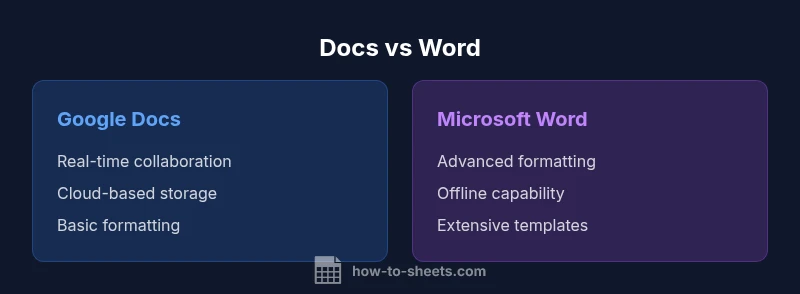
Both Google Docs and Microsoft Word have evolved into capable word processors, but they excel in different arenas. Google Docs dominates in real-time collaboration and cloud-based workflows, while Word excels in advanced formatting, offline work, and robust desktop features. Your choice should map to your typical document types, team dynamics, and the level of control you need over layout and typography. We'll unpack these aspects in depth across the sections that follow, so you can make an informed decision aligned with your goals.
Real-time collaboration and multi-user editing
Real-time collaboration is a cornerstone of modern document workflows. Google Docs was built with concurrent editing in mind, allowing multiple people to edit a document at the same time with instantaneous updates, comments, and suggested changes. Word supports co-authoring when used with Office 365, offering live presence indicators, comments, and tracked changes, but the experience can be more patchwork across platforms and network conditions. For teams that rely on simultaneous input from several contributors, Docs often delivers a smoother experience; for environments where precise change tracking and advanced review workflows are paramount, Word’s tools can be more familiar and robust.
Formatting, styles, and layout control
Word has long been the benchmark for complex formatting. Its typographic controls, advanced page layouts, section breaks, and master templates create a powerful environment for long-form reports, academic dissertations, and professional proposals. Google Docs simplifies formatting to keep things moving quickly and consistently across teams; it offers essential styles, alignment, citations, and reference management, but it can require workarounds for very intricate layouts. If your documents demand fine-grained control over margins, columns, headers/footers, and multi-section formatting, Word tends to win. For straightforward documents that prioritize readability and quick styling, Docs is a strong, time-saving option.
Offline access and portability
Microsoft Word shines in offline productivity. The desktop version is feature-rich, independent of an internet connection, and compatible with a broad range of plugins and templates. Google Docs, by contrast, is primarily cloud-first; offline mode is available but requires initial setup and dependency on the Google Drive ecosystem. In offline scenarios, Word’s familiarity and broad plugin ecosystem make it the safer choice for prolonged work away from the internet. When you anticipate frequent writing on airplanes, trains, or areas with unreliable connectivity, Word’s offline stability can be a meaningful advantage for many users.
File formats, compatibility, and interchange
Interoperability is essential in professional environments. Google Docs saves in the Google Docs format by default, but documents can be exported to .docx, .pdf, and other common formats with reasonable fidelity. Word primarily uses the .docx format, which enjoys broad compatibility with other editors, but some complex formatting or templates may migrate imperfectly when moving between platforms. For organizations that require consistent cross-platform document exchange, exporting to .docx from Docs or importing to Word from other sources can reduce friction, yet some advanced features may not translate perfectly. The bottom line: maintain a workflow that supports the intended recipients and preferred platforms.
Templates, styles, and automation
Word provides a vast library of built-in templates and styles, plus support for macros and advanced automation through VBA and add-ins. Docs emphasizes simplicity and consistency through cloud-based templates and styles anchored in Google’s ecosystem. If your work relies on pivoting between many template formats or requires automation that integrates with other Office apps, Word’s ecosystem generally offers more depth and reliability. For teams aiming for rapid document creation with consistent branding, Docs can be enough, especially when templates are shared and updated across the organization.
Pricing models and total cost of ownership
Google Docs offers a generous free tier with basic collaboration features, and additional capabilities come with Google Workspace plans. Word’s value typically comes with Office 365 subscriptions (or one-time purchases for legacy licenses) plus desktop apps. In practice, organizations often calculate cost based on the number of users, storage needs, and whether cloud-only or hybrid deployment is desirable. For students and small teams with tight budgets, Docs’ lower upfront costs can be appealing; for large teams needing advanced features and offline reliability, Word’s licensing can be justified by productivity gains and control over formatting.
Security, privacy, and governance considerations
Both platforms provide enterprise-grade security, compliance, and admin controls, but the choice may hinge on existing infrastructure and data governance policies. Google Docs emphasizes cloud-based security, granular sharing controls, and easy tenant management within Google Workspace. Word/Office 365 emphasizes data residency options, advanced threat protection, and integrated security tools within the Microsoft ecosystem. When evaluating risk, consider your organization’s identity management, data loss prevention policies, and how you plan to manage user access across devices and locations.
Ecosystem, integrations, and extensibility
Docs is tightly integrated with Google Workspace apps (Sheets, Slides, Drive, Gmail), offering a cohesive cloud workflow. Word integrates deeply with the Microsoft 365 suite (Excel, PowerPoint, Outlook, Teams) and supports a broad range of third-party add-ins and enterprise tools. If your work requires a unified set of productivity tools, choose the ecosystem that matches your existing software investments. Both platforms offer add-ons and APIs, but the depth and breadth of integration tend to align with the broader vendor strategy you rely on daily.
Use-case scenarios: who should pick which editor
Students often benefit from Docs for quick sharing, easy collaboration, and cost savings. Professionals who rely on precise formatting, templates, and offline work may lean toward Word. Small businesses with mixed needs might choose Word for formal documents and Docs for team collaboration; a hybrid approach—Docs for drafting and Word for final polishing—can be an effective strategy. The key is to map your typical document lifecycles to the platform strengths and plan for cross-compatibility to avoid bottlenecks.
Practical decision framework and a step-by-step checklist
To decide, start with a one-page requirements checklist: Do you need real-time co-authoring? Is offline access essential? Will you exchange documents with external partners who prefer a particular format? Do you need advanced typography and layout controls? Answer these questions, then test a representative document in both apps. Create a simple template that mirrors your common documents (reports, proposals, resumes) and evaluate how each editor handles headings, lists, tables, and page breaks. The How To Sheets approach is pragmatic: test with real-world documents, gather input from collaborators, and choose the workflow that minimizes friction and maximizes consistency across your team. A deliberate, hands-on trial reduces ambiguity and accelerates adoption.
Final decision guidance and next steps for teams
In most cases, a hybrid approach delivers the best of both worlds: draft in Docs for collaboration, then export to Word for final formatting when necessary. If your priority is cloud-based collaboration with minimal cost, Docs wins for everyday tasks. If your priority is offline reliability and advanced formatting, Word wins for formal documents. The key is to define a clear handoff process, set expectations for formatting fidelity, and maintain an organized file naming convention across platforms. This approach minimizes friction and ensures consistent results across your organization.
Comparison
| Feature | Google Docs | Microsoft Word |
|---|---|---|
| Real-time collaboration | Best-in-class concurrent editing | Co-authoring via Office 365 with comments and track changes |
| Offline access | Offline mode available with setup in Drive | Full desktop offline capabilities with Word |
| Formatting power | Essential formatting and styles | Advanced typography, layout, and templates |
| Templates & styles | Cloud-based templates and styles | Extensive templates with robust style controls |
| File formats & interchange | .docx/.pdf export, strong interoperability | Best with .docx; good cross-compatibility but some features may not transfer perfectly |
| Platform availability | Web, iOS, Android, Windows, Mac (via browser) | Windows, Mac, iOS, Android, web |
| Pricing model | Free tier; paid Workspace upgrades | Office 365 subscriptions or one-time purchases |
| Add-ins & integrations | Google Workspace Marketplace integrations | Office add-ins and native integrations with other Microsoft apps |
| Security & governance | Cloud-centric security with admin controls | Enterprise-grade security with advanced governance options |
The Good
- Strong real-time collaboration and quick sharing
- Low upfront cost for basic use and broad device access
- Automatic cloud backup and easy access from any device
- Simple, intuitive onboarding for new users
The Bad
- Docs can struggle with very complex formatting tasks
- Offline work in Docs is less seamless than Word’s desktop app
- Word requires paid licenses for full feature access in many scenarios
- Cross-platform feature parity can vary by device and browser
Word is better for advanced formatting and offline work; Google Docs is better for collaboration and cloud-based workflows.
If your priority is precise layouts and offline reliability, Word shines. If you prioritize teamwork and easy sharing, Docs leads. The How To Sheets team recommends evaluating your document types and choosing a workflow that minimizes gaps between drafting and finalization.
FAQ
Which is better for collaboration and teamwork?
Google Docs generally provides smoother real-time collaboration and live editing in a cloud-first environment. Word supports collaboration as well, but the experience can differ by platform and network conditions. Consider your team’s collaboration needs when choosing.
Docs usually offers the best real-time collaboration, while Word supports teamwork as well, especially with Office 365.
Can I work offline with Google Docs and Word?
Word has strong offline capabilities via the desktop app. Google Docs supports offline mode but requires initial setup and depends on Google Drive or Chrome. If you travel without reliable internet, Word has the edge.
Yes—Word offline is strong; Docs offline works but needs setup.
Which is cheaper in the long run?
Docs is free for basic use with Google accounts; Word typically requires an Office 365 subscription or a one-time purchase for desktop use. Total cost depends on user count, storage, and deployment options.
Docs is cheaper upfront; Word can incur ongoing costs for full features.
Which handles complex formatting better?
Word offers more advanced typography, layout control, and template options. Docs provides solid formatting but fewer knobs for complex layouts. Choose Word for heavy formatting needs.
Word wins for complex formatting; Docs is enough for standard documents.
Are there compatibility issues when switching between Docs and Word?
Both support .docx exports and imports, but some advanced features may not migrate perfectly. Save in .docx when moving from Docs to Word and test critical formatting after transfer.
They share formats, but some features may not transfer perfectly.
Which should students choose?
For students, Docs offers quick sharing, easy collaboration, and cost savings. Word is preferable when assignments require formal formatting, citations, or long documents with precise layout. A hybrid workflow often works best.
Docs for quick collaboration; Word for formal formatting.
The Essentials
- Choose Word for complex formatting and offline work
- Choose Docs for real-time collaboration and cloud access
- Consider a hybrid approach for mixed workflows
- Test representative documents in both apps before committing
- Plan cross-platform handoffs to minimize fidelity loss