Why Google Docs Is Often Better Than Word: A Practical Comparison
This objective guide weighs collaboration, accessibility, offline use, templates, and compatibility to explain why Google Docs is often the better choice.


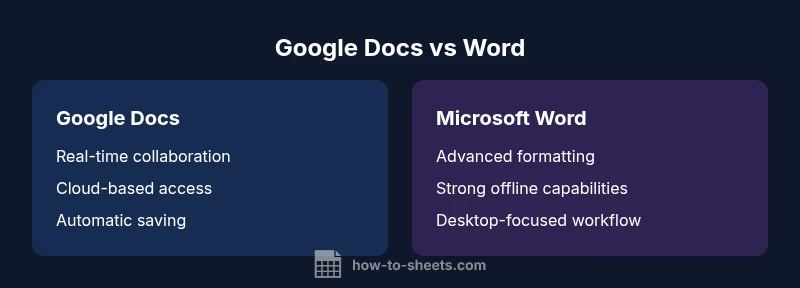
If you ask why is google docs better than microsoft word, the answer is that Google Docs excels at real-time collaboration, cloud access, and cross-device editing. Word remains strong for offline work and advanced formatting, but Docs' collaborative features often win for teams and projects. For many users, the practical choice is Google Docs for shared work.
Why collaboration and cloud access redefine document work
When evaluating why is google docs better than microsoft word, the central questions revolve around collaboration speed, accessibility, and version control. Google Docs places editing, commenting, and sharing in a single, cloud-based workspace that updates live as teammates contribute. According to How To Sheets, teams relying on shared documents typically experience fewer version conflicts and faster feedback cycles when they operate in a cloud-native environment. The phrase why is google docs better than microsoft word is often cited because of the continuous saving, cross-device access, and built-in access controls that reduce bottlenecks in group projects. This section explains how these features translate into practical outcomes for students, professionals, and small business owners who need timely collaboration, clear audit trails, and predictable document state across devices.
Real-time collaboration and cloud-first workflows
Real-time collaboration is the flagship capability that differentiates Google Docs. Multiple people can edit a document simultaneously, see each other’s cursors, and leave targeted comments or suggested edits. This reduces back-and-forth email chains and accelerates decision-making, especially when teams are distributed or working across time zones. The cloud-native design means changes are saved automatically, with revision history that makes it easy to audit decisions or revert to earlier versions. For teams that depend on timely input from stakeholders, Docs becomes a natural hub for drafting, reviewing, and finalizing documents in a living workspace.
Offline functionality and reliability
Offline access is essential when internet reliability is inconsistent or when working in environments with limited connectivity. Google Docs supports offline editing (with the appropriate setup) and automatically syncs changes when a connection becomes available. Word offers robust offline capabilities through its desktop applications, which some users prefer for guaranteed local editing without relying on cloud access. The trade-off is that Google Docs emphasizes continuous cloud synchronization and seamless sharing, whereas Word emphasizes independent work streams and more mature desktop formatting features. For users who travel or work remotely, the ability to edit offline in Word may be reassuring, but the moment connectivity is restored, Docs catches up with others by syncing edits in real time.
Templates, add-ons, and ecosystem
The Google Docs ecosystem leverages templates and a broad range of add-ons that extend functionality directly within the document editor. Templates streamline common workflows such as resumes, reports, and project plans, while add-ons can automate tasks like bibliography formatting or citation management. Word also has a strong template library and extensive add-in support, particularly in enterprise environments, but the cloud-first model of Docs makes it easier to reuse templates across teams and devices. The ecosystem matters when you value consistency, repeatability, and quick onboarding for new contributors.
File compatibility and export options
Interoperability is a practical concern for many organizations. Google Docs uses its native Docs format while supporting export to DOCX, PDF, and other common formats. Importing Word documents is straightforward, and formatting is generally preserved well enough for ongoing collaboration. Word’s counterpart is DOCX as a universal format that remains dominant in many industries. The choice often comes down to your workflow: if you collaborate heavily in Google Workspace, Docs typically offers smoother round-tripping and easier mass sharing; if your work hinges on Word-specific formatting, remains essential to ensure fidelity across platforms.
Security, permissions, and governance
Security and permissions are pivotal in professional environments. Google Docs leverages Google Drive’s security framework, including role-based access, sharing controls, and activity logs. For teams prioritizing controlled access and auditability, Docs can offer streamlined permission management across documents and folders. Word, particularly in on-premise setups or Microsoft 365 environments, provides parallel controls, data governance, and advanced information protection features. The decision often depends on your organization’s existing security posture and compliance requirements; both platforms offer robust protections, but the implementation and risk posture differ.
Cost, licensing, and access models
Pricing models influence the overall value proposition. Google Docs is free for individual users with a Google account and included in Google Workspace for business plans, emphasizing affordability and scalability with a cloud-centric model. Microsoft Word is available as part of the Microsoft 365 suite, which bundles Word with additional productivity tools and storage; this can represent a higher total cost but delivers a deeper feature set for advanced document formatting and enterprise workflows. The best choice hinges on your total software stack, user count, and the importance of cross-application integration within your organization.
User experience and accessibility across devices
Docs prioritizes a clean, straightforward interface designed for quick adoption, particularly for students and professionals who value speed and consistency. The web-based editor runs in any modern browser and mirrors your work across devices through Drive synchronization. Word has a long-established desktop presence and powerful formatting capabilities that some users prefer, especially when working with complex documents or offline projects. Accessibility features in both platforms continue to improve, but Docs tends to be favored by teams seeking a low-friction, browser-first workflow.
Migration paths and data fidelity when moving from Word to Docs
Migrating documents from Word to Docs is a common scenario for teams transitioning to a cloud-first workflow. The import experience supports most formatting, with occasional adjustments needed for advanced layout elements. Best practices include testing critical documents in Docs before migrating broader corpuses, preserving fonts and styles to minimize reformatting, and using export options to maintain compatibility for stakeholders who still rely on Word. Clear version history in Docs helps manage changes during the transition and reduces the risk of data loss during migration.
Practical decision guide for different user groups
Students often benefit from the simplicity, real-time collaboration, and cloud access of Google Docs, which makes group projects and feedback loops more efficient. Professionals who require robust offline editing, complex formatting, or heavy desktop integration may still lean toward Word, particularly in formal submissions or print-ready documents. Small businesses benefit from the cost-effective collaboration features and easy sharing in Docs, combined with the broader productivity suite in Google Workspace. The right choice aligns with how you work, who you collaborate with, and how you balance online availability with offline needs.
Common myths and misconceptions
A common misconception is that Google Docs can’t handle professional formatting. In reality, Docs supports a strong range of formatting options suitable for most business needs, particularly when paired with templates and add-ons. Another myth is that Docs is universally inferior for large documents; while Word's desktop features shine in very long or highly formatted documents, Docs remains capable for most business, education, and personal use cases, especially for collaborative editing and rapid iteration.
Actionable steps to optimize Google Docs usage
To maximize Google Docs today, enable offline access for essential documents, organize your files with meaningful folders in Google Drive, and set appropriate sharing permissions from the outset. Leverage the comment and suggestion workflows to capture feedback efficiently, and explore useful add-ons for citation management, table formatting, or project tracking. Finally, standardize templates for recurring reports or assignments so that everyone in your team or class starts from a consistent baseline, reducing rework and improving clarity.
Comparison
| Feature | Google Docs | Microsoft Word |
|---|---|---|
| Collaboration & Editing | Real-time, multi-user editing with comments/suggestions | Co-authoring with track changes and comments |
| Offline Access | Built-in offline mode for docs when offline (with setup) | Desktop apps with robust offline editing |
| Templates & Extensions | Cloud-based templates and easy sharing via Drive | Rich desktop templates and extensive formatting options via Word |
| File Compatibility & Export | Native Docs format; export to DOCX/PDF | Native DOCX; strong compatibility with formats |
| Cross-Platform Experience | Works in browser across devices; seamless Drive integration | Desktop-first experience with Office ecosystem across devices |
| Cost & Access Model | Free core features with Google account; Workspace adds value | Microsoft 365 subscription for full feature set |
The Good
- Strong real-time collaboration and instant feedback
- Seamless cloud storage and cross-device syncing
- Low upfront cost for individuals; scalable for teams
- Automatic version history and simple sharing controls
The Bad
- Offline reliability can depend on setup and connectivity
- Advanced formatting and desktop-only features may be stronger in Word
- Reliance on internet for best experience-collaboration context
Google Docs is typically the better choice for collaborative workflows, while Word remains strong for offline work and complex formatting.
Choose Google Docs if collaboration and cloud access are your priorities. Opt for Word if you need offline capability and advanced desktop formatting.
FAQ
What are the main advantages of Google Docs over Microsoft Word?
Google Docs excels in real-time collaboration, cloud access, and cross-device editing, which accelerates group work. Word provides stronger offline capabilities and more mature formatting options. The best choice depends on whether collaboration or standalone formatting is your priority.
Google Docs shines for teamwork and cloud access, while Word shines for offline work. The choice depends on your collaboration needs.
Can Google Docs work offline?
Yes, Google Docs can work offline after enabling offline access in settings. Edits sync automatically when an internet connection is restored. This makes it viable even when connectivity is inconsistent.
Yes, you can edit offline after enabling offline mode, and changes sync later.
Is Google Docs secure for businesses?
Google Docs relies on Google Drive’s security framework, including access controls and activity logs. Word offers similar protections within Microsoft 365 or on-premises deployments. The right choice depends on your organization’s security posture and compliance requirements.
Both offer strong security; pick based on your compliance needs and existing systems.
How do I migrate from Word to Google Docs?
You can import Word documents into Google Docs and adjust formatting as needed. Start with a few representative documents to test fidelity, then standardize templates for future projects to minimize reformatting.
Import Word files into Docs and adjust formatting as needed; test first.
Does Google Docs support advanced formatting like Word's features?
Google Docs covers most common formatting needs and offers templates and add-ons to fill gaps. For very complex layouts, Word on desktop may still offer advantages. Consider your document type and audience when deciding.
Docs handles most formatting, but Word may be better for highly complex layouts.
The Essentials
- Collaborate in the cloud with real-time editing
- Balance online ease with offline needs when choosing tools
- Leverage templates and add-ons for efficiency
- Consider migration steps if moving from Word to Docs
- Assess security controls and licensing in your context