What’s the difference between a Google Sheet and a Google Doc
Explore the key differences between Google Sheets and Google Docs, focusing on structure, collaboration, offline access, and best-use scenarios for data tasks versus writing.


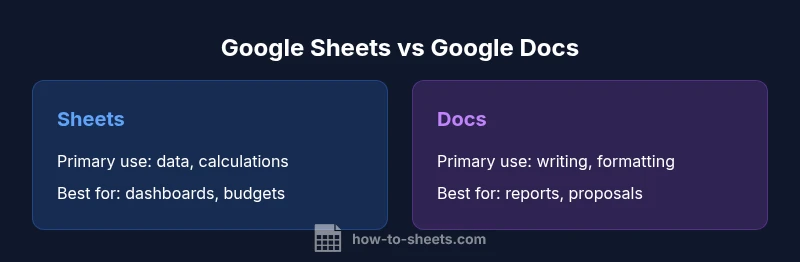
In short, Google Sheets is designed for data, numbers, and computations, while Google Docs focuses on writing, formatting, and long-form content. The two tools integrate smoothly—you can embed Sheets charts in Docs, or reference Docs content in Sheets via links and comments. For quick decisions, choose Sheets for data work and lists; choose Docs for narrative documents and reports. what's the difference between a google sheet and a google doc is fundamental to aligning workflow with task type, collaboration goals, and output requirements.
what's the difference between a google sheet and a google doc
In many teams, the question What's the difference between a google sheet and a google doc is not just academic—it's a decision that shapes how work gets done. This section grounds the distinction in practical terms, highlighting core capabilities, typical tasks, and the kinds of outputs each tool excels at. The emphasis here is on aligning the task with the appropriate workspace to maximize accuracy, speed, and collaboration. For anyone new to Google Workspace, understanding this difference helps prevent adopting the wrong tool for a given job and speeds up onboarding for new team members.
Core distinctions: structure and content models
Google Sheets and Google Docs share a common interface philosophy, yet their data models diverge. Sheets organizes data in cells, rows, and columns—perfect for numbers, lists, budgets, and dynamic charts. Docs organizes text, images, tables, and styles—ideal for essays, proposals, meeting notes, and manuals. This structural divergence influences how you format content, how you search and analyze data, and how you present insights to stakeholders. When you see a task involving structured data or quantitative analysis, the most effective approach is to lean toward Sheets; for narrative content and formal documents, Docs shines. The keyword whats the difference between a google sheet and a google doc appears here to reinforce the decision framework.
Data handling and calculations in Sheets
Sheets is built for precision in data handling. You can enter numbers, dates, and text in cells, then apply a wide range of functions to perform calculations, analyze trends, and automate repetitive tasks. Features like sorting, filtering, named ranges, and conditional formatting help you maintain data integrity and visibility across large datasets. Charting and pivot tables extend your ability to summarize data visually. For teams tracking budgets, forecasts, or inventories, Sheets provides the backbone for reliable quantitative work. The integration with other Workspace apps means you can pull data from Forms or upload to Drive with minimal friction.
Text creation and formatting in Docs
Docs prioritizes narrative structure and formatting versatility. You get headings, styles, bullets, tables, footnotes, and extensive publishing-ready layout options. Real-time collaboration supports comments, suggestions, and threaded discussions that keep the writing process transparent. When you’re producing reports, proposals, or knowledge bases, Docs helps you maintain consistent typography, accessibility, and version history. The balance of readability and editing controls makes Docs the preferred workspace for long-form content, legal documents, and documentation that requires precise presentation.
Collaboration and sharing workflows
Both Sheets and Docs excel at real-time collaboration, but they optimize different workflows. Sheets highlights concurrent data entry, cell-level edits, and built-in cell history, which is essential for multi-user data entry and rapid reconciliation. Docs emphasizes simultaneous writing, editorial feedback, and streamlined comments on text blocks. In projects that involve both data and narrative components, teams typically split tasks: data work happens in Sheets, reporting and storytelling happen in Docs, with links or embedded charts to connect the two. The collaboration model is powerful when you combine both tools rather than relying on one for all tasks.
Formatting, styles, and presentation
Sheets focuses on numeric presentation, conditional formatting, and chart-driven visuals within a grid. The formatting options are best suited to ensure data is readable and correctly aligned for analysis. Docs offers rich typography controls, advanced headings, page layouts, and print-ready formats. If you need a polished, publication-ready document, Docs provides a more robust set of formatting tools. But for dashboards, data-driven reports, and live charts, Sheets delivers more direct value. What’s the difference between a google sheet and a google doc becomes clear when you test readability and print quality across both environments.
Embedding and linking across apps
One of the strongest advantages of Google Workspace is cross-app integration. You can embed Sheets charts and data tables into Docs, linking sources so charts update automatically as the underlying data changes. Conversely, you can reference Docs content in Sheets via text references in cells or comments. This cross-pollination enables hybrid reports where the data backbone is in Sheets and the narrative in Docs. It’s a practical way to keep data-driven insights and written analysis synchronized, reducing manual duplication and errors. The capitalization of the integration makes the phrase much more than a casual query; it becomes a workflow strategy.
Offline access and reliability
Both Sheets and Docs support offline access, enabling you to view and edit content without an internet connection. Sheets offline mode preserves your formulas and data inputs locally, while Docs offline mode keeps your writing available for access and edits. On restoration of connectivity, changes sync automatically, preserving version histories. The offline capabilities ensure productivity in travel, commutes, or regions with intermittent connectivity. For teams that rely on field data collection or on-site reporting, offline readiness is a critical factor in choosing between Sheets and Docs and in planning a robust workflow across devices.
Formulas, functions, and automation
Sheets offers a comprehensive set of formulas and functions, enabling complex calculations, data transformations, and automation via Apps Script. It’s the go-to tool when your work requires numerical analysis, conditional logic, and multi-step data processing. Docs lacks spreadsheet-style formulas; it focuses on text processing and formatting. You can still automate repetitive writing tasks in Docs using features like templates and styles, but the computational depth sits squarely in Sheets. When your project hinges on live data manipulation, Sheets is the clear performer; when it hinges on narrative consistency, Docs takes the lead.
Integrations with other Workspace apps
Both tools integrate seamlessly with other Google Workspace apps like Forms, Slides, Gmail, and Drive. Sheets may pull data from Forms or export to Slides for dashboards, while Docs can pull images or charts to embed in reports. The key is to design the workflow: use Sheets for data collection and analysis, Docs for summary reports and communications, and Slides for presentation decks. The integration enables end-to-end workflows from data capture to narrative delivery, with minimal manual re-entry and maximum traceability.
Use-case scenarios: data tasks vs writing tasks
For data-centric projects—budgets, inventory tracking, or analytics—Sheets is the natural home. Its formulas, charts, and pivot capabilities support dynamic analysis and rapid iteration. For writing-centric tasks—proposals, meeting notes, policy documents—Docs is the more productive environment, offering richer formatting, easier collaboration, and stronger long-form readability. In blended projects, a common approach is to maintain the data core in Sheets and create a sit-down narrative in Docs that references charts and tables. This separation of concerns helps maintain accuracy while delivering clear, consumable outputs. The exact keyword phrase appears again here as a reminder that the choice hinges on task intent.
Security, permissions, and governance
Both Sheets and Docs inherit Google Workspace security controls, including granular sharing permissions, link settings, and audit trails. In Sheets, control access to specific ranges to protect sensitive data while still enabling collaboration. In Docs, you can restrict who can comment, suggest, or edit to preserve the integrity of the narrative. Establishing clear governance policies—such as naming conventions, version control, and review workflows—helps teams avoid data leakage and ensure compliance. Regularly review shared access and enable the appropriate level of collaboration for each project.
Migration tips: moving content between Sheets and Docs
When moving between Sheets and Docs, plan your data flow carefully. If you need numeric data in a narrative report, export the required ranges as CSV or copy charts as linked images. For charts, choose the option to 'Link to spreadsheet' so updates propagate. If you’re publishing or sharing externally, export Docs as PDF or Word for compatibility while preserving formatting. Practice a small pilot migration to identify formatting quirks and ensure the final output matches your expectations. The ongoing insight about what's the difference between a google sheet and a google doc is to think in terms of data vs narrative flow, not just file format.
Common mistakes and how to avoid them
A frequent error is using Docs for raw data storage or relying on Sheets for long-form writing. Misapplying one tool to a task can degrade workflow quality. Another pitfall is neglecting version history and permissions, leading to confusion or accidental data loss. Avoid these by establishing explicit roles, maintaining separate files for data and narrative, and leveraging cross-linking rather than duplicating content. Finally, remember to test charts and tables in context—appearance and clarity can change when embedded in Docs or shared with external viewers. The persistent question what's the difference between a google sheet and a google doc often resurfaces when teams attempt to reuse templates across tasks.
Quick-start decision framework: a 4-step approach
Step 1: Define the primary task—data manipulation or narrative writing. If data is central, start in Sheets; if the narrative is central, start in Docs. Step 2: Identify required outputs—dashboard, report, or proposal—and pick the tool that supports the best presentation of those outputs. Step 3: Consider cross-app needs—do you need charts in a document or text in a data sheet? Plan the integration early. Step 4: Establish governance—set access, templates, and version control for consistency. Following this framework helps teams apply the right tool for the right job, reinforcing the core concept of whats the difference between a google sheet and a google doc and its practical implications for everyday work.
Comparison
| Feature | Google Sheets | Google Docs |
|---|---|---|
| Primary use | Data organization, calculations, and charts | Long-form writing, formatting, and collaboration on text |
| Content types supported | Numbers, dates, formulas, tables, charts | Text, headings, images, tables, rich formatting |
| Formula/automation support | Full formulas and scripting (Sheets formulas, Apps Script) | No spreadsheet formulas; automation via templates and styles |
| Collaboration model | Cell-level edits, live collaboration, version history | Text-level collaboration, comments, suggestions, and track changes |
| Offline access | Yes, with Sheets Offline | Yes, with Docs Offline |
| Embeddable content | Charts and data embedded in Sheets; can export to PDFs | Can embed charts from Sheets and images; formatting focus |
| Output formats | XLSX, CSV, PDF, etc. | DOCX, PDF, ODT, etc. |
| Best for | Dashboards, budgets, data-heavy analyses | Reports, proposals, manuals, policies |
The Good
- Clarifies task boundaries, reducing tool misuse
- Strong data capabilities with Sheets for numbers and formulas
- Rich writing and formatting capabilities with Docs
- Excellent cross-app workflows (embedded charts, linked data)
The Bad
- Requires switching tools for blended tasks (data + narrative)
- Sheets is not ideal for long-form writing with heavy formatting
- Docs lacks built-in data analysis features and advanced formulas
- Over-reliance on cross-links can complicate maintenance
Use Sheets for data-centric tasks and Docs for writing-centric tasks; leverage cross-app features to create integrated reports.
Sheets handles data, calculations, and dashboards efficiently; Docs excels at narrative content and formatting. For blended projects, use both tools and connect them via charts, links, and embedded objects to maximize usefulness.
FAQ
What are the main differences between Google Sheets and Google Docs?
Sheets focuses on data, calculations, and charts, while Docs focuses on writing and formatting. Each is optimized for its core task, though you can connect them to create hybrid outputs.
Sheets is for data; Docs is for writing.
Can I use both tools for a single project?
Yes. You can build the data backbone in Sheets and the narrative in Docs, then link charts and insert them into the document for a cohesive report.
Yes—use both to leverage strengths of each.
When should I prefer Docs over Sheets?
Choose Docs when your priority is long-form writing, formatting, and publishing-ready documents such as reports or proposals.
Docs is best for writing and formatting.
When should I prefer Sheets over Docs?
Go with Sheets for budgets, data tracking, calculations, and quick data analysis.
Sheets is best for data work.
Do Sheets and Docs support offline access?
Yes. Both support offline mode so you can work without internet and sync later.
Both have offline modes.
Can I embed Sheets charts in Docs?
Yes, you can insert live charts from Sheets into Docs so they update when data changes.
Charts can be linked and updated.
The Essentials
- Choose Sheets for data analysis and dashboards
- Choose Docs for reports, proposals, and manuals
- Embed Sheets charts in Docs for dynamic reports
- Leverage cross-app links to maintain consistency
- Establish governance to manage access and versions