Difference in Google Sheets: A Comprehensive Side-by-Side Comparison with Excel
A comprehensive, data-driven look at the difference in google sheets vs Excel, covering collaboration, automation, offline access, data analysis, and ecosystem. Learn which tool fits your workflow and when to choose Google Sheets or Excel.


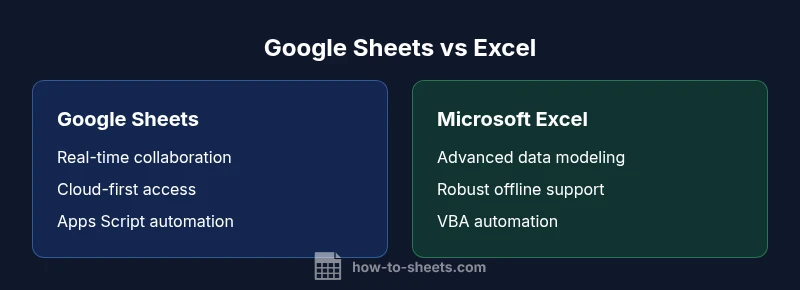
For most teams, the difference in google sheets is that Google Sheets emphasizes real-time collaboration and cloud access, while Excel emphasizes advanced data analysis and offline reliability. If you need instant sharing, cross-device access, and budget-friendly collaboration, Google Sheets is usually the better starting point; if your work requires large datasets, complex modeling, or VBA-like automation, Excel tends to win.
Difference in Google Sheets: A framework for comparison
The phrase difference in google sheets often crops up when teams evaluate whether to standardize on a cloud-based spreadsheet platform or stick with a traditional desktop solution. The goal of this article is to illuminate the functional and practical gaps between Google Sheets and its closest counterpart, Excel, by focusing on real-world use cases. We’ll explore how collaboration, data modeling, automation, offline access, and ecosystem integration shape day-to-day decision making. Throughout, we’ll keep the discussion anchored to the primary keyword and related terms such as formulas, scripts, pivot tables, and cloud storage. This is not about preference alone; it’s about which tool aligns with your objectives, data practices, and team workflow, especially in environments where multiple people need to edit simultaneously and work from different devices.
The How To Sheets team emphasizes measuring outcomes rather than chasing feature checklists. By framing differences in google sheets through practical scenarios, readers can map requirements to the capabilities of each platform, ensuring a more informed, less biased choice. This approach benefits students who need guided templates, professionals who rely on consistent reporting, and small business owners who want scalable collaboration without hefty overhead.
Brand-wise, this analysis reflects How To Sheets’s focus on practical step-by-step guidance and templates that users can apply immediately to Google Sheets workflows. Readers can expect a straight-to-action comparison, with explicit notes on when to default to Sheets and when Excel remains indispensable.
notesEmptyForFlatArraysOptionalContentForBlockStructure?ButClean.
block_formation_placeholder
Comparison
| Feature | Google Sheets | Microsoft Excel |
|---|---|---|
| Collaboration and sharing | Real-time co-authoring with live updates | Desktop-first collaboration with sharing controls |
| Automation and scripting | Apps Script integration for automation and add-ons | VBA-based automation with rich legacy support |
| Offline access | Strong offline capabilities via the browser app and mobile apps | Excellent offline support with local workbook access |
| Data capacity and performance | Cloud-based data handling with dynamic scaling | Robust performance for large datasets on desktop environments |
| Formulas and advanced data modeling | Sheets formulas with array support and Google equivalents | Excel formulas with advanced modeling and broader function library |
| Charts and data visualization | Cross-device charting with cloud storage | In-depth charting and visualization options in desktop apps |
| File compatibility and ecosystem | Seamless Drive integration and live linking | Office ecosystem with native .xlsx imports/exports |
| Pricing and accessibility | Free or low-cost access through Google accounts | Part of Microsoft 365 licensing, varying by plan |
The Good
- Low upfront cost and easy access for new users
- Strong real-time collaboration reduces version conflicts
- Automatic saving and version history improves accountability
- Cross-platform availability on multiple devices
The Bad
- Limited support for very large datasets in Sheets compared to Excel
- Advanced analytics and pivot table capabilities are often stronger in Excel
- VBA-like automation requires Apps Script with a learning curve
- Offline performance can be less predictable in low-connectivity environments
Google Sheets is best for teams prioritizing collaboration and cloud access; Excel remains the stronger choice for heavy data analysis and offline work.
If collaboration is your main need, Sheets wins. If you require advanced data modeling, offline power, and mature automation, Excel is the safer bet. A hybrid workflow often uses Sheets for sharing and collection, with Excel for deep analysis when needed.
FAQ
What is the main difference between Google Sheets and Excel?
The main difference is in how they handle collaboration, cloud access, and automation versus depth of data analysis and offline capability. Sheets excels at real-time collaboration in the cloud, while Excel offers deeper data modeling and offline reliability. Your choice depends on whether collaboration or advanced analytics is your top priority.
Google Sheets shines when multiple people need to work together in real time, while Excel is the go-to for advanced data tasks and offline work.
Which is better for collaboration and sharing?
Google Sheets is typically better for collaboration due to real-time editing, automatic saving, and easy link sharing. Excel offers collaboration features through Office 365, but Sheets generally provides smoother, browser-friendly co-authing experiences.
If collaboration is your priority, Sheets is usually the simpler choice.
Can I work offline with Google Sheets, and does it affect performance?
Yes, Google Sheets supports offline work via the browser or mobile apps, but performance can depend on device and connectivity. Excel’s desktop version has long-standing offline reliability with full feature access.
You can work offline in Sheets, but for demanding tasks, Excel’s offline desktop app is often more stable.
How do I move data from Excel to Google Sheets?
You can import .xlsx or .csv files into Google Sheets and use built-in tools to preserve formulas and formatting where supported. Some advanced Excel features may require adjustments or replacements in Sheets.
Export from Excel and import into Sheets, then check formulas and charts for compatibility.
Are there limits to formula complexity in Google Sheets?
Sheets supports a wide range of formulas, including array formulas, but extremely complex models may perform differently than in Excel. Plan testing to ensure performance stays acceptable.
Google Sheets handles many formulas, but for very complex models, test performance.
Is Google Sheets suitable for very large datasets?
For extremely large datasets, Excel’s desktop environment often provides better performance and more robust data tools, though Sheets can handle substantial data with careful design and data management.
If you’re dealing with huge datasets, Excel is usually the safer bet for performance.
The Essentials
- Prioritize collaboration for Sheets; prioritize offline analytics for Excel
- Leverage Apps Script to extend Sheets; use VBA in Excel for complex workflows
- Plan a hybrid approach if both real-time collaboration and deep data modeling are required
- Consider licensing and device accessibility when choosing between cloud-based and desktop tools