Google Sheets vs Excel: A Practical Comparison Guide
Compare Google Sheets with Excel in depth, focusing on collaboration, offline access, automation, and data visualization. Learn which tool better fits students, professionals, and small teams in a 2026 context.


Quick take: Google Sheets and Excel both power modern work, but the better choice depends on collaboration, offline access, and automation needs. If your team prioritizes real-time sharing and a low upfront cost, Google Sheets is typically the stronger option. For advanced analytics, offline reliability, and deeper data modeling, Excel remains the preferred tool.
What 'google sheets like word' means in practice
In conversations about choosing productivity tools, the phrase 'google sheets like word' often pops up as a shorthand for how far a sheet-based tool can substitute or complement word-processing tasks. For How To Sheets Analysis, 2026, this means assessing the degree to which a spreadsheet app handles rich text, layouts, and document-oriented features alongside data tables. In practice, a tool that is 'google sheets like word' should offer: robust text formatting within cells, the ability to produce clean, printable layouts, and easy export to common formats such as PDF or Word. It should also support templates that combine text blocks with tables, automatic footers, and headers. For students and professionals who frequently create reports from data, this blend matters as much as pure calculation power. The analysis will compare the two most common platforms—Google Sheets and Excel—through this lens, highlighting where word-processing-like capabilities are strong, and where they remain separate apps. According to How To Sheets Analysis, 2026, many teams opt for a combined workflow: data capture in Sheets, narrative in Docs or Word, and seamless export for reporting.
Core criteria for comparison
When evaluating whether Google Sheets or Excel is the better fit, you should anchor decisions to a few core criteria. These criteria reflect real-world workflows used by students, professionals, and small businesses alike. Real-time collaboration and cloud access are the first pillar, followed by offline reliability and data integrity. Automation, scripting, and AI-assisted features matter for scale, while templates, formatting, and reporting capabilities determine how easily you can produce polished outputs. Finally, licensing, price, and ecosystem compatibility strongly influence total value. This section maps each criterion to what matters most for a team implementing a “google sheets like word” approach in everyday work.
Collaboration and sharing: real-time co-authoring
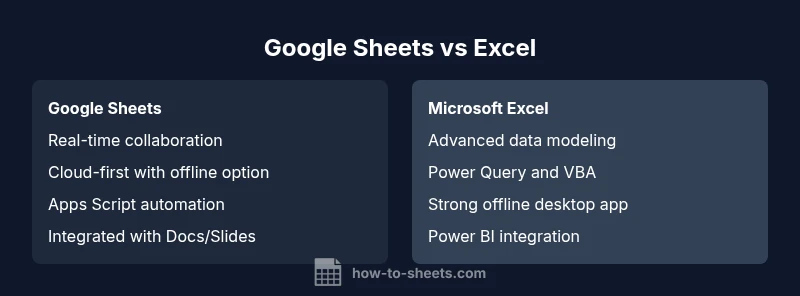
Real-time collaboration is a differentiator between fresh entrants and established suites. Google Sheets shines here with near-instant co-authoring, live chat within the sheet, and straightforward sharing controls. Excel’s online and cloud-based experiences offer solid co-authoring via Office 365, but performance can vary with larger files or slower connections. For teams that need simultaneous editing without friction, Sheets tends to reduce versioning headaches, while Excel offers parity when using the desktop app in a connected, licensed environment. In practice, choose Sheets for cross-functional teams that demand constant updates and quick iteration; choose Excel if you require more complex workbooks that multiple people will co-edit but only when everyone has a robust Microsoft 365 license.
Offline access and reliability
A central question for teams outside of reliable networks is how well the tool works offline. Google Sheets supports offline editing through a browser- or app-based mode, syncing changes once connectivity returns. Excel provides strong offline capabilities in the desktop application, and this offline reliability is a major advantage for people who work in environments with intermittent internet. The trade-off is that Sheets’ offline mode depends on enabling settings and initial synchronization, which can cause confusion for new users. If your workflows include frequent travel or fieldwork, Excel’s offline strength and predictable behavior can be critical, while Sheets is ideal when the majority of work happens online with occasional offline bursts.
Automation and AI features
Automation is a major driver for productivity and scale. Google Sheets offers robust automation through Google Apps Script, add-ons, and simple macros, enabling repetitive tasks, workflow automation, and data parsing right inside the sheet. Excel brings mature automation through VBA, Power Query, and Power Automate integrations in the Microsoft ecosystem, which can handle complex data transformations and enterprise-scale processes. When the goal is to automate simple, data-driven tasks and lightweight reporting, Sheets is often more approachable. For advanced analytics pipelines, Excel’s mature automation stack may deliver deeper control and performance, particularly for large datasets or existing Office-centric workflows.
Data handling, formulas, and precision
Data handling in Sheets and Excel shares many common functions, but edge cases matter. Sheets offers a broad set of functions, array formulas, and dynamic ranges with relatively straightforward syntax. Excel supplies deeper data modeling tools, richer pivot capabilities, and more extensive formula libraries, which supports sophisticated calculations and large datasets. If you frequently work with external databases, large datasets, or pivot-driven reporting, Excel often holds the edge. If your data scope is moderate and you value cloud access and quick sharing, Sheets remains highly capable for day-to-day analysis.
Templates, formatting, and reporting capabilities
Templates and formatting options influence the speed of turning raw data into narrative insights. Google Sheets provides templates and formatting features that align with Google Workspace, allowing you to build reports that blend text blocks with tables. Excel’s templates, formatting options, and advanced charting capabilities enable highly polished reports and dashboards. For a 'google sheets like word' workflow, you want a tool that can present data in a readable, print-ready format; Sheets and Excel both support this, but Excel tends to excel in heavy formatting and professional dashboards, while Sheets emphasizes quick layout and easy sharing across teams.
Integrations and ecosystem: Google Workspace vs Office 365
Your choice of tool is inseparable from its ecosystem. Google Sheets integrates tightly with Docs, Slides, Gmail, and Google Drive, enabling a seamless flow of data across everyday business tasks. Excel integrates smoothly with Word, Power BI, and the broader Microsoft 365 suite, enabling enterprise-grade workflows and data pipelines. If your organization relies on Google Workspace, Sheets is a natural fit; if your processes depend on Microsoft tools or on Power BI for visual dashboards, Excel’s ecosystem offers deeper integration potential. A thoughtful approach is to map current workflows and identify choke points where cross-application integration could save time—and then pick the tool that minimizes friction across those points.
Mobile experience and usability
Mobile usability matters for on-the-go data work. Google Sheets has strong mobile apps with collaborative features designed for quick edits from a phone or tablet, though some advanced formatting may be less convenient on small screens. Excel’s mobile apps compete well, especially for users who need access to hefty Excel workbooks on tablets or phones, complete with familiar formulas and charts. If mobile collaboration and rapid sharing are priorities, Sheets often delivers a smoother experience; if you require full feature parity on mobile devices, Excel’s mobile offerings are typically the better option.
Pricing, licensing, and value proposition
Pricing and licensing shape long-term value. Google Sheets is free to use with a Google account and scales with your Google Workspace plan, providing a low-cost entry point for students and small teams. Excel’s pricing is tied to Microsoft 365 subscriptions, with various tiers designed for individuals, businesses, and enterprises. The cost delta matters when you consider licensing across departments and the need for offline licensing or enterprise security controls. When assessing the value, map your required features, user count, and collaboration needs to understand total cost of ownership across a 1- to 3-year window.
Security, governance, and admin controls
Security and governance are critical in schools and small businesses. Google Sheets inherits Google’s cloud security model, with fine-grained sharing, audit trails, and centralized admin controls via Google Admin Console. Excel/Office 365 offers enterprise-grade security controls, conditional access, and advanced data governance options. For teams prioritizing cloud-first workflows, Sheets provides robust security with straightforward administration; for organizations managing strict compliance, Excel’s enterprise controls and compliance certifications can be decisive. In all cases, hardening access, implementing role-based permissions, and establishing data retention policies reduces risk.
Practical decision scenarios and implementation tips
When you’re choosing between a broad Google Sheets–like word workflow and a desktop-first Excel workflow, start with a pilot. Create a representative data-to-report task: collect data, run formulas, generate a narrative report, and export to PDF for stakeholders. Compare performance, ease of sharing, and the quality of the final document. Consider a hybrid approach if needed: capture data in Sheets, write the narrative in Docs or Word, then consolidate for final reporting. The right answer often comes down to collaboration needs, offline requirements, and the complexity of data tasks. As you plan, involve end users early and measure success against real-world tasks rather than theoretical capabilities.
Comparison
| Feature | Google Sheets | Microsoft Excel |
|---|---|---|
| Collaboration | Real-time co-authoring in Sheets | Co-authoring with Office 365; solid but sometimes slower with large files |
| Offline Access | Strong offline mode via apps/settings | Reliable offline desktop experience; offline features in online apps vary by plan |
| Automation & AI | Apps Script, add-ons, and automation | VBA, Power Query, Power Automate—mature automation |
| Data Capacity & Modeling | Good for typical datasets; strong web-based performance | Excellent for large datasets; advanced modeling and pivots |
| Templates & Reporting | Templates tied to Google Workspace; quick reporting | Rich templates and advanced formatting for polished reports |
| Pricing & Licensing | Free with Google account; scalable with Workspace | Microsoft 365 subscription; licensing varies by tier |
| Cross-Platform Access | Web, mobile apps; seamless cloud sync | Desktop-heavy but available on multiple platforms |
| Data Visualization | Built-in charts; dashboards via Google tools | Powerful charts; pivot charts and dashboards via Excel |
| Security & Admin | Cloud-native security; admin controls in Google Admin | Enterprise-grade security and policies; compliance options |
| Import/Export Compatibility | Good import/export; common formats supported | Strong compatibility with Excel formats and workflows |
The Good
- Clear side-by-side evaluation helps stakeholders align tooling with collaboration needs
- Highlights licensing and ecosystem trade-offs without vendor bias
- Reveals practical migration steps and onboarding considerations
- Supports decision-making for students, professionals, and small businesses
- Encourages pilots and real-world testing before committing
The Bad
- May not capture every enterprise-grade nuance of large organizations
- Some features depend on licensing or regional availability
- Can oversimplify complex data scenarios when applied broadly
Google Sheets is the better pick for collaborative, cloud-first teams; Excel is preferred for heavy data modeling and offline work.
For most students, professionals, and small businesses, Sheets offers superior real-time collaboration and cost efficiency, while Excel delivers deeper analytics. The How To Sheets Team recommends running a pilot with representative tasks to validate which tool best fits your workflow.
FAQ
Which tool is easier to learn for beginners?
Both tools are widely used and have extensive learning resources. Google Sheets tends to be more approachable for new users due to its streamlined interface and browser-based workflow. Excel has a steeper learning curve but offers deeper capabilities once mastered.
Google Sheets is usually quicker to pick up for beginners, while Excel rewards persistence with advanced features.
Can I work offline with Google Sheets?
Yes, Google Sheets supports offline editing when you enable offline mode in your settings. Changes sync automatically when you reconnect to the internet. Expect occasional sync delays if you switch devices frequently.
Yes, you can work offline in Sheets and it syncs once you’re back online.
What are data limits when switching between Sheets and Excel?
Sheets handles typical business datasets well, but Excel generally supports larger workloads and more complex data models. Large, pivot-heavy workbooks in Excel can outperform Sheets in sheer volume and calculation depth.
Excel handles bigger datasets better; Sheets is great for everyday data tasks.
How do automation features compare?
Sheets uses Apps Script and add-ons for automation; Excel relies on VBA, Power Query, and Power Automate. VBA can be more powerful for complex operations, while Apps Script offers a simpler entry point for many teams.
Automations differ by platform—Sheets uses Apps Script, Excel uses VBA and Power tools.
Is Excel better for reporting and dashboards?
Excel excels at advanced formatting and pivot-driven dashboards, while Sheets provides quick charts and dashboards integrated with Google data sources. Choose based on the required polish and complexity of the visuals.
Excel usually has the edge for polished, complex dashboards.
How can I migrate data between Sheets and Excel effectively?
Start with a small pilot workbook to test formulas and formatting. Use common formats like CSV or XLSX, and verify critical functions post-migration. Maintain a rollback plan in case of unexpected incompatibilities.
Test with a small file first to ensure formulas still work after migration.
The Essentials
- Prioritize collaboration and cloud access for team-centric work
- Assess offline needs before choosing a platform
- Test automation and data modeling requirements with real tasks
- Plan a phased approach if migrating between tools