Google Sheets . Instead Of: A Practical Comparison Guide
Compare Google Sheets with Excel and Airtable on collaboration, features, offline access, data capacity, and pricing to decide which tool best fits your workflow.


When evaluating 'google sheets . instead of', the quick answer is that Google Sheets generally offers the best balance for real-time collaboration and low upfront costs, while Excel remains superior for advanced analytics and offline power; Airtable provides a database-like alternative for lightweight projects. This comparison helps you decide which tool to use based on team size, data needs, and workflow requirements.
Context and intent behind 'google sheets . instead of'
The phrase "google sheets . instead of" signals a broader decision about which spreadsheet tool to adopt for an entire team or project. Users ask whether Sheets can replace Excel for reporting, budgeting, or data collection, or if Airtable is a more suitable middle ground. According to How To Sheets, the answer hinges on collaboration needs, data volume, offline requirements, and the specific analytics tasks your team performs. This section explains how these factors shape the decision and why a simple feature comparison often misses the real driver: how teams work together. By framing the question around workflow, not just features, you’ll choose a tool that scales with your organization.
In practice, teams that require live collaboration across departments tend to favor Google Sheets for its cloud-first, multi-user experience. Professionals who depend on sophisticated data modeling and offline access may lean toward Excel, while project-oriented teams may prefer Airtable for its relational structure. This article compares Google Sheets, Microsoft Excel, and Airtable in practical terms, highlighting strengths, weaknesses, and trade-offs. The How To Sheets team emphasizes a deliberate evaluation approach to avoid misaligned tooling that stifles productivity.
Why this comparison matters for teams
As organizations scale, choosing the right spreadsheet tool affects productivity, data governance, and cost. The criteria below are the lens through which we evaluate Google Sheets, Excel, and Airtable: collaboration model (how teams co-edit and share work), data capacity and performance (how large datasets behave), formula and automation capabilities, offline access, integrations and ecosystem, pricing and licensing, and platform availability across devices. For students, professionals, and small business owners, hitting the right balance between ease of use and power can save dozens to hundreds of hours per quarter. How To Sheets emphasizes that the best choice aligns with your team's workflow and data strategy rather than chasing feature parity alone.
Side-by-side criteria: Collaboration, offline access, data strategy, and automation
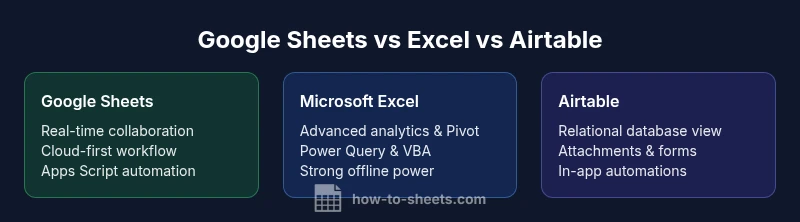
This section translates abstract criteria into tangible, side-by-side considerations. For collaboration, Google Sheets excels in real-time editing and comments, while Excel offers robust co-authoring in the cloud with Office 365; Airtable provides thread-like collaboration but with a database flavor that may be unfamiliar to spreadsheet-only users. Offline access differs: Sheets supports offline mode in browsers with limited features, Excel offers strong offline power on desktop, and Airtable's offline is more limited. Data strategy encompasses capacity and performance; large datasets may be more comfortable in Excel, while Sheets handles many rows and formulas well in standard workloads. For automation, Sheets leverages Apps Script and integrations with Google Workspace; Excel offers macros and Power Automate, plus deep enterprise integrations. Each tool has a distinct footprint in automation potential and workflow integration.
Deep dive by scenario: when to choose each tool
- Lightweight analysis and collaborative reporting: Google Sheets shines here with live sharing, chat-like comments, and simple visualizations. It minimizes friction for teams that work across geographies. In this scenario, Sheets often reduces the turnaround time for collaborating on budgets, class projects, or client-ready dashboards.
- Heavy analytics and complex data models: Microsoft Excel remains the go-to for advanced analytics, large data models, and sophisticated pivot tables. It supports power users who rely on features like Power Query and advanced VBA macros. For regulated industries or teams performing heavy modeling, Excel typically offers deeper capability.
- Database-like workflows and lightweight records: Airtable is a strong fit when projects resemble a lightweight database rather than a spreadsheet. It handles attachments, relationships, forms, and automation within a familiar interface, making it suitable for project tracking, content planning, and inventory lists that require relational data without a full database system.
- Hybrid or cross-tool workflows: Some teams keep Sheets for shared inputs and Excel for analysis, with data syncing through CSV imports/exports or ETL tools. This approach can deliver the best of both worlds but requires governance to avoid data drift.
Practical migration strategies and best practices
If you’re transitioning from one tool to another, the following practical steps help minimize risk and preserve data integrity. Start with a data map: list all the critical data fields, formulas, and automation rules you rely on. Validate formula compatibility across platforms; many functions exist in both Sheets and Excel but may have subtle differences. Use a staged migration: pilot a small project in the new tool, measure performance, and gather feedback before broad rollout. Establish governance: define version control, sharing permissions, and data retention policies. Finally, leverage built-in migration paths and templates where available, and plan for staff training to smooth the change curve. How To Sheets recommends a phased approach to avoid surprises and maintain continuity.
Authority sources
- https://www.harvard.edu
- https://www.nist.gov
- https://www.census.gov
Note: These sources provide context on data governance, collaboration, and data management best practices, which underpin the decision framework used in this comparison.
Feature Comparison
| Feature | Google Sheets | Microsoft Excel | Airtable |
|---|---|---|---|
| Collaboration & real-time editing | Excellent real-time collaboration in cloud-based Sheets | Co-authoring in Excel Online is strong but can be slower with large files | In-app collaboration with relational records in Airtable |
| Offline access | Offline mode available in browsers with syncing | Strong offline editing in desktop Excel; cloud options via OneDrive | Limited offline support; relies on web access |
| Data capacity & performance | Efficient for standard datasets; performance depends on browser | Handles very large datasets with advanced analytics features | Best for lightweight records; relational data can affect performance |
| Advanced analytics & formulas | Robust formulas; Apps Script enables automation | Power Pivot/Power Query and VBA for advanced analytics | Formulas exist but fewer analytics capabilities; relational features shine |
| Automation & integrations | Apps Script; broad Google Workspace integrations | Power Automate; deep enterprise integrations with Microsoft Stack | In-app automations; connectors to external apps available |
| Pricing & licensing | Free tier; Google Workspace plans for teams | Office 365/licensing; per-user options | Tiered pricing with free tier in basic Airtable |
| Platform availability | Web, iOS, Android; strong cross-device support | Desktop and web apps on multiple platforms | Web-based with mobile apps; good cross-platform access |
| Import/Export compatibility | Import from Excel/CSV; export to Excel/CSV | Native Excel formats; strong CSV interoperability | CSV import/export; screenshots and attachments supported |
The Good
- Excellent real-time collaboration across teams
- Low upfront cost for basic use and broad accessibility
- Strong cloud ecosystem and cross-device access
- Easy CSV/Excel interoperability via import/export
The Bad
- Advanced analytics may require learning curve or separate tools
- Sheets performance can degrade with extremely large datasets
- Airtable's database-like approach may not replace Excel for complex modeling
Google Sheets is the default choice for collaboration-focused, lightweight workloads, while Excel remains essential for advanced analytics and offline work.
For teams prioritizing real-time collaboration and cost efficiency, Sheets is typically the safest starting point. If your work involves complex data modeling or offline-heavy workflows, Excel offers superior capabilities, and Airtable is best for database-like project tracking.
FAQ
What is the primary difference between Google Sheets and Excel for collaboration?
Sheets emphasizes real-time collaboration with cloud sharing and concurrent editing, while Excel emphasizes co-authoring within the Office ecosystem and stronger enterprise features. In practice, Sheets often wins for rapid teamwork across geographies; Excel wins for deep, centralized analytics workflows.
Sheets is best for quick, collaborative work online; Excel shines when teams need deep analytics and enterprise-grade co-authoring.
Can Google Sheets handle large datasets effectively?
Sheets handles large datasets reasonably well for everyday tasks, but performance can degrade with extremely large files or very complex formulas. For enterprise-scale analytics, Excel is typically more robust.
Sheets works for big but not massive datasets; Excel is generally better for very large analytics tasks.
Is it possible to work offline with Google Sheets?
Yes. Google Sheets supports offline mode in modern browsers and apps, allowing edits offline and syncing when you reconnect. This makes it viable for intermittent internet access or travel scenarios.
Yes—you can edit offline, and changes sync when you’re back online.
How easy is it to migrate from Excel to Google Sheets?
Migration is often straightforward for standard spreadsheets, but some Excel-specific features (like certain macros or advanced data connections) may not translate 1:1. Plan for formula checks and testing in Sheets.
Migration is usually doable, but check formulas and features that don’t map 1:1.
What about pricing and licensing between these tools?
Google Sheets offers a free tier and affordable Google Workspace plans; Excel requires Office 365 licenses or a one-time purchase for older versions. Airtable uses a tiered plan with a free baseline and paid upgrades for advanced features.
Sheets can be very affordable; Excel costs vary with licensing; Airtable adds tiered pricing for more features.
Do these tools support automation and integration with other apps?
All three offer automation paths: Sheets via Apps Script and APIs, Excel via Power Automate and macros, and Airtable with built-in automations and external connectors. Depth and complexity vary by platform.
Yes—each tool has automation options, with deeper integration in Sheets and Excel depending on your tech stack.
The Essentials
- Prioritize collaboration needs first
- Match data size and analytics requirements to the tool
- Plan a phased migration to minimize risk
- Leverage automation features to extend capabilities