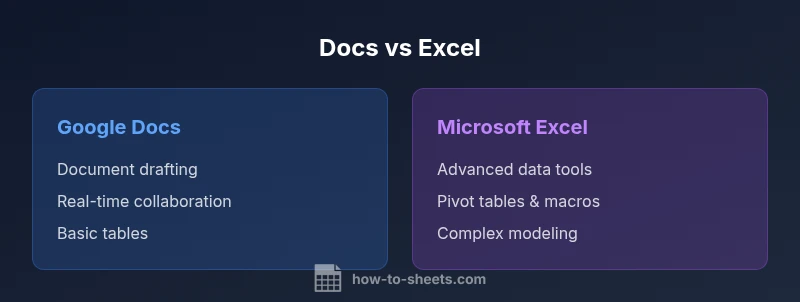
Docs vs Excel: When to choose Google Docs over Excel
A practical comparison of google docs instead of excel for document-driven work, covering collaboration, formatting, data handling, and when to switch to Excel.


Google Docs is best for collaborative document work, while Excel excels at data analysis. If your priority is team editing and easy sharing, google docs instead of excel makes sense for text-heavy tasks. For complex calculations, pivoting, and large data models, Excel remains the stronger choice.
What google docs instead of excel Means for everyday workflows
In many offices, teams face a decision about whether to use Google Docs instead of Excel for certain tasks. While the term 'docs' is a word processor, it is part of a broader suite where documents, templates, and simple data tables can be created and shared in real time. This decision is not simply about feature parity; it's about aligning tool strengths with the work at hand. According to How To Sheets, the most important factor is the nature of the task: writing, outlining, and collaborative drafting benefit from Docs, whereas numbers, calculations, and data modeling lean toward Excel.
Google Docs shines when your documents require input from multiple stakeholders, version history matters, and you want seamless integration with Drive and other Google Workspace apps. The How To Sheets team found that teams leveraging Docs for templates, meeting notes, and policy documents can save time by keeping everything in one workspace. However, for anything more than basic tables—especially tasks involving formulas, data validation, or sizable datasets—Excel or Google Sheets will usually deliver faster, more reliable results.
As you consider the switch, evaluate the intended outcomes, the skill level of the team, and the frequency of cross-tool data exchange. A decision guided by task type will reduce rework and confusion. The goal is not to force one tool to do everything, but to use each tool where it excels.
wordCountOverrideed?":false},
bodyBlocks2?This field intentionally left as part of the same block structure
blockData continues with additional blocks to expand on the topic
Comparison
| Feature | Google Docs for document-focused tasks | Microsoft Excel for data-focused tasks |
|---|---|---|
| Core purpose | Text/document creation with basic tables | Numerical data analysis, modeling, and calculation |
| Formulas & calculations | Limited; basic table use and simple calculations | Extensive functions, complex formulas, macros (VBA) and data tools |
| Data visualization | Embedded simple charts limited to documents | Advanced charts, pivot tables, and rich graphing options |
| Collaboration | Real-time co-editing across documents | Co-editing in workbooks; cross-user workbook changes |
| Offline access | Offline via Drive integration | Full offline access with desktop/app versions |
| Interoperability | Import/export to Docs formats; limited direct Excel compatibility | Native .xlsx support; easy data interchange |
| Cost & licensing | Included with Google Workspace (subscription) | Part of Microsoft 365 (subscription) |
| Best for | Document-centric tasks, templates, notes | Data-heavy tasks, budgeting, analytics |
The Good
- Real-time collaboration across documents within Google Workspace
- No software install required; browser-based access
- Auto-save and robust version history reduce data loss
- Strong integration with Drive, Sheets, and Slides for workflows
- Low barrier to adoption for teams already in Google Workspace
The Bad
- Limited data analysis capabilities compared to Excel
- Fewer advanced data tools (pivot tables, macros) in Docs
- Interoperability requires data transfers when moving between formats
- Docs lacks native advanced formatting controls for large datasets
Excel remains superior for data-heavy tasks; Google Docs excels at collaborative document work
Use Google Docs for drafting, templates, and note-taking with real-time collaboration. Reserve Excel for complex calculations and data modeling. For blended workstreams, pair Docs with Sheets and Excel to get the best of both worlds.
FAQ
Can Google Docs replace Excel for all data tasks?
No. Google Docs is not designed for complex calculations or large datasets. Use Docs for drafting and templates, and rely on Excel (or Google Sheets) for data-heavy work. Apps Script can add automation, but it does not match Excel's built-in data tools.
Docs is great for writing and collaboration, but Excel is better for numbers and data work. For complex data tasks, use Excel or Sheets.
Is it easy to move data between Docs and Excel?
You can transfer data by copying tables from Docs into Sheets or Excel, or by importing/exporting files in compatible formats. For robust data work, move data into Sheets/Excel first and reference it in Docs when needed.
You can copy tables between Docs and Sheets/Excel, but for large data tasks, use Sheets or Excel first.
What about offline access for these tools?
Docs supports offline mode when enabled in Google Drive, allowing editing without internet. Excel provides strong offline support via desktop applications. Choose based on whether your workflow requires offline document editing or offline data modeling.
Docs works offline with Drive; Excel’s desktop apps are solid offline for data work.
Which tool is better for collaboration?
Docs offers robust real-time collaboration for documents. Excel Online provides co-authoring for workbooks, but the experience can differ depending on data complexity. Align your choice with the type of collaboration you need.
Docs excels at team writing; Excel Online supports multi-user editing of spreadsheets.
How can I build a hybrid workflow using both tools?
A practical approach is to draft content in Docs, manage data in Sheets/Excel, and embed charts or tables back into Docs or presentations. This keeps each tool in its strength zone while enabling cross-linking.
Draft in Docs, crunch data in Sheets/Excel, then link back to Docs.
Are there licensing costs I should consider?
Google Docs is included with Google Workspace subscriptions; Excel requires Microsoft 365. If your team already uses one ecosystem, staying within it can reduce training and integration costs.
Docs is included with Workspace; Excel costs come with Microsoft 365.
The Essentials
- Choose Docs for document-centric workflows and collaboration
- Choose Excel for advanced data analysis and modeling
- Leverage Sheets for data-heavy tasks within Google Workspace
- Plan data handoffs to minimize format conversions