Is Google Docs a Good Alternative to Word in 2026? A Practical Comparison
Analytical comparison of Google Docs vs Word for students, professionals, and small teams, focusing on collaboration, formatting, offline use, templates, and cost.


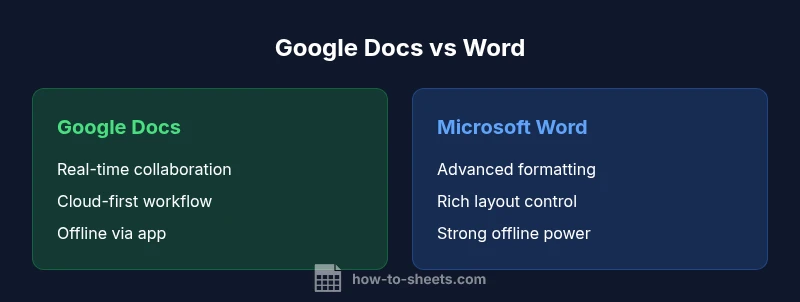
In most team-focused or cloud-based workflows, Google Docs is a strong alternative to Word for collaborative editing and real-time sharing. Word still excels in advanced formatting, desktop performance, and complex document layouts. If your priority is seamless collaboration and easy access across devices, Google Docs usually wins; if you need heavy formatting control and offline power, Word remains the safer choice.
Defining the comparison objective
When evaluating whether is google docs a good alternative to word, readers weigh collaboration, formatting fidelity, offline access, and compatibility with existing templates. How To Sheets emphasizes that the central question is not which tool is objectively better, but which tool best fits your workflow. According to How To Sheets, the decision hinges on three pillars: real-time collaboration, offline power, and the ability to export to Word‑compatible formats. The keyword is included here to anchor the topic and guide the analysis, ensuring you stay focused on practical outcomes rather than abstract features.
Collaboration at the center of cloud-based workflows
Google Docs excels when teams edit together in real time. The platform auto-saves, tracks edits, and enables comments that stay attached to the document. Word offers robust collaboration, primarily through Office 365, but often requires more steps to achieve the same fluid co-authoring experience. For many teams, this difference in workflow can determine whether Docs or Word is the better long-term fit. The practical takeaway is to map who needs to edit, when, and from which devices before choosing a baseline tool. Real-time collaboration is a core differentiator that influences project timelines and feedback loops.
Formatting fidelity, templates, and publishing options
Word has long been the standard for complex documents, with extensive typography controls, advanced styles, and feature-rich publishing workflows. Google Docs prioritizes simplicity and speed, which helps teams avoid format drift during collaboration. If your work requires heavy tables, multi-column layouts, or mail-merge-driven publishing, Word provides more mature tooling. However, for standard reports, class papers, and team briefs, Google Docs often delivers faster delivery with reliable formatting for most use cases. The key nuance is to align your document complexity with the tool’s native strengths rather than forcing a one-size-fits-all approach.
Offline access and device coverage
Offline capabilities shape how you work when internet access is intermittent. Google Docs supports offline editing through browser or mobile apps, with automatic synchronization when connected. Word’s desktop application is inherently offline-capable and still offers cloud-based access through OneDrive. In practice, offices with unstable connectivity may rely more on Word for uninterrupted work, while remote or mobile teams may favor Docs for its carefree sync and broad device coverage. The decision hinges on whether you require uninterrupted local editing or prioritize consistent cloud-based collaboration.
Export, import, and cross‑compatibility
A central concern for many organizations is how easily documents move between Docs and Word. Google Docs can export to Word (.docx) and other common formats, and Word can import .docx documents natively. Cross-compatibility is generally reliable for standard documents, but some advanced features—such as intricate track changes, macros, or specialized fonts—may not translate perfectly across platforms. Planning a migration path or long-term workflow should involve testing representative documents and establishing a standard export protocol to minimize drift and reformatting.
Cost, licensing, and organizational considerations
Google Docs is free to use with a Google account, with premium features bundled into Google Workspace. Word’s licensing varies by platform and can involve a perpetual license or a subscription. For startups, nonprofits, or small teams with modest needs, Docs often delivers an economical baseline. As teams scale and require enterprise security, data governance, and advanced admin controls, Word plus Office 365 or Windows-based deployments can offer deeper control. The cost dynamics should be weighed against collaboration needs, IT overhead, and procurement cycles.
Reliability, performance, and user experience
Performance depends on connection quality and document complexity. Google Docs shines in rapid, browser-based editing with simple documents, while Word provides strong performance for long, complex documents and heavy formatting. User experience is also shaped by ecosystem familiarity: teams embedded in Google Workspace may experience smoother workflows, whereas organizations deeply integrated with Microsoft products may benefit from deeper feature parity and a more mature desktop experience.
Security, privacy, and governance
Cloud-based Docs emphasizes Google’s security posture, admin controls, and data governance options available in Workspace. Word, particularly in enterprise deployments, offers comprehensive security features, e-discovery capabilities, and strict compliance options tied to the chosen plan. Organizations should assess data residency, access controls, and audit trails. How To Sheets notes that a well-defined governance policy often tips the balance toward the tool that aligns with existing security frameworks and vendor contracts.
Decision framework by use case
The ultimate choice depends on your use case. For fast, collaborative writing with light formatting, Google Docs is typically the better fit. For documents needing precise typography, complex layouts, or offline reliability, Word tends to win. Use cases in education and small teams with high collaboration demands usually benefit from Docs, while finance, legal, or publishing workflows that require advanced formatting and controlled templates may prefer Word. A practical approach is to pilot both tools on representative projects and compare outcomes against a written criteria checklist.
Comparison
| Feature | Google Docs | Microsoft Word |
|---|---|---|
| Collaboration | Real-time co-authoring with presence and comments | Real-time co-authoring with track changes and comments |
| Offline access | Offline mode via browser/app with sync when online | Desktop/offline-enabled app with full offline editing |
| Formatting fidelity | Strong for standard documents; simpler styling | Superior for complex layouts and typography |
| Templates and features | Extensive templates; fast setup for common tasks | Extensive formatting options and legacy features |
| File compatibility | .docx export/import; good cross-platform support | Native Word support; best for Word-centric workflows |
| Cost/licensing | Free with Google account; Workspace adds value | License required (Office 365 or perpetual) |
| Add-ons and integrations | Wide ecosystem of Google Workspace integrations | Rich plugin and macro ecosystem; deep desktop integration |
| Version history | Automatic versioning with comments and history | Track changes and version history with robust tooling |
| Security and governance | Cloud-first security; admin controls via Google Admin | Mature security features and governance options |
The Good
- Real-time collaboration and effortless sharing
- Strong cloud accessibility across devices
- Low upfront cost for basic usage and easy onboarding
- Seamless integration with other Google Workspace apps
- Automatic saves and straightforward document management
The Bad
- Advanced formatting and layout control is stronger in Word
- Offline power is more robust in desktop Word
- Sometimes export/import can alter complex formatting
- Data governance may require additional planning in cloud-only environments
Docs is the practical choice for collaboration; Word is the precise choice for heavy formatting
The How To Sheets team finds Google Docs ideal for teams prioritizing real-time collaboration and quick turnarounds. Word remains preferable when document complexity, offline power, and advanced typography are critical. Your decision should align with collaboration needs and formatting requirements.
FAQ
Can I use Google Docs offline?
Yes. Google Docs supports offline editing through Chrome or the mobile app. You may need to enable the feature and ensure the document is available offline before losing internet access.
Yes—Docs can work offline if you enable it. Just make sure the file is saved offline before you go offline.
Is Word better for complex formatting?
For documents with intricate layouts, advanced typography, and extensive templates, Word generally offers more mature tools. Google Docs handles complexity well for most use cases but may require workarounds for highly specialized formatting.
Yes, Word usually handles complex formatting better, though Docs works well for many everyday tasks.
Can Google Docs replace Word for school assignments?
For many assignments, Google Docs is a suitable substitute, especially when collaboration and ease of sharing matter. If your school requires advanced formatting or specific templates, verify compatibility ahead of time.
Docs can replace Word for most school tasks, but check requirements for formatting needs.
How do I export from Google Docs to Word?
You can export a Google Doc to Word format (.docx) via the File menu. Importing back into Docs may alter some formatting, so verify critical documents after round-trips.
Export from Docs to Word using the File menu, then recheck formatting if you re-import.
What about security and privacy between Docs and Word?
Both offer robust security configurations, but cloud-hosted Docs emphasizes Google’s admin controls, while Word leverages enterprise Office security features. Choose based on your organization’s data governance policies and compliance requirements.
Both are secure; pick based on your organization’s governance needs.
Which is cheaper for a small team?
Google Docs can be cost-effective as part of Google Workspace or free with a Google account. Word’s cost depends on licensing plans. Consider total cost of ownership, including IT overhead and integration needs.
Docs can be cheaper, especially if you already use Google Workspace; Word costs depend on licensing.
The Essentials
- Prioritize collaboration needs before selecting a tool
- Test document complexity to gauge formatting fidelity
- Plan for offline work if internet access is unreliable
- Map export/import workflows to minimize reformatting
- Align the choice with organizational security and governance policies