Monthly Calendar Template for Google Sheets
Learn to build a reusable monthly calendar template in Google Sheets. Step-by-step instructions, formulas, and formatting tips to track events and deadlines effectively.


You will create a reusable monthly calendar template in Google Sheets that tracks days, events, and deadlines. Start with a clean 7-column grid for the days of the week, add date logic and navigation, and apply formatting for readability. This template stays current as months change and scales across different workflows.
Why a monthly calendar template matters in Google Sheets
A monthly calendar template in Google Sheets helps you visualize deadlines, events, and tasks across a full month without switching apps. For students, it can map class schedules; for professionals, it helps coordinate meetings and project milestones; for small businesses, it supports staffing and delivery calendars. When you build such a template, you gain a single source of truth that updates automatically as the month changes. The keyword monthly calendar template google sheets appears naturally here and reinforces the practical nature of this guide. According to How To Sheets, a well-designed calendar template should be flexible, easy to customize, and resistant to accidental edits. Start with a clean grid: a 7-column layout for days of the week and 5–6 rows for dates, plus space for notes. The best templates scale from month to month and maintain readability on both desktop and mobile devices. You should aim for a layout that you can copy as a starter for past months and future planning. In short: the calendar template should be usable, maintainable, and adaptable to different workflows.
Core design principles for a monthly calendar
Designing an effective monthly calendar template requires clear structure, readability, and flexibility. Start with a 7-column grid that represents the days of the week and reserve space for a month header, notes, or links to tasks. Use a consistent color scheme and typography so readers can quickly scan dates and events. Decide whether weekends should stand out, whether holidays are shaded, and how you will handle months with fewer than 30 days. For the keyword monthly calendar template google sheets, keep the layout generic enough to reuse across months while allowing month-specific data. According to How To Sheets, templates should scale across devices and integrate with other sheets like budgets or to-do lists. A well-built calendar integrates with your data rather than duplicating it, using named ranges for months and formulas to pull dates automatically. Finally, consider accessibility: high-contrast text, readable font sizes, and avoiding overly dense layouts so users can navigate with screen readers or mobile screens easily.
Step-by-step planning and setup overview
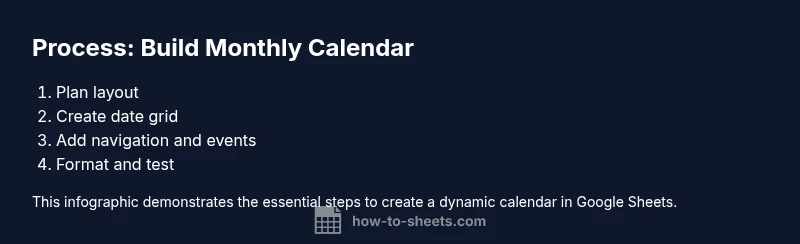
Before you touch formulas, sketch the layout on paper or a whiteboard. List the elements you need: header with month, weekday columns, date cells, an events area, and a notes section. Decide where to place navigation controls (previous/next month) and how you will reflect the current date. Plan to reuse this template by keeping core formulas in named ranges and by isolating template additions in dedicated sheets or tabs. A strong plan reduces rework and makes it easy to hand off to teammates. For visual guidance, create a rough mockup showing where dates, events, and summaries will appear, then translate that mockup into Google Sheets with a clean naming convention for sheets, ranges, and cells. The month-specific data should be driven by formulas rather than static entries, so you can change the month without rewriting cells. A small prototype is worth testing: input January, verify dates fill correctly, then copy the sheet to February and verify behavior remains intact. This upfront design pays off when you need to adapt the calendar for budgets, vacations, or project sprints.
Adding date logic and auto-fill using formulas
The core of a monthly calendar template is dynamic date generation. Start by placing the first day of the month in the top-left date cell using a formula like =DATE(YEAR(TODAY()), MONTH(TODAY()), 1). In the cell below, fill with =A2+1 and copy down through the end of the month. Use IF logic to stop at the last day: for example, in A3 you could use =IF(A2="","",IF(A2 < EOMONTH(TODAY(),0), A2+1, "")). Label the top row with weekday names, such as Sunday through Saturday, or Monday through Sunday depending on your region. To allow month navigation, compute the current month using MONTH(TODAY()) and reference a separate cell where you can override the month for testing; your dates should update automatically when the reference month changes. You can also add a small sub-calendar that highlights today with conditional formatting: use =A2 = TODAY() as the rule. These steps keep the calendar accurate with minimal manual updates.
Customization and formatting: conditional formatting, data validation, and styling
Make the calendar readable and friendly with targeted formatting. Use conditional formatting to shade weekends and holidays, for example: if the date falls on a weekend, apply a light blue fill; if it matches a holiday list in another range, apply a grey tint. Add a data validation dropdown for event types (Meeting, Deadline, Reminder) to standardize entries in the events area. Create a small legend that explains color meanings and event types. Keep fonts legible (at least 11pt) and use a consistent font pair throughout. For the monthly calendar template google sheets, consider adding a compact summary row that shows the number of events per week or per month. You can also implement a simple conditional rule to highlight days with more than two events. If you plan to print, set up a print-friendly area and adjust margins so the calendar fits on one page. Finally, document the layout with a short guide tab so new users can understand how to add events, navigate months, and customize colors.
Sharing, templating, and maintenance best practices
Once your calendar is solid, save it as a template in Google Drive so you can reuse it for future months and share with teammates. To keep a clean template, lock header rows or protect critical cells while leaving the dates and events area editable. Create a separate summary sheet that collects counts, upcoming deadlines, or export-ready data for reports. If you routinely plan for multiple months, duplicate the template and rename the copy for upcoming months, or create a single template and switch the active month via a control cell. For teams, store the template in a shared drive with clear access permissions. Document changes in a changelog so you can track improvements over time. The approach helps you scale the monthly calendar across projects, classes, and departments without rebuilding from scratch.
Real-world use cases and variations
Organizations use monthly calendar templates google sheets in a variety of ways. A class administrator uses it to align syllabus milestones with exam dates and assignment windows. A project manager tracks sprint milestones and client meetings while keeping a separate budget tab in the same workbook. A small business owner uses it to coordinate staffing shifts during peak periods and to schedule holidays. You can adapt the template to generate a printable calendar for handouts or to publish a lightweight web view. Viewing the calendar on mobile helps keep your team aligned when people are away from their desks. With minor tweaks, you can turn this calendar into a quarterly planner, a semester schedule, or a personal planning tool to track goals and events. The flexibility makes it a valuable addition to any Google Sheets toolkit.
Common pitfalls and how to avoid them
To ensure reliability, avoid hard-coding dates or months or relying on manual edits in the date cells. Always use dynamic references and avoid combining static cells with formulas in a way that breaks when you switch months. Keep your event data separate from the date grid to prevent accidental overwrites; use separate columns or an events tab with clear links to dates. Test across multiple months before sharing, and maintain a small sample dataset to verify the auto-fill logic remains correct across months with 28, 29, 30, or 31 days. Finally, document your formulas and logic so future editors understand the workflow and can extend it without breaking existing behavior.
Tools & Materials
- Google account with Google Sheets access(Sign in to Google Drive to create and save templates)
- Blank Google Sheet(You can start from scratch or copy a starter layout)
- Month data source or reference date(Use TODAY() and EOMONTH() for dynamic month calculation)
- Optional event list(CSV file or a separate sheet tab for bulk import)
- Color palette or theme(For consistent visuals in formatting)
- Print settings(If you plan to print the calendar)
- Documentation or user guide(Optional to help teammates)
- Device with internet connectivity(Useful for editing on the go)
Steps
Estimated time: 60-90 minutes
- 1
Define the calendar layout
Decide on a 7-column grid for days of the week and allocate a header, an area for dates, and space for events and notes. Establish where navigation controls will live and how you will present today’s date. Create a simple mockup to guide real-sheet implementation.
Tip: Sketch on paper first to align columns, headers, and the events area. - 2
Create the month header and weekday row
Insert a bold month label at the top and place weekday names in the row beneath. Keep the header row separate from the date grid for clarity and easy printing.
Tip: Use a single font style for headers to improve readability. - 3
Populate the dates for the current month
Enter the first day using `=DATE(YEAR(TODAY()), MONTH(TODAY()), 1)` in the first date cell, then fill down with `=A2+1` to generate the rest of the month. Stop at the last day with an IF condition or by referencing EOMONTH.
Tip: Test with February in a leap year to verify date boundaries. - 4
Add an events area linked to dates
Create a column or tab where events are entered and link each event to a date cell. Use a separate column for event type (Meeting, Deadline, Reminder) with a data validation dropdown.
Tip: Keep event data on a separate sheet to avoid overwriting the date grid. - 5
Implement navigation and today highlight
Add controls to simulate changing months (a control cell or buttons) and apply a conditional formatting rule to highlight TODAY().
Tip: Use TODAY() for live updates and a helper cell to test other months without editing formulas. - 6
Apply styling and readability rules
Set up a color scheme for weekends and holidays, enable print-friendly formatting, and add a legend. Verify the sheet remains legible at smaller screen sizes.
Tip: Document your color choices in a legend tab. - 7
Save as a reusable template
Convert the finished sheet into a template in Google Drive and protect critical cells. Create a template version for sharing and a separate copy for month-by-month usage.
Tip: Lock headers and formulas to prevent unintended edits. - 8
Test with multiple months and finalize
Duplicate the template for different months, ensure date logic remains correct, and adjust any month-specific settings. Gather feedback from users.
Tip: Run a quick test with January through March to confirm stability.
FAQ
What is a monthly calendar template in Google Sheets?
A monthly calendar template in Google Sheets is a reusable layout that tracks dates and events for a given month. It uses dynamic date formulas so changing the month updates the grid automatically. It’s designed to be shared and adapted for different workflows.
A monthly calendar template in Google Sheets is a reusable, date-driven layout for tracking events across a month. It updates automatically as the month changes.
Can I auto-fill dates for future months?
Yes. Use dynamic date formulas and a month navigation control to update the date grid when you switch months. This keeps the calendar accurate without manual edits.
Yes. Use dynamic date formulas and a month control to update the grid automatically.
How do I customize colors for weekends and holidays?
Use conditional formatting to shade weekends and holidays. Maintain a holiday list on another tab and reference it in your rules to highlight those dates consistently.
Apply conditional formatting for weekends and holidays to keep the calendar readable.
Is this template suitable for sharing with teammates?
Yes. Save as a Google Sheets template or copy the workbook for each team, and set appropriate sharing permissions. Keep the data area editable but protect critical formulas.
Yes, you can share by saving as a template and controlling access.
How do I print the calendar neatly?
Adjust print settings to fit the calendar on one page, including margins and orientation. Do a test print to ensure dates and events align correctly.
Tweak print settings to fit on one page and test print.
Do I need advanced formulas to build this?
You can start with basic DATE, TODAY, and EOMONTH formulas. Advanced users can enhance with VLOOKUP, FILTER, or INDEX+MATCH to pull events from a separate data sheet.
Basic formulas are sufficient to start; you can add advanced ones later if needed.
Watch Video
The Essentials
- Plan layout before building.
- Use dynamic dates to auto-fill months.
- Format for readability and printability.
- Keep data separate from the grid to avoid edits.
- Save as a reusable template for teams.